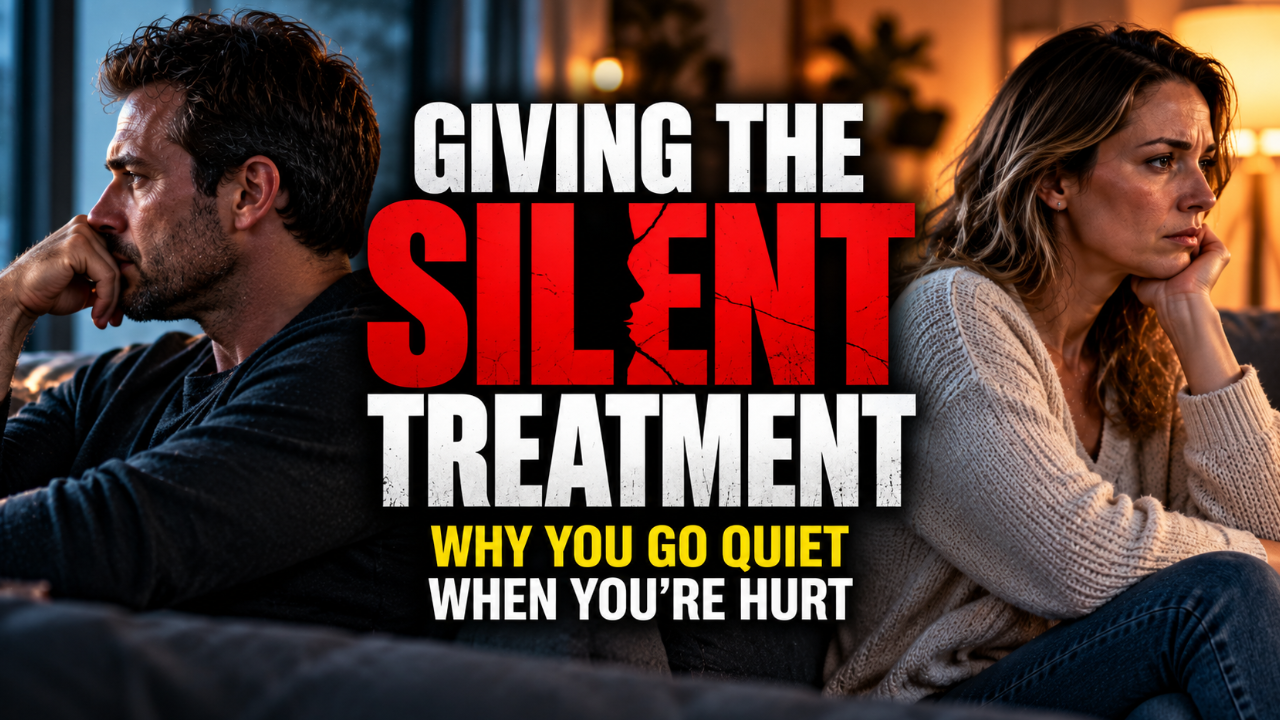
Giving The Silent Treatment: Why You Go Quiet When You're Hurt
Oct 20, 2026Silent Treatment Decoded: Why You Go Quiet When You're Hurt
The silent treatment is usually a freeze response wearing a dignified coat. When you feel hurt, criticised or unheard, your brain's threat system decides that saying the words out loud is more dangerous than saying nothing. Going quiet brings instant relief from a row you might lose, a sense of control and often an apology from the other person. That payoff trains the habit, so the silences get longer while the real problem goes unspoken.
 It starts with something small. A comment about the way you stacked the dishwasher, a plan changed without anyone asking you, a joke at your expense in front of friends. Your face sets. Your partner asks if you're alright and you say you're fine, in the tone that tells everyone within three miles that you are not fine. Then the house goes quiet. Cupboard doors close a little harder than they need to, answers shrink to one word and you sit at opposite ends of the sofa watching a programme neither of you is following.
And part of you is enjoying it, which is the bit nobody admits. There's a cold, tidy satisfaction in being the wronged party and in holding the one thing they want, which is for you to speak. Another part of you wants it over, yet when they finally ask what's wrong, the words jam behind your teeth. So why do you give the silent treatment when you know it never fixes anything? And why does the quiet seem to last longer every time?
Want the full method for breaking the freeze before it costs you another weekend? Get Anger Lied To Me: The Hidden Psychology of Rage and How to Escape It on Amazon.
The Story You Tell Yourself About Going Quiet
The story most people tell themselves is that going quiet is the mature option. You're not shouting. You're not slamming doors, well, not many. You're rising above it and refusing to say something you'll regret. Compared with the screaming matches you may have grown up around, silence looks like self-control.
But there's a crack in that story. Silence that keeps the peace doesn't need an audience. The silent treatment does. It needs the other person to notice it, to feel it and to come asking about it. If you were calmly rising above things, you'd get on with your evening. Instead you're tracking their every move and keeping a mental ledger of who owes whom an apology. That isn't calm. That's anger with the volume turned down.
The calmest person in the house is sometimes the angriest. Anger has two exits. One is loud, the explosion I took apart in Anger Decoded. The other is silent, and because it never raises its voice, it gets away with far more for far longer.
What the Silent Treatment Is Doing to Your Brain
When you feel slighted, the alarm system deep in your brain doesn't wait for a committee meeting. It reads criticism, rejection or being made to look foolish as a threat and floods you with stress chemistry in a fraction of a second. You'll know fight and flight. There's a third response, freeze, and it's the one the silent treatment is built on. Your jaw locks, your throat tightens and the part of your brain that finds words goes offline. You aren't choosing silence so much as being taken over by it, then dressing it up as a choice afterwards.
What you show and what you feel can be miles apart. Researchers who study couples have a name for one version of this, the demand and withdraw pattern, where one partner pushes for a conversation and the other shuts down. In a study of how emotions drive the demand and withdraw cycle in couples, published on the NIH's PubMed Central, the husbands who withdrew the most were feeling plenty of negative emotion while showing very little of it. So the stone face isn't an absence of feeling. It's a storm with the shutters closed.
Then there's the other side of the sofa, where being ignored hurts in a surprisingly literal way. Work summarised in this review of the neural bases of social pain found that rejection and social exclusion activate some of the same brain regions involved in physical pain. That's why the silent treatment works so well as a weapon, and why it leaves marks that outlast the row. Many of us learned that as children, when a parent's silence was the most frightening noise in the house.
The Sulk Loop: How a Small Slight Becomes a Three-Day Freeze
Like most habits, the silent treatment runs on a simple loop. The cue is a flash of hurt, usually about feeling unseen or taken for granted. The routine is withdrawal, the flat voice, the vanishing eye contact and the one-word answers. Then come the rewards, and there are three of them. You get instant relief from a confrontation you might lose. You get a sense of power, because the other person is now the anxious one. And often you get an apology, or a cup of tea placed beside you like an offering to a moody god.
Those rewards don't arrive every time, and that's what makes the loop so sticky. A reward that turns up unpredictably trains a habit harder than one that turns up on schedule, the same machinery that keeps people feeding a fruit machine. So the silences start to stretch. What began as an hour of frost becomes an evening, then a weekend. Eventually the other person learns to stop chasing, and now you're both silent, two people politely sharing a fridge.
None of this came from nowhere. The NHS guidance on getting help with anger lists ignoring people and sulking among the ways anger shows up in behaviour, and it notes that many of us learned our way of handling anger from the adults around us as children. If your house growing up was one where nobody shouted but everybody knew when Dad wasn't speaking, you didn't choose this software. You inherited it, and the children watching you now are quietly installing the same programme.

Why Counting to Ten and Keeping the Peace Keep Failing
The first fix is the old rule about never going to bed on an argument. It's well meant, but it forces a conversation while your brain is still in freeze. At midnight at the kitchen table, your partner wants a resolution and you can't find a single sentence. The talk goes badly, which proves to your nervous system that silence was safer all along.
The second fix is counting to ten. That's decent advice for the shouter. For the sulker it's useless, because silence is already the thing you're doing. You can count to ten thousand and still be sitting there with your arms folded on Thursday.
The third fix is keeping the peace, swallowing the hurt and pretending it never happened. The original issue goes into a drawer with all the others. But swallowed hurts don't dissolve. They pile up, which is why a comment about the bins can trigger a two-day freeze that makes no sense to anyone, including you. The swallowing habit is a close cousin of the trap I explored in People-Pleasing Decoded.
The fourth fix is the reluctant apology, one of you saying sorry for something neither of you can name. It buys peace for a week, but nothing has changed, and saying sorry to make a bad mood go away is its own trap, one I took apart in Over-Apologising Decoded. All four fixes fail for the same reason. They manage the silence without ever touching what the silence is trying to say.
Ready for the full method that goes after the fear underneath the freeze? Get Anger Lied To Me: The Hidden Psychology of Rage and How to Escape It on Amazon and stop paying for arguments you never had out loud.
Silence Is a Message With the Words Taken Out
Here's the reframe that turns it inside out. The silent treatment isn't the absence of communication. It's a message with the words removed. Underneath every sulk sits a sentence, and it's usually a simple one. I felt dismissed. I'm hurt that you didn't ask me. I'm scared you don't value me. Saying it out loud feels dangerous because it shows the soft underbelly, so the brain sends the feeling out in code and waits to see whether the other person can crack it.
That's the hidden test inside the silent treatment. If you loved me, you'd know what's wrong. It asks the other person to read your mind, then punishes them for failing. In the book I describe anger as fear that has decided to go forward. Silence is fear that has decided to go underground. It looks like strength because it doesn't flinch, but strip away the cold shoulder and what's left is a frightened person who doesn't trust that their hurt will be taken seriously.
I should know, because I was a champion sulker for years. I could spend a whole weekend in wounded dignity over a forgotten phone call, telling myself I was the reasonable one because at least I wasn't shouting. It took me far too long to see that my silence was every bit as loud as anyone's temper, and that the people on the receiving end were paying for my fear. That realisation sits at the centre of Anger Lied To Me, which shows why the shouting, the sulking and the swallowing all run on the same machinery.
Your First Small Move: The Named Pause
Your first move is to replace the open-ended silence with a named pause. The next time you feel the jaw setting and the words drying up, say one short sentence before you go quiet. Something like, I'm feeling hurt and I need twenty minutes, then I'll come back and talk. That's it. You're still allowed the pause, because your brain needs time to come out of freeze. But now it has a label and an end time, so it stops being a punishment and becomes a promise.
Then keep the promise. When the twenty minutes are up, go back and say the hidden sentence in a simple shape. I felt this when that happened, and what I'd like is this. I felt embarrassed when you made that joke in front of everyone, and next time I'd like you to save it for when we're alone. One feeling, one moment and one request. No essay and no list of everything they've done since 2019. It will feel clumsy the first few times. That's old software being overwritten.

Try it for two weeks and note how long each frost lasts. Many people find the silences shrink from days to hours, because the loop loses its main reward once nobody has to chase. If the freeze is tangled up with a deeper fear of being left, my hypnosis session for fear of abandonment can help settle the alarm underneath. If silence in your home has become a way of controlling or frightening someone, on either side, or your anger feels out of your hands, please speak to your GP or a qualified professional alongside any self-help. To work through your own pattern one to one, my coaching page explains how.
The Question Nobody Asks About the Silent Treatment
Most advice asks how to make the silence stop. Hardly anyone asks what the silence is protecting. Somewhere along the line, probably as a child, you learned that saying I'm hurt out loud was risky. The silent treatment was a clever solution back then. It's a poor one for the adult you are now.
So, what is the sentence you've been waiting for someone to guess? And what would happen if you said it first, out loud and in plain words, tonight?
Ready to swap the cold shoulder for a conversation that ends the cold war? Pick up your copy of Anger Lied To Me: The Hidden Psychology of Rage and How to Escape It on Amazon today and find out what your anger has been trying to tell you all along.
"For twenty years I thought going quiet made me the bigger person. This book showed me my silence was every bit as loud as my husband's temper. I started using the named pause, and our disagreements now last an hour instead of a week." (Linda P., Omaha, Nebraska)
"I'd sulk for days and then wonder why my wife seemed so tired of me. Seeing the silent treatment as a message in code changed how I handle every argument. I say the sentence now, clumsy as it is, and we've had the best year of our marriage." (Mark T., Raleigh, North Carolina)
"I grew up in a house where nobody shouted and everybody froze, and I was raising my kids the same way without noticing. Learning that anger can hide inside silence was the jolt I needed. Our dinner table is a noisy, happy place again." (Jennifer L., Boise, Idaho)
Frequently Asked Questions About the Silent Treatment
Why do I give the silent treatment instead of talking?
Usually because your brain has learned that silence is safer than words. When you feel hurt or criticised, your threat system can tip you into a freeze response, which shuts down the part of you that finds the right words. Going quiet then brings relief, a sense of control and sometimes an apology. Those rewards train the habit, especially if you grew up in a home where silence was how anger was handled.
Is the silent treatment a form of abuse?
It depends on how and why it's used. Going quiet for a while to calm down, then coming back to talk, is a normal way of handling strong feelings. When silence is used again and again to punish, control or frighten someone, it becomes harmful and can be part of an abusive pattern. The key difference is whether the silence has an end and leads to a conversation, or whether it's a weapon designed to make someone suffer.
How do I stop giving the silent treatment?
Replace the open-ended silence with a named pause. Before you go quiet, say one sentence such as, I'm hurt and I need twenty minutes, then I'll come back and talk. Then return and say what's underneath, using one feeling, one moment and one request. The pause lets your nervous system calm down, while the promise to return stops the silence becoming a punishment. Many people find the frosty spells shrink within a couple of weeks.
About the Author
 Craig Beck spent years as a UK broadcaster, where he learned that a pause on air can say more than a paragraph and that silence is never as neutral as it seems. He is a certified NLP Master Practitioner and the author of more than a hundred books on human behaviour, from quitting alcohol to anger in all its forms. His work skips the pep talk and shows readers the machinery underneath their habits. Find out more on his about page.
Last updated 17 October 2026.