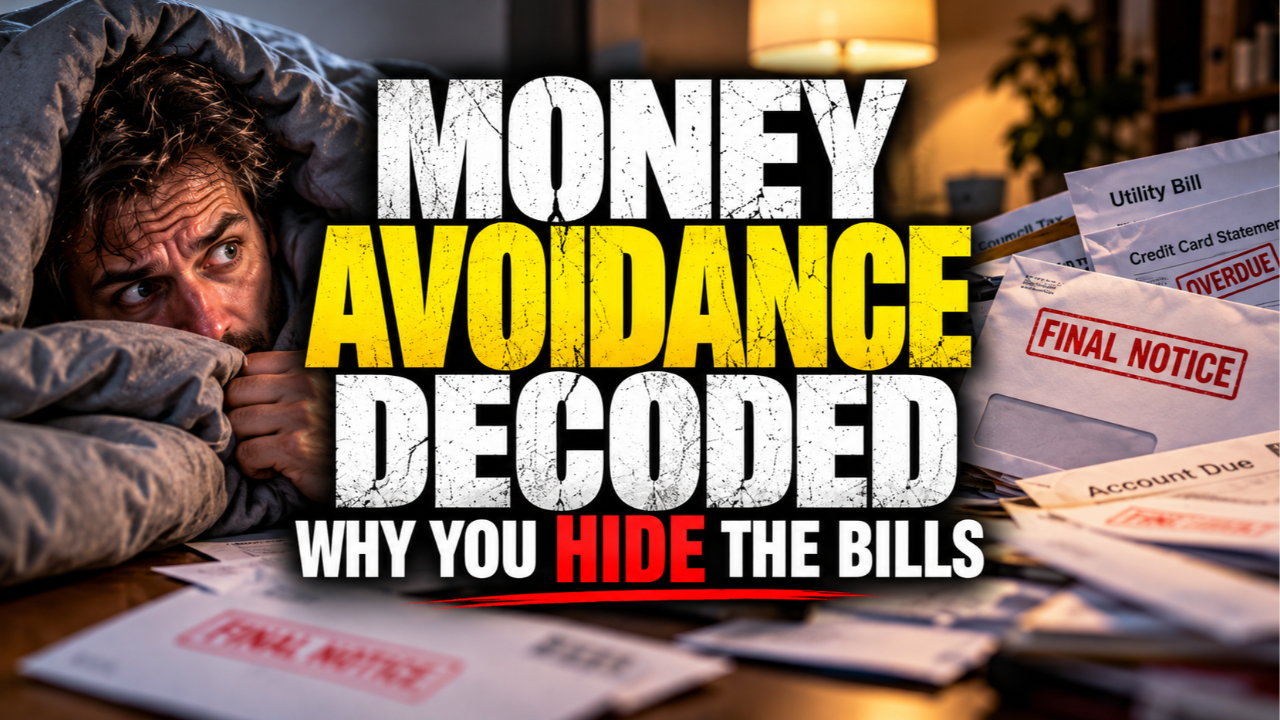
Money Avoidance Decoded: Why You Hide the Bills
Oct 12, 2026Money Avoidance Decoded: Why You Hide the Bills
Money avoidance is not laziness, and it has nothing to do with being bad at maths. It is mental software that treats your bank balance as a threat and looking away as safety. Every time you leave a bill unopened or swipe past the banking app, your nervous system pays you in relief, and that relief teaches it to dodge again. That is why you avoid looking at your bank account even when you know it makes things worse.
 It is Thursday morning and the post has landed on the mat. Among the pizza leaflets there is a brown envelope with a little plastic window, and you know exactly what kind of letter lives behind a little plastic window. You do not open it. You carry it into the kitchen with the confidence of someone who fully intends to deal with it later, and you slide it into the drawer with the takeaway menus, the spare keys, and four other envelopes that look suspiciously like it. Then you make a coffee and feel oddly pleased with yourself, as though you have handled something.
And it is not only the post. The banking app has been quietly exiled to the third screen of your phone, inside a folder called Utilities. At the cashpoint you take the money and decline the receipt. When your partner asks whether the car insurance went out, you say you think so in the same breezy tone you use for the weather. So, why does a capable adult who runs a team, manages a household and remembers every birthday in the family go cold at the sight of a sealed envelope? And why does not looking feel so much better than looking, right up until the moment it feels very much worse?
Want the full method for rewriting the money story that runs quietly in the back of your head? Get Millionaire Mindset: How to Become Rich in 7 Easy Steps on Amazon.
The Story You Tell Yourself About Money Avoidance
Ask someone who dodges their finances why they do it and you will usually hear one of three explanations. I'm just rubbish with money. I'll sort it all out properly at the weekend. I'd rather not know. Each one sounds honest, and each one quietly assumes the problem is a missing skill. If you were better with numbers, the theory goes, you would look. It is a comforting story, because skills can be learnt later, and later is exactly where you would like this whole business to live.
Here is the crack in that story. Plenty of people who avoid their bank balance are perfectly good with numbers. They build spreadsheets at work, they haggle over the price of a sofa, and they can tell you what a pint cost in 1995. The maths is fine. What has changed is that the number on the screen has stopped being information and started being a verdict. In coaching sessions I have lost count of the clients who could not say their own balance out loud without their voice wobbling, even when the balance was perfectly healthy. The figure was never the point. The point was what they believed it said about them.
That is why money avoidance survives good news. A pay rise does not fix it, and neither does a windfall. People with comfortable savings still leave statements unread, because the flinch is attached to the act of looking rather than to the amount. If you want a sense of how deep those early money beliefs run, my piece on the Millionaire Mindset unpicks where most of them come from.

What a Brown Envelope Is Doing to Your Brain
The moment you see that envelope, an ancient threat system in your brain gets there before you do. It cannot read, and it does not know the difference between a gas bill and a bear. It simply notices something that has hurt you before and fires the same alarm: a tight chest, a hot face, a sudden urge to be somewhere else. The thinking part of your brain, the bit that knows a gas bill is survivable, gets the message second. By then your hand has already put the letter in the drawer.
Now watch what happens next, because this is the part that keeps the whole machine running. The second the envelope is out of sight, the alarm switches off. Your shoulders drop. That wave of relief is a reward, and your brain treats rewards as instructions. Psychologists call this negative reinforcement, which is a dry name for a simple deal. Do the thing that makes the bad feeling stop, and you will be paid in relief. Avoidance is a decision your nervous system gets paid for, every single time. Run that deal a few hundred times and you have built a reflex that fires before you have had a chance to think.
There is a cost hiding inside the relief, too. Worry about money does not stay politely in its drawer. Researchers found that simply asking people on tight budgets to think about a tricky financial problem was enough to drag down their scores on reasoning tests, and that the same farmers performed worse on those tests before harvest, when money was short, than after it. You can read the abstract of the study on how money worries eat mental capacity on PubMed. In plain English, the unopened envelope keeps humming in the background, using up the very brainpower you would need to deal with it. Economists have a name for looking away from bad financial news, the ostrich effect, which is rather unfair on ostriches, but you get the idea.
The Avoidance Loop and the Interest It Charges
Every loop needs a trigger, and money avoidance has plenty to choose from. The ping of a payment notification. A friend suggesting a weekend away. The last week of the month. Your partner saying they need a word about the credit card. Each trigger fires the alarm, each dodge earns the relief, and each round makes the next envelope a little heavier. The cruel twist is that avoidance creates the very outcome it was trying to protect you from. Bills that are not opened do not get paid, and bills that do not get paid grow teeth in the form of late fees, reminder letters and phone calls from numbers you do not recognise.
Then shame joins the party, and shame is the best fuel this loop ever gets. Now there is more than a bill in the drawer. There is a story about the sort of person who has a drawer like that, and you would rather not look at the story either, so you look away from both. The NHS guide to money worries and mental health lists leaving bills unopened and putting off money advice among the ways a struggling mind starts to handle money, which tells you how common this is. You are far from the only person with a drawer.
Left alone long enough, the loop leaks into everything else. Money stress tends to travel with poor sleep, low mood and a constant low hum of anxiety, and one large review found that people in debt were far more likely to experience depression, although the authors were careful to say that cause and effect are hard to untangle. You can read the summary of that review of debt and mental health for yourself. If the worry has started to feel unmanageable, or you are having thoughts of harming yourself, please speak to your GP or call Samaritans on 116 123 today rather than carrying it alone.
If you are ready to stop treating money as a monster and start treating it as a tool, Millionaire Mindset: How to Become Rich in 7 Easy Steps is waiting for you on Amazon.
Why Budgets, Spreadsheets and Money Apps Keep Failing
Most people who finally decide to tackle money avoidance do it in one heroic sitting. Sunday afternoon is declared Finance Day. You make a large pot of coffee, empty the drawer onto the kitchen table and open a blank spreadsheet with the energy of someone about to climb a mountain. Two hours later you are still on the first tab, the coffee is cold, and you have discovered three subscriptions you forgot existed. You feel worse than when you started, so the envelopes go back in the drawer, and Finance Day quietly becomes something nobody mentions again.
That plan was doomed from the start, and discipline had nothing to do with it. It asked your nervous system to swallow months of avoided dread in one sitting, which is like curing a fear of dogs by spending an afternoon locked in a kennel. The alarm went off at full volume, and the lesson your brain took away was that looking really is as awful as it suspected. Money apps fail for a gentler version of the same reason. They send you colourful charts of everything you spent on coffee, and every chart lands as another small telling-off. Within a fortnight the notifications are switched off and the app is back in the folder called Utilities.
Then there is willpower, the fix everyone reaches for. Try harder, be more responsible, stop being such a child about it. Willpower is a finite resource, and it is usually running on fumes by the time the post arrives. Worse, every resolution you break becomes fresh evidence for the story that you are hopeless with money. If stress is already running the show in your life, my piece on how to decrease stress with hypnosis explains why a calmer nervous system makes every other change easier.
Money Is a Story, Not a Monster
So, here is the reframe at the heart of this whole piece. The thing you are avoiding is not money. Money, when you strip it back, is a made-up idea. When you pay someone, nothing physical travels anywhere. Nobody loads a van with coins and drives it to their bank. A few numbers change on a computer screen in a building you will never visit. What makes those numbers frightening is the story you have wrapped around them, and that story was almost certainly written before you ever had a bank account of your own.
Think about what you heard about money as a child. Money doesn't grow on trees. We can't afford it. People like us don't have that sort of thing. Maybe you heard nothing at all, and the silence taught you that money was something shameful nobody discussed. Those early messages became the code your adult brain still runs. When the brown envelope arrives, you are not reacting to a gas bill. You are reacting to a decades-old instruction that money means danger, scarcity, or failure. The number on the screen is information. It was never a verdict on your worth.
This is where the identity shift happens. As long as you think of yourself as someone who is bad with money, every envelope confirms the label and every glance at the balance feels like a test you expect to fail. The moment you start seeing yourself as someone who looks, whatever the number says, the deal changes. Looking stops being a performance review and becomes a habit, like checking the weather before you leave the house. Oddly enough, the fear of looking often sits right next to a quieter fear of having more, which I unpack in my article on the fear of success.
The Ninety-Second Look: Your First Small Move
Forget Finance Day. Your first move is so small it will feel faintly ridiculous, and that is the point. Once a day, at the same time, open your banking app and look at the balance for ninety seconds. Do not fix anything. Do not move money or make a plan. Simply read the number out loud, notice what your body does, and give the dread a score out of ten. Then close the app and get on with your day. You are not trying to solve your finances this week. You are teaching your nervous system that looking is survivable.
Ninety seconds is a deliberate choice. The first surge of stress chemistry tends to peak and start to fade in roughly that time if you leave it alone. Stay with it, and the alarm runs its course without the escape hatch it has been relying on. Most people find the score drops within a week or two. The number on the screen may not have changed, but the flinch has, and the flinch was always the real problem.

Once the daily look feels boring, and boring is the goal, add the drawer. Open one envelope a day. Read it, write the amount and the due date on the front, and put it in a single folder marked Dealt With, even if dealing with it simply means knowing what it says. Some days that will be all you do. On other days you will find yourself paying a bill or ringing a provider, and you will notice it took eleven minutes rather than the eleven years you had set aside for it in your head. If you want to work on the old beliefs from the inside as well, the Millionaire Mind Rewired hypnosis session targets the same subconscious money blueprint.
The Question Nobody Asks About Money Avoidance
Everyone asks how to get better with money. Hardly anyone asks what they are protecting themselves from by not looking. Sometimes it is a number. More often it is a conversation, a comparison with a sibling who seems to have it all worked out, or the fear that if you look properly you will need to admit you could use some help. The drawer is hiding a story about who you are, and stories lose their grip the moment you read them out loud. The people I write about in Building Extreme Wealth rarely started with a fortune. They started by being willing to look.
So, what would you find if you opened the drawer tonight? And what might change if the number on the screen became a piece of information you checked each morning, as ordinary as the weather and about as frightening?
Ready to swap the old money story for a better one? Grab your copy of Millionaire Mindset: How to Become Rich in 7 Easy Steps on Amazon today and start reading your bank balance with your eyes open.
"I had a shoebox of unopened letters under the bed for almost two years. The ninety-second idea sounded silly, but I did it every morning with my coffee. The shoebox is gone, I am on a payment plan I can manage, and I sleep through the night again." (Tamara J., Spokane, Washington)
"I earn good money and still could not look at my statements. This book showed me I was running my dad's fear on repeat. I check my account every day now, I have started investing for the first time, and my wife and I can talk about money without it turning into a row." (Derek H., Columbus, Ohio)
"Money always felt like a monster in the corner of the room. Now it feels like a tool. I opened a savings account, paid off my store card, and last month I booked a trip to see my sister without panicking about the cost." (Gloria R., Albuquerque, New Mexico)
Frequently Asked Questions About Money Avoidance
Why do I avoid looking at my bank account?
Because your brain has learnt that looking feels dangerous and not looking feels safe. The moment you dodge the balance, your anxiety drops, and that relief rewards the dodge, so you repeat it. Over time the habit becomes automatic, even when your finances are healthy. The fear is usually attached to old beliefs about money and self-worth rather than to the number itself. Short, regular looks with no pressure to fix anything are the quickest way to retrain that response.
Is money avoidance a sign of anxiety?
It can be connected. Many people who avoid their finances feel a rush of anxiety whenever money comes up, and avoidance is a classic way of keeping that feeling at bay. Money avoidance on its own is a learned habit rather than a diagnosis. If money worries are affecting your sleep, your mood or your ability to cope from day to day, it is worth speaking to your GP, and a free debt advice service can help with the practical side.
How do I stop avoiding my finances?
Start smaller than you think you need to. Spend ninety seconds a day looking at your balance without trying to change anything, and score your dread out of ten each time. Once that feels routine, open one piece of post a day and simply note what it says. Skip the marathon budgeting session, which tends to overwhelm the nervous system. Small, repeated looks teach your brain that facing money is safe, and practical action follows far more naturally.
About the Author
 Craig Beck spent more than two decades in UK broadcasting, a career that taught him how quickly a listener decides whether to trust the voice coming out of the radio. He is a certified NLP Master Practitioner, a hypnotherapist, and the author of more than 100 books on human behaviour, habit, and persuasion, ranging from the bestselling Alcohol Lied to Me to his Decoded series of psychological profiles. His work treats behaviour as software rather than a character flaw, which means nobody is broken and anybody can be reprogrammed. Find out more about Craig Beck and the thinking behind these breakdowns.
Last updated 10 October 2026