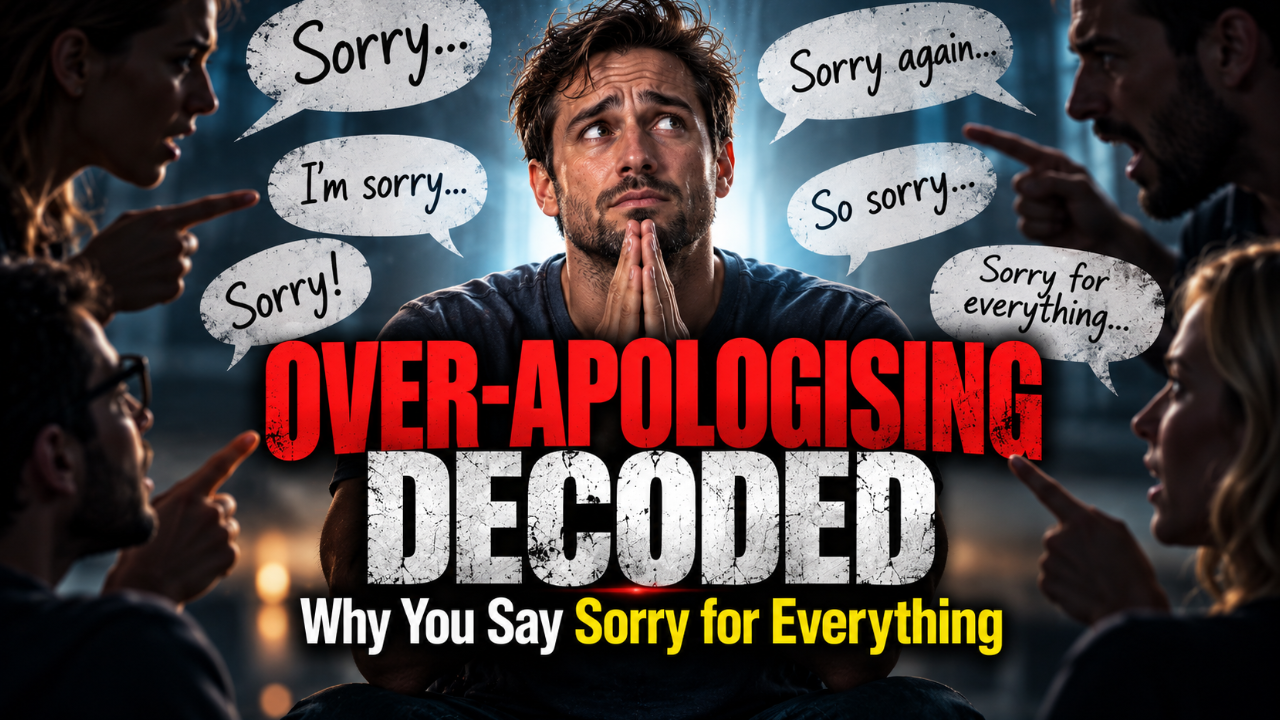
Over-Apologising Decoded: Why You Say Sorry for Everything
Oct 06, 2026Over-Apologising Decoded: Why You Say Sorry for Everything
Over-apologising is not good manners taken a little too far. It is a social safety reflex. Your brain learned, usually early in life, that saying sorry first lowers the risk of disapproval, so now it fires the word whenever you take up space, ask for anything, or get bumped into by somebody else. Each sorry buys a flicker of relief, and that relief is the reward that keeps the habit running.
 You know the drill. Somebody steps on your foot in the queue and you are the one who says sorry. You open an email to a colleague with sorry to bother you, when answering emails is their entire job. You apologise to the barista for wanting oat milk, to the doctor for taking up their time, and to your partner for being tired after a long day. You even apologise for apologising, which is the verbal equivalent of tripping over the rug you have just tripped over. By lunchtime the word has left your mouth thirty times, and on most of those occasions you had done nothing wrong at all.
So, here is the question worth sitting with. If none of those moments involved any harm, what exactly were you apologising for? And why does the word fall out before your brain has even checked whether it is needed? The answer has very little to do with politeness, and a great deal to do with an old piece of software that believes you are one wrong move away from being pushed out of the group.
Want the full method for building confidence from the ground up? Get Fearless and Unstoppable: The Ultimate Self-Confidence Blueprint on Amazon.
What Over-Apologising Is Doing to Your Brain
Start with the machinery, because the machinery is far less personal than it feels. For most of human history, being accepted by your group was a survival issue. A person who irritated the tribe risked being pushed to the edges, and the edges were where the cold, the hunger, and the predators lived. So the brain developed a social threat detector that never fully switches off. It scans faces, tone of voice, and awkward silences for signs that you have overstepped, and when it detects even a hint of risk it reaches for the quickest peace offering available. In the modern world, that peace offering is a two-syllable word.
Watch a group of dogs in the park and you will see the same behaviour in a furrier costume. A dog that senses it has annoyed a bigger dog drops its head, lowers its tail, and rolls over. Psychologists call the human version appeasement, and sorry is our way of rolling onto our backs. It signals I am no threat, please do not bite. That is useful when you have trodden on somebody's toes. It becomes a problem when the detector is so sensitive that sending an invoice, asking a question, or standing in a doorway all register as offences. Research into why some people apologise more than others suggests the difference often comes down to where each person sets the bar for what counts as offensive behaviour in the first place. Your sorry reflex is a security system with the sensitivity turned all the way up.
The Lie That Saying Sorry Makes You a Nice Person
Ask a chronic apologiser why they do it and you will hear a flattering story. I am being polite. I was brought up properly. I would rather be too considerate than come across as rude. And there is a grain of truth in it. A well-placed apology does smooth things over, and a world with a bit more courtesy in it is hardly a tragedy. The story says your constant sorry is evidence of kindness, empathy, and decent manners, and that the only alternative is turning into the sort of person who barges through doors and never says thank you.
Here is the crack in that story. Real politeness is aimed at the other person. Reflex apologising is aimed at your own nervous system. Notice how you feel in the instant before the word comes out. It is rarely warmth. It is a small spike of tension, a sense that you are about to be judged, and the sorry is there to get you out ahead of the verdict. A few years ago a waiter brought me a plate of fish when I had ordered steak, and I heard myself say sorry, I think I asked for the steak. I apologised to him for his mistake. That was not manners. That was a jumpy brain dodging a moment of friction that nobody else in the restaurant cared about.
And here is the cruel twist. Saying sorry too much does not make people like you more. It makes the word cheaper. Like a currency printed without limit, the apology loses value until nobody notices it, so on the day you mean it, it barely lands. It also sends a quiet status signal. People start treating you as someone who expects to be in the way, because that is exactly how you keep describing yourself. If you recognise how much of your life goes on managing what other people might think, you will find plenty to chew on in my piece on why you should care less about other people's opinions.
The Loop That Turns One Sorry Into Fifty
Like every habit, over-apologising runs on a simple loop of cue, routine, and reward. The cue is any moment where you take up space. You need something, you interrupt, you disagree, you arrive late, or someone else walks into you. The routine is the sorry, usually delivered before you have consciously decided anything. And the reward is the reply. No worries. Do not be silly. That is fine. A tiny wave of reassurance washes over you, the threat detector stands down, and the brain logs the whole transaction as a success. Sorry worked. Use it again.
Because the reward arrives almost every time, the loop strengthens quickly. Within a few years, sorry stops being a word you choose and becomes a verbal tic, as automatic as blinking. It spreads into new territory too. Sorry, quick question. Sorry, can I just. Sorry, me again. Then it moves into your body language, the rounded shoulders and the apologetic half smile, and into your decisions, where you stop asking for the pay rise or the better table because asking itself feels like an imposition. The habit that began as a way to avoid conflict ends up shrinking your life to a size where you never trouble anybody. Every reflex sorry is a small vote for the belief that you are a burden.
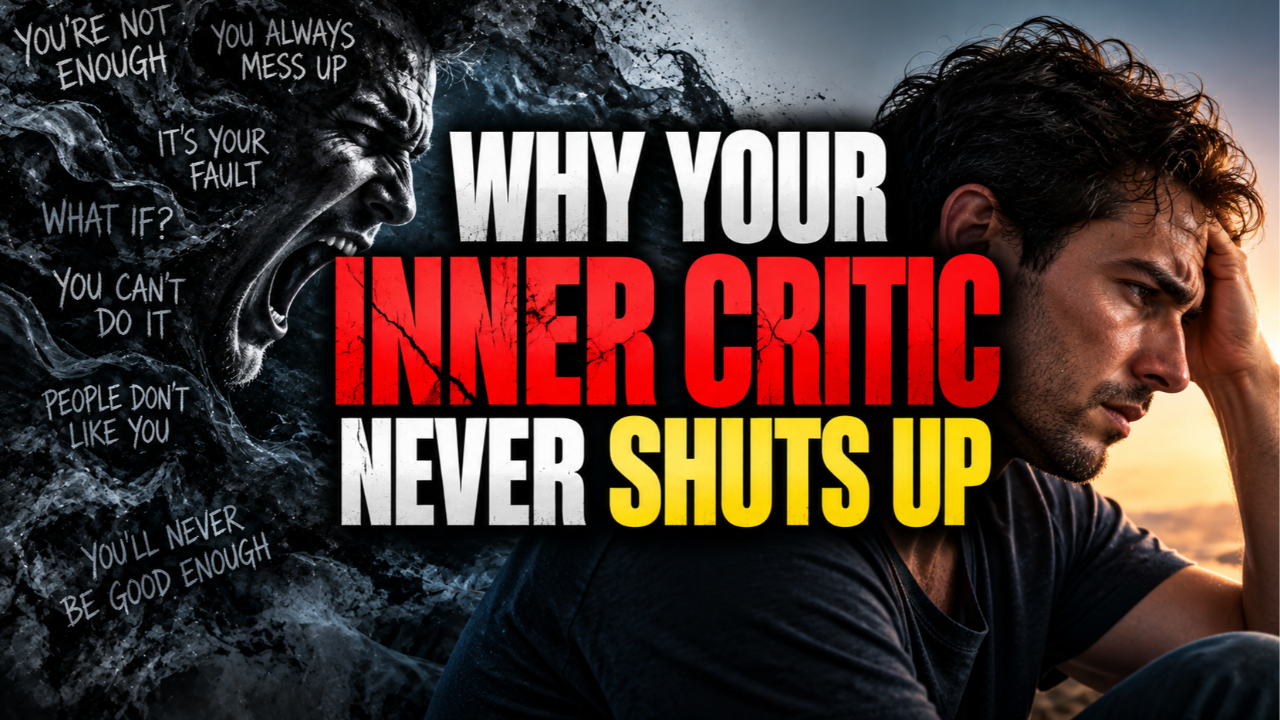
That belief is where the real damage lives. Identity follows behaviour, and if you rehearse an apology for your existence fifty times a day, your brain eventually concludes that the apology must be warranted. This is where over-apologising meets its noisy cousin, the harsh inner voice I took apart in Negative Self-Talk Decoded. One habit tells you that you are getting in the way. The other is happy to explain why.
If you are ready to stop asking permission to exist, grab Fearless and Unstoppable on Amazon and work through the complete confidence blueprint at your own pace.
Why Telling Yourself to Stop Apologising Keeps Failing
The usual advice is to ban the word. Catch yourself, bite your tongue, and replace sorry with something punchier. Plenty of people try it for a week and discover the habit is far more slippery than they expected. Block sorry and it simply puts on a disguise. Now your emails say just checking in, only if you have a moment, or I might be wrong but. The words have changed and the posture is identical. You are still paying the same premium. You have merely switched insurers.
There is a deeper reason the ban fails. Willpower is a finite resource, and you are asking it to police a reflex that fires dozens of times a day, usually when you are tired, rushed, or stressed. That is exactly when the threat detector is at its jumpiest. Worse, every time you slip you feel a jolt of embarrassment, and embarrassment is the very feeling the sorry habit was designed to soothe. So, the attempt to stop apologising generates more of the discomfort that fuels apologising, and then you apologise to yourself for failing. The fake it until you make it brigade has a similar problem. Booming, borrowed assertiveness laid over a nervous system that still expects rejection feels like wearing someone else's suit. Other people can tell, and so can you.
What Changes When You Stop Paying the Sorry Tax
Here is the reframe at the heart of all this. Every reflex apology is an insurance premium. You are paying in advance against the possibility of disapproval, rejection, or conflict. The trouble is that you are insuring a house that is not on fire, and you are paying the premium every hour of every day. Over a lifetime that adds up to an extraordinary amount of confidence handed over in exchange for protection you never needed. The people who seem effortlessly self-assured did not inherit some magical immunity. They simply stopped paying a tax nobody had ever charged them.
This is the central idea in Fearless and Unstoppable. Confidence is not a personality trait you either have or lack. It is a skill, and like any skill it is built through experience rather than argument. You cannot think your way out of over-apologising, because the threat detector does not listen to logic. It listens to evidence. The only way to recalibrate it is to let it watch you take up space without a sorry, again and again, and survive every time. Each time the feared outcome fails to arrive, the alarm drops a notch. That is how a ten out of ten threat quietly becomes a two.
What changes is far more than vocabulary. When you stop pre-apologising, your requests become clearer, your boundaries become visible, and your real apologies regain their weight. People do not suddenly decide you are rude. Most of them never noticed the sorry in the first place, which tells you how little protection it was buying. Confidence is rarely loud. Mostly it is unapologetic about being in the room.
The Sorry Audit: Your First Small Move
So, here is the first move, and it is deliberately small. For the next three days, keep a tally of every sorry that leaves your mouth or your keyboard. Use the notes app on your phone or a scrap of paper in your pocket. Next to each one, write a single letter. R for real, meaning you caused genuine harm or inconvenience. A for automatic, meaning you simply existed near another human being. Most people are startled to find that the automatic column outnumbers the real one by something like ten to one. That number alone loosens the habit, because it is very hard to keep running software once you can see the code.
On day four, choose one automatic sorry each day and swap it. Trade sorry I am late for thank you for waiting. Trade sorry to bother you for a plain hello and the question. When someone bumps into you, say nothing and let them do the apologising. Then sit through the three seconds of silence that follow, because that silence is the whole exercise. Your threat detector will insist something awful is about to happen. Watch closely and notice that nothing does. The meeting carries on. The colleague answers your email. The barista hands over the oat milk without a second glance.

Keep your real apologies, by the way. When you have hurt someone, an honest, unhurried sorry is one of the most powerful things a person can say, and it lands better because it is no longer buried under a thousand cheap ones. If your constant apologising comes from living or working with someone who frightens you, please speak to your doctor or a trusted professional, because that deserves proper support rather than a tally chart. And if your sorry reflex sits inside a bigger fear of being judged, the NHS has a clear guide to social anxiety and how it is treated, while my hypnosis session for fear of rejection works on calming the same overactive alarm.
"I counted 41 sorries on the first day of the audit and only two of them were real. Seeing that number changed something. Three months later I asked for a raise without a single apology in the email, and I got it." (Danielle K., Austin, Texas)
"I always thought apologising made me easy to get along with. It mostly made me invisible. Now I say thank you instead, and people at work have started asking for my opinion first." (Brian H., Columbus, Ohio)
"The three seconds of silence were terrifying at first. Now they feel like breathing room. I speak up in meetings, I send back the wrong order, and I no longer feel like a guest in my own life." (Monica R., Tampa, Florida)
The Question Nobody Asks About Saying Sorry
Most people ask how to stop apologising. It is a fair question, but there is a sharper one hiding underneath it. Who taught you that you were in the way? Very few of us arrive in the world apologising. Somewhere along the line, a busy parent, a stern teacher, or an unpredictable home taught a small person that keeping the peace was their job, and that the safest way to do it was to shrink. The sorry was a brilliant solution for that child. It is simply out of date for the adult reading this.
You do not need to become brash or cold to fix this. You only need to notice the reflex, question the premium, and let the alarm watch you survive. What would you ask for this week if you no longer felt the urge to apologise for asking? And how much more room might you take up, once you stop paying rent on space that was always yours?
Ready to build the kind of confidence that never needs a permission slip? Pick up your copy of Fearless and Unstoppable: The Ultimate Self-Confidence Blueprint on Amazon today.
If you want to know more about the person behind these breakdowns, and why I treat behaviour as software rather than a character flaw, start at About Craig Beck.
About the Author
 Craig Beck spent 25 years in UK broadcasting, a career built on sounding certain while a red light glowed in front of him and a few thousand strangers listened in. Behind the microphone he became fascinated by why people do what they do, and that curiosity turned into a second career. He is a certified NLP Master Practitioner, a hypnotherapist, and the author of more than 100 books on persuasion, habit, and human behaviour, from the bestselling Alcohol Lied to Me to the Decoded range of psychological profiles. He writes for intelligent adults who have had enough of motivational posters and want to see the machinery behind their own behaviour.
Last updated 6 October 2026
Frequently Asked Questions About Over-Apologising
Why do I apologise so much for things that are not my fault?
Because the apology was never about fault. It is a reflex your brain uses to lower the risk of disapproval, and it fires whenever you sense you are taking up space, needing something, or creating even the smallest friction. Each time someone replies with no worries, you get a hit of relief that strengthens the habit. Over the years the word becomes automatic, so it arrives before you have checked whether anything went wrong. Seeing it as a trained reflex, rather than a personality flaw, is the first step to changing it.
Is over-apologising a sign of low self-esteem?
It often travels alongside low self-esteem, but it is better understood as a habit than a diagnosis. Many confident, capable people over-apologise simply because they grew up in homes or workplaces where keeping the peace felt essential. The trouble is that the habit feeds the belief over time. Rehearsing an apology for your existence dozens of times a day teaches your brain that you must be a burden. Interrupting the reflex tends to lift self-worth, because every unapologetic request becomes evidence that you belong in the room.
What can I say instead of sorry?
Swap the apology for gratitude or a plain statement. Thank you for waiting works better than sorry I am late. Hello, quick question works better than sorry to bother you. When someone else bumps into you, say nothing and let them apologise. Avoid simply replacing sorry with softer padding such as just or only if you have a moment, because that keeps the same nervous posture. Keep genuine apologies for genuine harm, and they will carry far more weight when you use them.