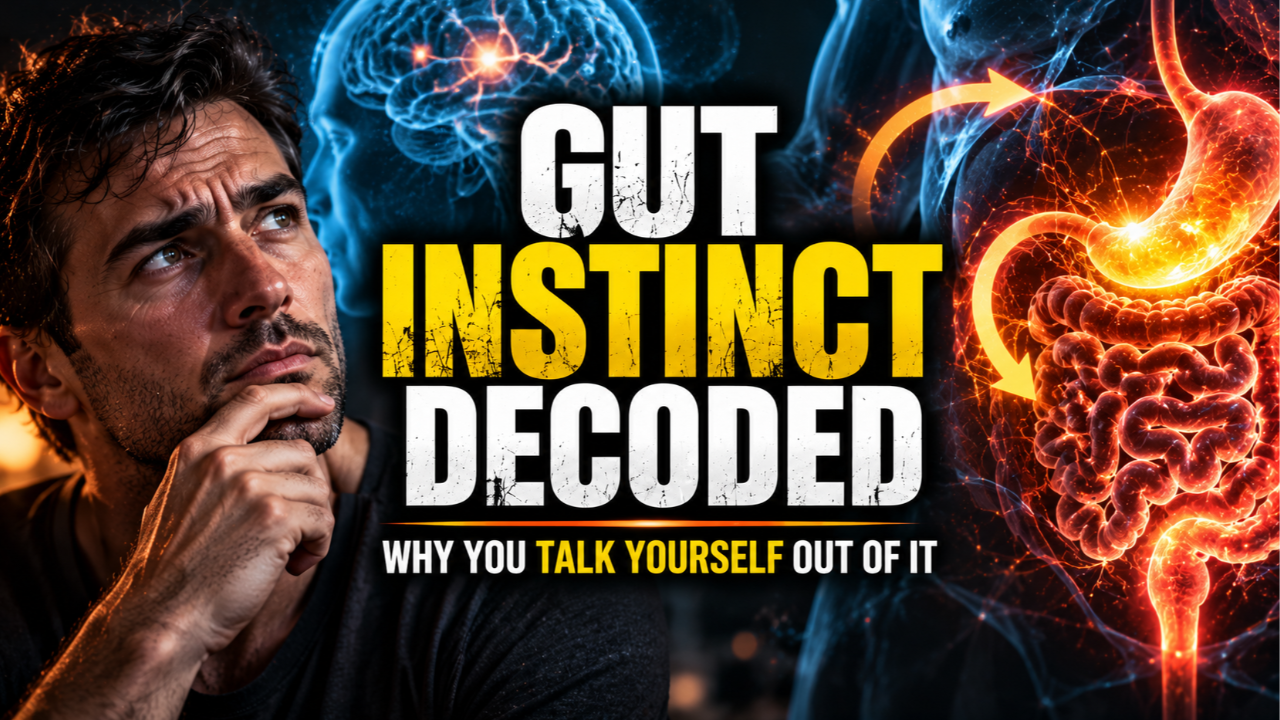
Gut Instinct Decoded: Why You Talk Yourself Out of It
Oct 04, 2026Gut Instinct Decoded: Why You Talk Yourself Out of It
Gut instinct is not a mystical fog or a mood. It is fast pattern recognition arriving before your loud mind finishes its speech. When you talk yourself out of it, you are not being sensible. You are running an override loop where the verbal brain invents respectable reasons to ignore a quieter signal that already did the summing. Once you see that loop, ignoring your gut stops looking like wisdom and starts looking like software defending the familiar.
 You know the moment. Something is off about the job, the deal, the person, the room. Nothing dramatic. Just a clean drop in the stomach, a slight coolness behind the ribs, a sudden urge to leave while everyone else is still smiling. Then the commentary starts. You are being dramatic. You need more data. Grown-ups do not make decisions based on vibes.
Ten minutes later you have a tidy argument against yourself, and the original signal has been filed under nonsense. That is not maturity. That is the override loop doing its favourite trick.
Want the full method for hearing that quieter intelligence without turning your life into a crystal shop? Get The Higher Self Decoded on Amazon.
What Gut Instinct Is Doing When You Override Yourself
Your nervous system is constantly sampling. Tone of voice. Micro-timing in a conversation. The gap between what someone says and how their face holds still. Past outcomes that look nothing like the present on paper but rhyme in the body. That sampling finishes faster than speech. The result lands as a hunch, a lean, a no that has not yet found words.
Gut instinct is that compressed report. It is not infallible. It is not a personality quiz. It is your deeper pattern engine sending a summary while the committee upstairs is still printing agendas. The trouble starts when the committee treats the summary as unwelcome evidence and starts cross-examining it into silence.
Here is the crack in the flattering story. You tell yourself you are being rational. Often you are being verbal. Verbal can be brilliant. Verbal can also be a defence lawyer for whatever keeps your identity and schedule undisturbed. The gut said move. The mouth said wait until it feels safer. Safer usually means more familiar, not more true.
Work on reasoning and intuition shows how often the explanations we produce after a judgment are post hoc stories rather than the real engine of the choice. You can read that framing in the NIH archive piece on reasoning, cognitive control, and moral intuition. You do not need the academic costume. You need the lived point: the loud explanation arrives late and then claims it was driving.
The Respectable Lie That Makes Ignoring Your Gut Feel Smart
The surface story is polished. I am thorough. I sleep on it. I gather facts. I refuse to be impulsive. Those are good habits in the right room. They become a costume when they are recruited to cancel a clear bodily no.
Check the invoice. After the spreadsheet, the group chat, and the third friend poll, do you feel clearer? Or do you feel temporarily soothed because you delayed a decision that already had a direction? Ignoring your gut often feels like care. It frequently functions as delay with better branding.
This is why willpower pep talks miss. You are not failing because you lack spine. You are succeeding at a different goal: staying socially legible and cognitively busy so you do not have to act on a signal that would rearrange your week. The behaviour is blunt. You are not broken. You are running override software as designed.
If the same nervous system later swaps doubt for heat, that neighbouring pattern sits under Anger Decoded. Different costume. Same refusal to sit with the quieter message.
How the Override Loop Hijacks a Clean Signal
Watch the sequence in slow motion. First comes the signal. Soft. Fast. Often physical before it is verbal. Then comes the threat appraisal: if I honour this, I look awkward, expensive, dramatic, or disloyal. Then comes cognitive dissonance, the tension of holding two stories at once. The gut says leave. The identity says I am someone who gives people a chance.
To resolve the tension, the mind does not usually update the identity. It updates the evidence. It invents sensible arguments. Maybe they were tired. Maybe you misread the room. Maybe one more month will clarify everything. The reward is immediate: the tension drops. The cost arrives later as resentment, stuckness, or a mess you saw coming and refused to name.
That drop in tension is the real payment. The override loop is not paid in truth. It is paid in short-term calm. Your system learns: when the gut speaks, argue until the body goes quiet. Quiet feels like resolution. It is often just numbness with footnotes.
Clinical writing on intuition and mood notes how rumination and heavy analysis can crowd out the fast, associative channel healthy people use for everyday choices. A clear overview lives in Frontiers in Psychology on intuition and impaired gut feelings in depression. Again, skip the diagnosis game. Take the mechanism: loud looping thought can drown the channel you keep calling unreliable.
Why more information rarely ends the argument
People in the override loop collect data the way a person in a stalled relationship collects text messages. Not to decide. To postpone deciding while looking responsible. Extra information can help when the gut is silent. When the gut already spoke, more tabs often become anaesthesia.
You are not researching. You are bargaining. Bargaining keeps the familiar identity intact. Decisive action would update who you are in public. That is why the arguments feel so earnest. They are protecting a story, not chasing accuracy.
The Escalation Nobody Notices Until Regret Arrives
Left alone, the override loop expands its territory. First you talk yourself out of small exits. Then out of medium ones. Then you start needing a court case standard of proof before you trust a basic bodily no. Identity wraps around it. You become someone who overthinks. That sentence feels descriptive. It is a contract.
Identity is sticky. Once you decide you are the rational one who never trusts hunches, a clean intuition can feel dangerous, as if trusting it would make you frivolous. Clever people stay stuck longer because they write better briefs against themselves. Intelligence builds better excuses. It does not automatically uninstall them.
You may notice the override borrowing from old programmes. Fear of being seen succeeding can make a good opportunity feel suspicious for reasons that have nothing to do with the opportunity. If that rings, the companion pattern is in Fear of Success. And when the ego will not shut up long enough for quieter guidance to land, the adjacent conversation is Higher Self Decoded.
Prefer the complete map of how that deeper intelligence signals through the body, and how the loud mind keeps interrupting it? Grab The Higher Self Decoded on Amazon and walk the method end to end.
Why Your Usual Fixes Were Doomed
Pro and con lists shouted over a body that already voted are theatre. Affirmations that you trust yourself, recited while you keep ignoring yourself, are noise. Asking five friends to validate a feeling you already had turns your nervous system into a committee meeting. Waiting for certainty is waiting for a feeling the override loop is trained to withhold.
These fixes fail for the same structural reason late starts fail when the cue is Monday and the reward is temporary relief. They attack the wrong layer. They try to improve the decision after the signal has been talked into a corner. They leave the threat appraisal intact. They leave the identity intact. Then they blame you when the familiar loop wins.
Failed fixes are useful data. They tell you the fight was aimed at the output. The training lives in the first sixty seconds after the hunch, in the story that sensible people never move without a spreadsheet, and in the reward of tension reduction that arrives when you talk yourself quiet.
If your particular delay costume prefers calendars and fresh starts, the neighbouring decode is Start on Monday Decoded. Different timing. Same refusal to act while the signal is still hot.
The Reframe That Simplifies Everything
Here is the Decoded frame I want stuck above your kettle. You are not flaky for having a gut feeling. You are not childish for noticing it. You are running two channels: a fast integrative channel and a loud verbal channel. The override loop is what happens when the verbal channel claims jurisdiction every time the fast channel threatens change.
Stop asking, How do I make the feeling louder? Ask, What threat does honouring this signal create for my identity, and what reward am I getting by arguing it away? Most people discover the reward is not clarity. The reward is belonging to the story of being careful, loyal, thorough, or unshakeable.
Once you see that, you can offer your system a cleaner form of care. Not a leap off a cliff. A structured hearing. Capture the signal before the lawyer arrives. Write one ugly sentence: My gut says X. Then write the first three respectable arguments that showed up. Then write what those arguments are protecting. Often they are protecting image, money timing, or someone else's comfort. Rarely are they protecting truth.
Mainstream self-help guidance from the NHS on mindfulness keeps pointing people back toward noticing present-moment experience without immediately wrestling it. You do not need a meditation career. You need a pause long enough that the body report is recorded before the override begins its closing statement.
That quieter channel is what I unpack as higher-self intelligence in the book: not fluffy destiny talk, but the hidden guidance system that speaks in lean, restlessness, clean no, and unforced yes while the ego is busy looking clever. If manifestation talk has ever felt half true and half noise, the mechanics of attention and signal also sit beside Law of Attraction Decoded.
The First Move That Interrupts the Override
Concrete beat theoretical. The next time a gut feeling arrives, do not debate it for an hour. Give it ninety seconds of unedited capture. Phone note. Scrap paper. Voice memo you will delete later. One sentence for the signal. One sentence for the body location. One sentence for the action it points toward, even if the action is simply leave the room.
Then set a short hold. Not forever. Twenty-four hours for a big decision. Twenty minutes for a social exit. During the hold, you may gather facts. You may not gather applause. Facts change the map. Applause often reloads the override.
At the end of the hold, ask one adult question: If I already knew, what would I do? Notice what your body does when you ask. Softening toward yes. Tightening toward no. Neutral boredom toward delay. Treat that as data, not theatre. Then take the smallest honourable step that matches it. Send the email. Decline the invite. Leave the call. Book the medical check. Do not wait for a cinematic certainty that the loop is trained to withhold.
Prediction updates through evidence. Evidence comes from what you do when the signal fires, not from what you promise yourself after three coffees and a motivational reel. If anticipatory dread is the neighbouring costume, where the mind rehearses disaster before anything happens, that decode lives at Anticipatory Anxiety Decoded. Related, not identical. One invents future threat. The other talks past present knowing.
Ready for the full method behind trusting that hidden intelligence without becoming reckless? Get The Higher Self Decoded on Amazon today.
What Changes When You Stop Cross-Examining Yourself
People who rebuild trust with gut instinct rarely become impulsive caricatures. They become faster at clean exits and slower at self-betrayal. They still use spreadsheets where spreadsheets belong. They stop using spreadsheets as a personality.
The private ugly detail is this: most adults do not lack intuition. They lack permission. Permission was trained out by classrooms that rewarded the verbal answer, workplaces that rewarded compliance, and families that treated bodily no as rudeness. Relearning is not mystical. It is rehabilitation of a channel you already have.
"I finally left a partnership my gut flagged for months. Within six weeks my sleep returned and I stopped rehearsing arguments in the shower." - Megan H., Austin, Texas
"I used to poll everyone before every decision. Now I capture the first signal first. I am less popular in group chats and far more honest with myself." - Derrick P., Columbus, Ohio
"Trusting the quiet no saved me from a job that looked perfect on paper. My bank account took a hit. My nervous system did not." - Alicia R., Portland, Oregon
None of that is magic. It is what happens when the override loop loses its unpaid internship as your inner counsel.
The Question Worth Sitting With
So here is where I will leave you, without a neat bow. What decision are you currently calling careful that is actually just the loud mind winning another argument against a signal you already understood?
You do not need to announce a reinvention. You need one recorded hunch, one short hold, and one honourable step. The rest is practice. The machinery was never your enemy. The silence you taught it to keep was.
If you want a fuller sense of who is writing this and why I keep decoding behaviour as software rather than moral failure, start at About Craig Beck.
About the Author
 Craig Beck is a 51-year-old former UK broadcaster, certified NLP Master Practitioner, and human behaviour author with more than one hundred books spanning self-help, psychology, the Decoded range, and fiction. He writes for intelligent adults who are done with motivational fog and want the mechanism behind the habits that keep stealing their life. Last updated 4 October 2026.
FAQ
Is gut instinct the same as anxiety?
Not usually. Anxiety often arrives as a loud, looping forecast of disaster and keeps demanding more mental rehearsal. Gut instinct tends to arrive as a shorter, quieter signal with a direction attached, like leave, wait, or move closer. If the feeling expands into endless catastrophe cinema, treat it as anxiety software first. If it stays compact and bodily, give it a hearing before you talk it out of existence.
How do I know my gut is not just bias?
You do not get certainty on demand. You get better odds by separating the first signal from the later story. Capture the hunch early, then check whether your arguments are seeking truth or protecting image, loyalty, or delay. Bias loves flattering narratives. Useful gut instinct often feels inconvenient, socially awkward, or expensive in the short term, which is why the override loop works so hard to cancel it.
What is the first practical step if I always override myself?
Install a ninety-second capture rule. The moment the feeling arrives, write one sentence for the signal, one for where it sits in the body, and one for the smallest action it suggests. Set a short hold before you gather opinions. That tiny protocol interrupts the override loop at the cue, which is where change actually lives, rather than in another promise to trust yourself someday.