Am I an Alcoholic? Why the Question Keeps You Drinking
Sep 30, 2026Alcohol Decoded by Craig Beck: Audiobook Release!
Am I an alcoholic is the wrong question, and asking it is one of the reasons you keep drinking. The word conjures a man on a bench with a bottle in a paper bag, so the comparison always clears you and the pouring carries on. Medicine quietly dropped the diagnosis in 2013 in favour of a sliding scale that most regular drinkers sit somewhere on. The useful question needs no label at all: is alcohol taking more from you than it gives?
 You have taken the quiz. Probably around 2am, house asleep, laptop glow on a glass of something red, twenty questions promising you a verdict. And you negotiated with every one of them.
Do you ever drink alone? Define alone, the dog was in the room.
Has anyone expressed concern? Your partner's face over the recycling bin floated up and you clicked no on a technicality.
Even with the scales thumbed that hard, the result came back "cause for concern", and you closed the laptop, decided the website was hysterical, and poured another glass to recover from the ordeal. The question had been asked and answered and the answer changed nothing. It never does.
This article is about why.
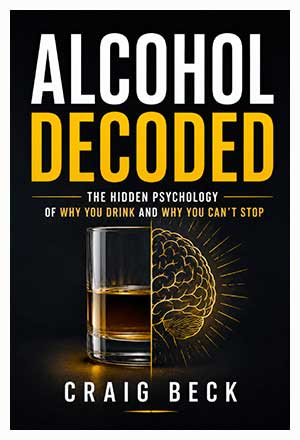
Everything below is the short version. The full decoding, every belief that keeps the glass in your hand and the exact way each one comes apart, is in my book Alcohol Decoded, now released as an audiobook on Audible, read by me. If you would rather have the whole map than the postcard, that is where it lives.
The Picture the Word Painted Before You Ever Drank
Say the word to yourself now. Alcoholic. Notice the image that arrives fully formed: trembling hands around a can at nine in the morning, a face full of burst capillaries, a man who has lost the house, the job and the plot. You did not paint that picture. It was painted for you over decades by films, jokes and news reports, and whatever anyone intended, its effect is precise. It is so extreme, so visibly ruined and so unlike you, that the comparison always comes back clean. "Am I an alcoholic" translates in your head to "am I that", and nobody with a Wi-Fi connection and matching crockery is that. Enquiry closed, cork out.
The word also sorts the entire drinking world into two boxes with no corridor between them. Box one holds normal drinkers, the vast majority, for whom the product is harmless fun. Box two holds a tragic minority born with something broken, for whom the same product is poison. And every drinker files themselves into box one, unsupervised, because box two is unthinkable. Nobody volunteers for doomed.
So, the wall goes up brick by brick. He drinks in the morning, you never do, except at airports, which everyone knows don't count. He has lost everything, you have a pension. He needs it, you choose it. Every brick a difference, and behind the wall, a bottle a night, invisible.
The Ladder of Words You Are Standing On
When the wall wobbles, language sends reinforcements, and it is worth looking at the rungs because you are on one of them right now. At the top sit wine lover, foodie, works hard and plays hard. A rung down comes likes a drink, social drinker, party animal, the sort of thing said fondly at funerals. Further down is heavy drinker, which admits quantity while denying meaning, the way a man might confess to owning rather a lot of knives. And then the modern favourite, worn like a tailored suit by millions: high-functioning. "I'm probably a functioning alcoholic," we say with a practised half-laugh, and the table chuckles and somebody tops everyone up.
Look at what that phrase does. The noun makes the confession and the adjective withdraws it in the same breath. Functioning is a report on the parts of your life other people can see: the job held, the lawn mowed, the emails answered before nine. It says nothing about the 3am ceiling, the counting, the treaty negotiated at the fridge door. It is a plea bargain.
Guilty to the lesser charge of drinking impressively, in exchange for never discussing the interior. Each rung of the ladder is the same bargain at a different price, and the whole structure exists so a person can descend for thirty years without ever touching the word at the bottom.
Who Benefits When the Customer Takes the Blame
 I spent twenty years studying persuasion, and the first question that training teaches you to ask about any belief is who profits from it. Apply that to the two boxes. If the catastrophe of drink lives inside a defective minority, then the drink itself stands acquitted for everyone else. The cancers, the wrecked marriages, the early deaths all get warehoused in the biology of the unlucky few, and the product line walks free. It is the most elegant liability shield ever built, and it was built into the language itself.
Consider how alone alcohol is in enjoying this arrangement. When someone gets hooked on heroin we say heroin is addictive; we do not diagnose them with a heroin personality. When the truth about cigarettes finally landed after forty years of industry resistance, nobody concluded that a minority of smokers had smoking disease.
We concluded that cigarettes cause addiction in whoever smokes enough of them. Alcohol is the last drug on earth where the customer takes the blame for the product working exactly as designed. I wrote about how the wanting gets installed in the psychology of why you can't stop drinking, and the loop runs on the same chemistry in everyone. The difference between the bench and the dinner party is time and dose.
The Diagnosis That Was Struck from the Books
The confidence with which the two-box model gets repeated hides how shaky its foundations are. The famous curve, the inevitable slide from first sip to gutter that generations of doctors pinned to their walls, rested when you go and look on a few dozen questionnaires posted to members of a single fellowship in the 1940s, self-selected and self-reported, with the women's responses discarded along the way. The researcher behind it spent his later years asking the world to hold his conclusions more loosely, and the world declined. Folklore outlives evidence by a century.
Then medicine itself left the building. In 2013 the profession's own diagnostic manual deleted alcoholism as a category. In its place sits a spectrum called alcohol use disorder, graded mild, moderate and severe against eleven plain-language criteria: drinking more than you intended, wanting to cut down and failing, time lost to it, carrying on despite the damage. Two criteria and you are on the scale.
The official science now describes a slope that ordinary drinkers slide along by degrees, and the doctors adopted it without ceremony and told almost nobody. Which means the person at the kitchen table at 2am is taking a quiz for a condition that officially no longer exists, and measuring themselves against a verdict struck from the books over a decade ago.
The genetic version you hear at dinner parties deserves the same haircut. Vulnerability does run in families, but what gets passed down is a scatter of small tilts, a liver that clears the drug faster or a temperament that runs anxious, and every one of them needs years of pouring before anything resembling addiction exists. People are born with different slopes. The rolling is done by the drink.
If this is already rearranging a few things in your head, the audiobook goes further than I can here. Listen to Alcohol Decoded on Audible on the commute, on the dog walk, or at 6pm in the kitchen where the argument usually happens.
Everyone Is Standing on the Same Beach
Throw out the boxes and let me hand you the picture I wish someone had handed me. Every regular drinker in the world is standing on the same beach, and the tide is coming in. The water is the mechanism, the rebound anxiety that calls the next drink and the tolerance that shrinks the reward, and it rises on everyone the same way. What differs is where people are standing. Some waded in at 14 and some at 24. Some carry the inherited tilts. Some work in careers that pour constantly. And some, and this matters more than almost anything, are standing in lives that hurt, because pain moves you down the beach faster than any gene.
A series of experiments in the 1970s makes the point. Rats caged alone with two bottles, one plain water and one laced with an opiate, drugged themselves relentlessly, and for years that was held up as proof of what drugs simply do. Then a sceptical researcher built a roomy, social enclosure full of wheels and tunnels and other rats, offered the same two bottles, and the residents largely ignored the drug. The cage was half the addiction. So, when you see someone deep in the water, the disease story whispers born faulty. The tide model asks better questions: how early did they wade in, what were they carrying, and what was on the shore behind them that made walking back feel pointless?
Why the Label Carries the Addiction on Its Back
Here is the part I care about most, and the reason I would remove the word from the language tomorrow if you gave me the keys. It is not that the label is unkind. It is that the label is load-bearing, and what it bears is the drinking itself. Words you accept about yourself are not descriptions; they are instructions, and this one arrives with terrible small print. Clause one: you are different from other people, permanently, at the level of your cells.
Clause two: you are powerless before this substance, one sip and it owns you. Clause three: there is no cure, only a lifelong trench, one day at a time, forever.
Watch what those clauses do to the two moments that decide every drinker's fate. The first is the moment of seeking help. To raise your hand you must first accept the whole identity, bench and paper bag and forever included, so people bargain and delay, often for the better part of a decade, drinking hard the entire time while they wait to be sure they are that. The label guards the door of the burning building and demands ID.
The second is the moment of the slip. Sooner or later, on some ragged evening, a person who has stopped has a glass. What happens in the next ten minutes is decided almost entirely by the story they hold. The one who believes a tired decision was made on a bad day can put the glass down and carry on. The one who believes the disease has woken drinks the bottle and then the cupboard, because why fight a verdict, and wakes inside the catastrophe the belief itself organised. Powerlessness is the only diagnosis I know of that causes its own symptoms on contact.
I should tell you how close I came to signing up for the trench. In my worst year I drove to a church hall on a Tuesday night and sat in the car park watching people file in through the rain in ordinary coats with ordinary faces. I could not open the door. I told myself it was the plastic chairs and the instant coffee. It was the sentence. The price of that room was to say the word about myself once, out loud, and then own it for life, introducing myself by my wound in 2040, still one drink from ruin at 80. I drove home and drank for five more years. Those rooms have caught millions of falling people and handed them back their lives, and anything that does that has my respect. My quarrel is with what the sentence did on its way out of that hall and into the wider culture, where it became the only story anyone knew.
The Question That Needs No Confession
So, change the question. "Am I an alcoholic" asks what you are, demands identity surgery before it will release any help, and cannot be answered without a courtroom in your head. Swap it for this: is alcohol taking more from me than it gives? That question requires no label and no bench. It asks what the drink does to your sleep, your afternoons, your face, your patience with the people you love. Run the audit like a bookkeeper rather than a defendant. And notice what happens to your standing the moment the question changes. Under the old word the best you could ever be was a recovering defective, gripping the rail. Under the new one you are a normal human being who took a highly addictive drug regularly for years inside a culture that cheered, and got hooked to a degree. That is not a malfunction. It is the machine working.
A second reframe follows from the first. Two people can stop in the same January and, three years on, one calls it his sentence and the other has forgotten the anniversary. The difference is one sentence carried in one head: I have given something up. We reserve giving up for treasures. Nobody gives up cholera. Park that phrase on top of quitting alcohol and the mourning starts before a single conscious thought arrives, and mourning has no expiry date while the lost thing stays precious. The person who does the audit and finds the drink was a debt performs an eviction. You do not count the days since the burglar left. The friends who push hardest when you stop are running the same accounts, which I covered in why your drinking buddies don't want you to quit.
Two Words That Close the Case
When you are out, and the audit tends to get people out without anyone white-knuckling anything, you inherit the shortest, freest sentence in this whole business. Not "I am an alcoholic", said standing, forever. Simply: I don't drink. No history attached, no disease disclosed, no daily vigil implied. Nobody has ever asked a vegetarian to introduce themselves as a recovering carnivore, and you are under no obligation to wear your old chains as jewellery.
Choose the wording with care, because the gap between "I don't" and "I can't" has been put to the test. Researchers armed people resisting temptation with one phrase or the other and watched what held. The "I can't" group crumbled at nearly three times the rate. Listen to why. "I can't" is the voice of a prisoner reporting the rules; it concedes the desire is alive and merely fenced, and every utterance rattles the fence. "I don't" is a statement about who is speaking. It closes the question rather than guarding it. A question held 99 per cent shut hums in the background at every wedding and every sunny Friday. At 100 per cent you made the decision once, and closed files cost nothing to carry.
Here is the first move, and you can make it before you close this tab. Tonight, before the usual hour, write down in one honest line what the drink gives you and what it costs you: the sleep you did not get, the morning heart rate, the text you should not have sent, against the one warm hour. Then say the two words out loud, in the car, at the kettle. I don't drink. The first ten times it will feel like someone else's coat. Around the thirtieth it starts to fit, because identity is not something you wait to feel before acting on; it is something you act your way into, one spoken sentence at a time. If you drink heavily every day, speak to your GP before you change anything, since stopping suddenly can be physically dangerous; the NHS guidance on alcohol use disorder is a sensible first stop, and a book is a companion to that, never a replacement.
The complete method, every chapter of it, is now in my own voice on Audible. Get the Alcohol Decoded audiobook here and let the argument run in your earphones instead of your kitchen. For years you have been listening to a narrator inside your own head who has a vested interest in the next glass. It seemed only fair to give you a different one.
And here is the thought to leave with. The word was never there to describe you. It was there to make sure you never looked too closely at the bottle, and it has done that job in millions of kitchens for the better part of a century. The moment you stop asking what you are and start asking what it does, the quiz at 2am has no more questions left for you.
"I'd spent four years telling myself I was high-functioning. The line about the adjective withdrawing the confession stopped me cold. I did the audit that night, and I haven't poured a glass since February. My blood pressure is normal for the first time in a decade."
Rebecca Lindqvist, Portland, Oregon
"I refused help for years because I wasn't 'that bad'. Switching the question to what the drink was doing to me got me out without ever having to stand up in a room. Nine months dry and my daughter says I'm fun again."
Tyler Brannock, Cincinnati, Ohio
"The 'I don't' versus 'I can't' thing sounds too simple until you try it. I'd relapsed six times on willpower. This time the question is just closed. Down 24 pounds, sleeping through, and I stopped hiding receipts from my wife."
Marcus Dellinger, Fort Worth, Texas

About the Author
 Craig Beck is the world's foremost expert on persuasion and human behaviour. A certified NLP Master Practitioner, former broadcaster and bestselling author of more than one hundred books, he has spent two decades reverse engineering why people say yes, including why they keep saying yes to the one thing they swore they would refuse. More than a million readers and listeners worldwide have used his work to see the hidden mechanics behind their own decisions. He spent long enough on the wrong side of this argument to write about it without a trace of a lecture, and he narrates every one of his audiobooks himself.
Last updated: 30 September 2026
FAQ SECTION:
Frequently Asked Questions
Am I an alcoholic if I drink every night?
The word is the wrong measuring stick, because it invites you to compare yourself with an extreme cartoon and pass every time. Since 2013 medicine has used a sliding scale called alcohol use disorder, and drinking more than you intended, wanting to cut down and failing, or continuing despite the harm each count towards it. Two of those and you are on the scale. The more useful question is whether alcohol is taking more from you than it gives, and a nightly drinker who has to ask usually already knows the answer.
What is the difference between a heavy drinker and an alcoholic?
Less than the language suggests. The two-box model, normal drinkers on one side and a broken minority on the other, was built on a few dozen questionnaires in the 1940s and has since been abandoned by the diagnostic manuals. Every regular drinker is on the same slope, moved along it by the same chemistry and conditioning. Heavy drinker is simply a rung on the euphemism ladder that admits quantity while denying meaning, and it exists so a person can keep descending without touching the word at the bottom.
Can I stop drinking without calling myself an alcoholic?
Yes, and for many people it is easier that way. The label carries three instructions: you are different, you are powerless, and it is forever, and each one makes seeking help and surviving a slip harder. Auditing what the drink does to your sleep, mood and relationships requires no confession, and the identity you inherit at the end is two words: I don't drink. Anyone drinking heavily every day should speak to a doctor before stopping, because sudden withdrawal can be physically dangerous.