Why You Can't Stop Drinking: The Psychology Decoded | Craig Beck
Sep 05, 2026Alcohol Decoded: The Hidden Psychology of Why You Drink and Why You Can't Stop
 You can't stop drinking because alcohol has become the cure for a problem alcohol created. Each drink calms your nervous system for an hour or two, then your brain rebounds in the opposite direction and leaves you more restless than before you poured it.
Tomorrow's 6pm craving is tonight's wine calling itself back. Willpower fails because you are fighting a loop that runs below conscious thought, and the way out begins with reading how that loop was built.
It is 5.52pm on a Tuesday. On Sunday night you made a promise, a proper one, spoken out loud to the bathroom mirror. Nothing until Friday. And now you are standing in the kitchen with the fridge door open, looking at a bottle you do not remember deciding to buy, and a voice in your head is explaining, very reasonably, that it has been a difficult day.
It has. That is the maddening part. The voice is never wrong about the day. It is only ever wrong about the solution. If you have read the famous books, tried the app, done a dry month and quietly slid back, this article is for you. Not to tell you to try harder. To show you the machinery.
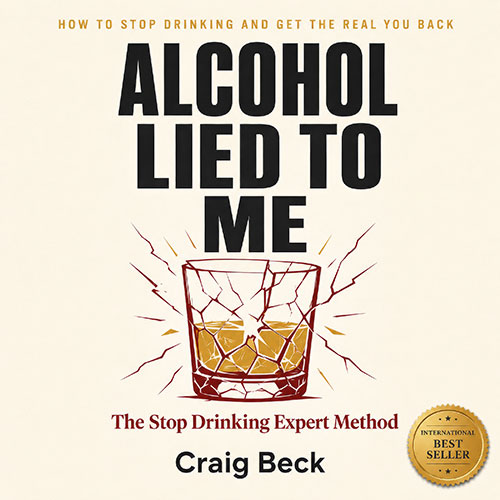
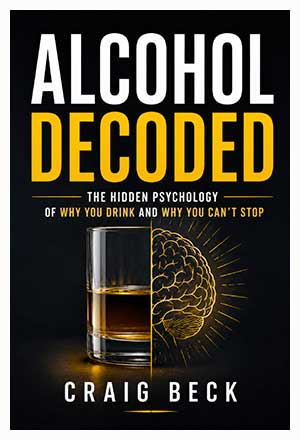
Before we go any further, a quick word about where this leads. Everything below is the summary. The full method, from the beliefs that keep the bottle in your hand to the exact way they come apart, is in my book Alcohol Decoded: The Hidden Psychology of Why You Drink and Why You Can't Stop. Grab it on Amazon if you want the whole map rather than the postcard.
The Story Every Intelligent Drinker Tells Themselves
Here is the version of events you currently believe, and I want to be fair to it, because it sounds sensible. You drink because you enjoy it. You work hard, you carry a lot, and a glass of something once the day is done is one of the few pleasures that asks nothing of you. You are not lying in a doorway. You hold down a job, you remember birthdays, you pay the council tax. You could stop if you wanted to; you did most of January in 2023 and felt fine. The drinking is a choice, and choices are allowed.
Every sentence of that is the kind of thing a clever adult would say, which is exactly why it has survived so long. The story does a job. It lets you drink on Tuesday without having to think about Monday, and it lets you feel like the author of your evenings rather than a passenger. I told myself the same story for years, in a slightly posher accent, and I believed every word.
The Bit That Doesn't Add Up
Now let me put a few questions to that story, and watch what happens. If you drink because you like the taste, why does the first glass go down in four swallows while the third gets sipped? If it is a reward for a good day, why do you drink most on the days that go badly? If it is a treat, why do you push the empties under the cardboard in the recycling so the neighbours cannot count them? And if you could stop whenever you wanted, why are you reading an article about why you can't?
A pleasure you feel the need to hide is not behaving like a pleasure. It is behaving like a debt. The contradiction sits right there in plain view, and your mind has been stepping around it for years the way you step around a loose paving slab on a familiar street. Psychologists call the discomfort of holding two clashing beliefs cognitive dissonance, but you do not need the label. You have felt it every time somebody asks "how much do you drink, roughly?" and you hear yourself round the number down.
What the 6pm Drink Is Doing Inside Your Skull
Alcohol works on the brain like a foot on the brake. It boosts the calming chemistry and dampens the alerting chemistry, which is why the first glass feels like somebody loosened a collar you had forgotten you were wearing. Your brain, though, is a machine built to keep things level. When it notices the brake being pressed night after night, it presses the accelerator harder to compensate. This is the part nobody explains at the pub.
When the alcohol leaves your system, usually somewhere between 2am and 4am, the brake lifts but the accelerator is still floored. You wake with your heart going like a drum, your mouth dry, a vague dread you cannot pin to anything. The National Institute on Alcohol Abuse and Alcoholism describes this rebound plainly: as the drink wears off, people can feel more restless and anxious than before they drank. That morning anxiety is not your job or your marriage. It is a chemical hangover of the nervous system, and by mid-afternoon it has matured into a craving that feels exactly like needing to unwind.
So, the loop closes. The drink you had last night manufactured the tension you will drink to relieve tonight. Alcohol sells you the cure for the disease it gave you, and it does it so smoothly that you thank it for the service. I wrote about the conditioning behind that automatic reach in how your brain reaches for the glass before you have decided to, and the short version is that the deciding happens after the reaching, not before.
Why the Craving Arrives Before the Stress Does
You probably think of cravings as something that happens to you when life gets hard. Look closer and you will notice the order is often reversed. The wanting turns up at the same time each day regardless of what the day contained. Good day, bad day, boring day, it arrives at 6pm like a train. This is where dopamine earns a mention, because almost everybody gets it wrong. Dopamine is not the chemistry of enjoying. It is the chemistry of wanting, of anticipation, of the brain saying "that thing, over there, go and get it."
Every time you have paired a cue with a drink, and there are thousands of cues by now, the brain has stored the pairing. The sound of the front door closing behind you. The clink of the cutlery drawer. The theme tune of the programme you watch while you cook. The word "wine" in a text from a friend. Each one now fires the wanting circuit before any conscious thought is involved. The craving is not a response to stress. It is a response to the clock, the kitchen, and the habit loop you built one ordinary evening at a time. Stress just gives the voice something to point at.
And because the brain has learned that alcohol is the fastest known route from "on duty" to "off duty," it has quietly stopped bothering to learn any other route. That is the hidden cost. The drink did not only become a habit. It became the only exit you know.
How a Glass of Wine Quietly Became a Lifestyle
Nobody sets out to drink a bottle a night. You drift there, and the drift has a mechanism. Remember that accelerator the brain keeps pressing to counter the brake? Over months and years it presses harder, which means the same glass produces less relief. The dose that once switched you off now barely takes the edge off, so the glass becomes a large glass, the large glass becomes most of a bottle, and the Friday habit gets an early start on Thursday. The NHS puts the line for regular drinking at 14 units a week. Two bottles of wine gets you there. A lot of people I hear from are through it by Wednesday and would not describe themselves as heavy drinkers.
The escalation is invisible from the inside because it happens in steps too small to notice. You do not compare tonight with 2019. You compare tonight with last night, and last night was about the same. That is how a person who "just likes a drink" ends up checking the recycling day on the calendar, buying from a different shop so the same cashier does not see them twice, and deleting the online order confirmation before their partner sees the email. None of that is weakness. It is a nervous system doing exactly what it was trained to do, with a clever brain assigned to write the excuses.
If you want to understand how the wanting gets built and how it gets dismantled, that is the spine of Alcohol Decoded. It is the book I wish somebody had handed me in the years I was still convinced I was in charge.
Why Moderation, Willpower and the App All Lost Before Kick-Off
Let us go through the fixes you have tried, because each one failed for a reason, and the reason was never you. Moderation first. Only at weekends, only after 7pm, only wine, never spirits, never alone. The rules work for about nine days, which is roughly how long it takes for one bad afternoon to arrive and remind you that the rules were written by the sober version of you, who is not the one standing at the fridge. Moderation asks the wanting circuit to negotiate, and the wanting circuit does not negotiate. It just waits.
Willpower is next, and here is the uncomfortable truth about it. Willpower is a finite resource, a tank that drains through the day as you make decisions, resist snacks, bite your tongue in meetings and referee the kids. By 6pm the tank is close to empty, and 6pm is when the craving arrives. You are bringing your weakest weapon to the strongest opponent at the worst possible hour. Motivation versus discipline is the wrong argument entirely. Both run on the same drained battery.
Then the app with the streak counter, which turns sobriety into a score you can lose, so that day 12 collapsing to day 0 feels like a verdict on your character rather than a data point. The alcohol-free beer, which rehearses every step of the ritual except the last one and keeps the cue pathways beautifully oiled. And the annual dry month, which has become for many people a kind of proof of innocence: I managed 31 days, therefore I am fine, therefore February can begin. Each failure gets filed as evidence, and after enough evidence a person stops believing change is available to them at all. Psychologists call that learned helplessness. You would call it "I've tried everything." I have a longer piece on how to quit drinking without relying on brute willpower, if that is the fight you keep losing.
The Moment You Stop Fighting Yourself
Here is the reframe, and it is the heart of everything I teach. You have been treating this as a battle between a good you who wants to stop and a weak you who keeps drinking. That model guarantees defeat, because every drink is proof that the weak one is winning, and every proof makes the next drink more likely. Shame is not the cure for the last relapse. Shame is the fuel for the next one.
There is no weak you. There is a belief, installed early and reinforced daily, that alcohol gives you something: relief, confidence, connection, an off switch. All the wanting hangs from that belief like a coat from a hook. Take away the hook and the coat falls. This is why the people who stop for good rarely describe it as giving something up. They describe it as seeing through something. The drink stops looking like a treat you are denying yourself and starts looking like a con you are no longer falling for, and nobody needs willpower to stop buying from a salesman they have caught lying.
Notice how consistent you have been, by the way. For years you have kept a promise to alcohol with a discipline you would never credit yourself with. Same time, same place, same brand, week in and week out. The consistency was never missing. It was aimed at the wrong thing. Identity does the work that goals cannot, and the identity shift is not "I am someone trying not to drink." It is "I am someone who has understood the trick." One of those is a diet. The other is a decision that does not need renewing at 6pm.
I should be honest about my own version of this. Somewhere around 2010 I poured a bottle of red down the sink at 11pm and went to bed feeling like a man who had finally sorted himself out. At 11 the next morning I was at the supermarket buying two more, telling the woman at the till they were for a dinner party. There was no dinner party. That was not a failure of resolve. It was the belief still fully intact, wearing a different outfit. The resolve was never the problem.
The social side deserves a mention too, because a private problem is easy to keep private when the whole culture drinks. Nobody at the barbecue asks why you are on your fourth. They ask why you are not. I looked at that pressure in what happens to your friendships when you stop drinking, and the short answer is that the ones worth keeping survive it.
One Thing to Do Before You Close This Tab
I am not going to ask you to stop tonight. I am going to ask you to run an experiment, and it takes two minutes. Before your next drink, write down on your phone, in one line, what you expect it to do for you. "Take the edge off." "Help me sleep." "Make the evening feel like mine." Be precise. Then set a reminder for three hours later and answer a single question: did it? Not did it feel nice for twenty minutes, but did it deliver the thing you hired it for?
Do that for a week. You will not be white-knuckling anything, and you will not be counting days. You will simply be auditing a supplier. Most people who try this discover that the drink has been failing to deliver for years, and that the discovery does more damage to the belief than any rule ever managed. If the physical side of stopping worries you, and it should if you are drinking heavily every day, speak to your GP before you change anything; the NHS alcohol support page is a sensible first stop, and a book is a companion to that, never a replacement.
The Question Nobody Asks About Drinking
Everyone asks how to stop. Almost nobody asks the question underneath it, which is this: what is the drink doing for you that you have never learned to do for yourself? Switching off, softening, feeling at ease in your own skin. Those were never in the bottle. The bottle only borrowed them from tomorrow at a brutal rate of interest. The moment you can answer that question without flinching, the 6pm voice loses its best argument, and you begin to hear how thin it always was.
If you want to take that question all the way down, the complete method, every belief and how to unpick it, is in Alcohol Decoded on Amazon. Read it before Friday. You already know what Friday looks like otherwise.
"I'd done three Dry Januarys and slid back every February. Six months after reading this I don't miss it, and my 3am wake-ups stopped in the second week." Marcus T., Raleigh, North Carolina
"I was hiding bottles from my husband and hating myself for it. Understanding the loop took the shame out of it. I haven't wanted a drink since April and we're finally talking again." Jenna Whitfield, Boise, Idaho
"The expectation audit did it for me. Two weeks of writing down what the beer was supposed to do and noticing it never did. I've lost 19 pounds and I'm sleeping like a teenager." Dale Ferreira, Tucson, Arizona

Frequently Asked Questions
Why do I crave alcohol at the same time every day?
Because your brain has paired that time, and everything around it, with a drink. The end of work, the kitchen, the first quiet moment of the evening all became cues, and cues fire the wanting circuit automatically. Add the rebound effect from yesterday's drink, which leaves the nervous system running hot by late afternoon, and you get a craving that turns up on schedule whether or not the day was hard. It is a scheduled event, not a reaction.
What happens in the first 30 days after you stop drinking?
The pattern varies from person to person, but a common shape is a rough first week, with disturbed sleep and irritability as the nervous system stops compensating for the brake it was used to. Sleep often deepens through week two and three, and the morning dread tends to fade as the rebound effect disappears. The cravings do not vanish on a timetable; they weaken as the cues stop being rewarded. Anyone drinking heavily every day should speak to a doctor before stopping, because physical withdrawal can be serious.
Is it possible to stop drinking without willpower?
Willpower is what you need when you still believe the drink is worth having. Change the belief and the fight shrinks with it. People who stop for good usually describe a shift in how they see alcohol rather than a heroic act of resistance. The drink stops looking like a reward being withheld and starts looking like a trick they have seen through. That shift is learnable, and it is the method the book is built around, though it works alongside medical support rather than instead of it.
About the Author
 Craig Beck is a former UK broadcaster who became one of the world's leading authorities on persuasion and human behaviour. A certified NLP Master Practitioner and the author of more than 100 books, he has spent twenty years taking apart the hidden reasons people say yes, keep going back, and cannot seem to stop. His work has reached well over a million readers worldwide, many of them people who had already tried everything else. He does not deal in theory or pep talks. He shows you the wiring, and then he shows you where the switch is.
Last updated: 5 September 2026