Busyness Decoded: Why Doing Nothing Feels Wrong
Oct 11, 2026Busyness Decoded: Why Doing Nothing Feels Wrong
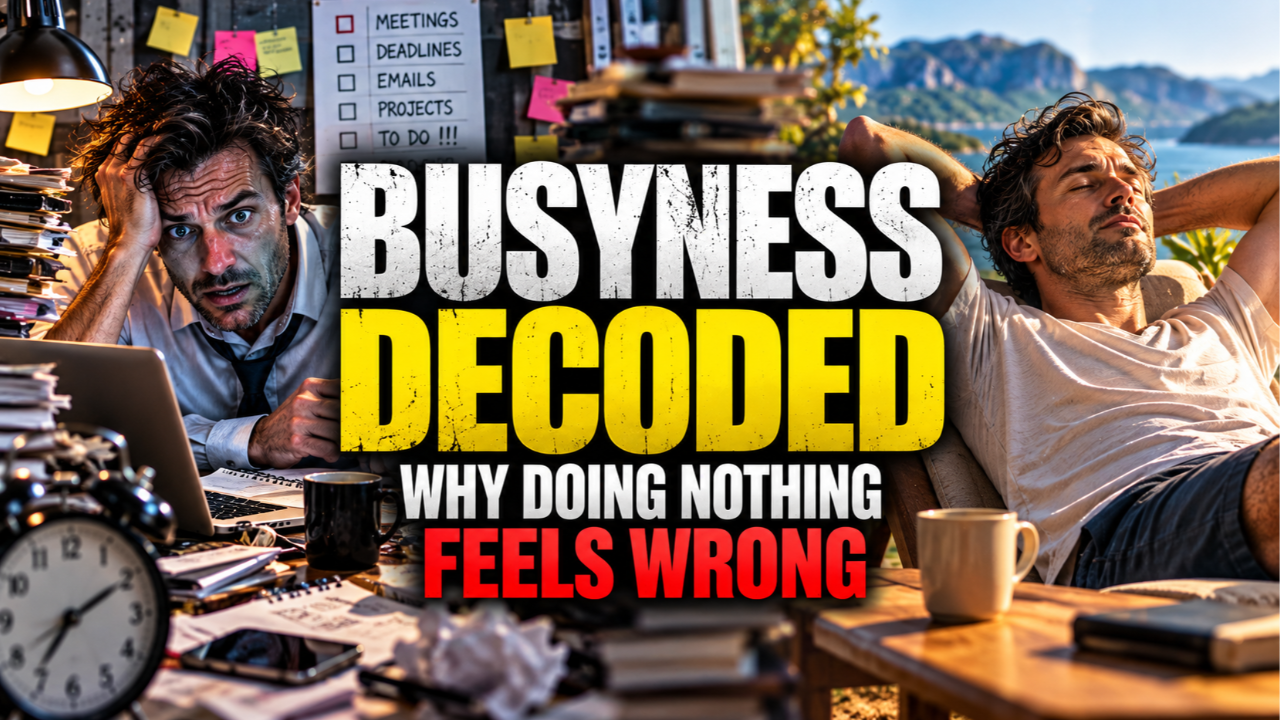
Busyness is rarely about how much there is to do. It is a piece of mental software that treats stillness as a problem and activity as the cure. Every finished task pays out a small hit of relief and approval, so your brain learns that being busy equals being safe and worthy. That is why you feel guilty doing nothing, even when the jobs are done and nobody is asking you for anything.
 It is half past three on a Sunday. Lunch is finished, the family has sunk into the sofa, and someone has put a film on. You sit down too, for about four minutes. Then you notice the crumbs on the worktop, so you wipe them. While you are up you empty the dishwasher and reply to a work email that could easily have waited until Monday. By the time you come back the film is half over and you have no idea who the man in the hat is. Somebody asks why you can't just sit down for five minutes, and you laugh, because you honestly don't know.
And it follows you everywhere. On holiday you are the one who has read every review of every restaurant within ten miles, who checks the work inbox by the pool to keep on top of things, and who feels oddly flat by day three. On a free evening you reorganise the spice rack. So, why does a perfectly capable adult find it so hard to do nothing for twenty minutes? And why does resting, the thing you claim to want most, leave you feeling like you have been caught bunking off school?
Want the full method for swapping constant forcing for effortless action? Get Effortless Action, Boundless Results: Living The Wisdom Of The Tao Te Ching on Amazon.
The Story You Tell Yourself About Being Busy
Ask a chronically busy person why they never stop and you will usually hear one of three answers. There is too much to do. Nobody else will do it properly. I'll relax once everything is finished. Each one sounds reasonable, and each one quietly assumes that the busyness is caused by the workload. Fix the list, the theory goes, and the rest will follow. It is a comforting story because it puts the problem outside you. The world is demanding, you are responsible, and the exhaustion is simply the price of being a grown-up who gets things done.
Here is the crack in that story. The list never ends, and deep down you know it never will. Finish the jobs and you invent new ones. Give a busy person a free afternoon and watch what happens. Within an hour they have found a shelf that needs putting up or a drawer that needs sorting. That is a person who cannot tolerate the gap between tasks. I know this one from the inside. In radio, silence is the cardinal sin. Three seconds of dead air and the alarms go off in the studio, and the boss is on the phone before the fourth. I spent years treating every quiet moment at home as dead air, and it took me far too long to realise that my living room was not a radio station.
The tell is in how you feel when you stop. You do not feel relaxed. You feel restless. There is a low hum of guilt, a sense that something somewhere is going undone, and a magnetic pull toward the laptop on the kitchen table. That hum is the clue that busyness is doing a job for you, and that job has very little to do with the tasks on your list.

Why Your Brain Would Rather Take an Electric Shock
There is a famous experiment that sums this up rather brutally. Researchers left people alone in a plain room for 15 minutes with nothing to do but think, and most of them found it unpleasant. Then they gave people a button that delivered a mild electric shock. Two thirds of the men and a quarter of the women chose to shock themselves rather than sit quietly with their own minds. You can read the summary of the disengaged mind experiment on PubMed. When I first heard about it, I laughed. Then I remembered the spice rack.
The reason is surprisingly simple. A brain left with nothing to do does not go quiet. It starts generating its own material, and for most of us that material is a mix of worry, regret, and unfinished business. Neuroscientists call the system that switches on when you are not focused on a task the default mode network, which is a fancy name for the part of your mind that wanders off toward everything you have been avoiding. Busyness is the fastest way to switch that channel off. Give the brain a job, any job, and it stops replaying the awkward conversation from Tuesday. So, stillness feels uncomfortable for a reason. It is the moment the background noise gets loud enough to hear.
There is a second layer. Humans dislike idleness so much that we invent reasons to stay in motion. In one neat piece of research, people given the choice between sitting and waiting or taking a longer walk to complete the same errand chose the walk as soon as they were handed a flimsy excuse, and they ended up happier for it. Psychologists call this idleness aversion, and you can read the abstract of this paper on the need for justifiable busyness. Your brain is rarely hunting for meaningful work. It is hunting for permission to keep moving, and a dusty skirting board will do nicely.
The Busyness Loop and the Dopamine of Ticking Boxes
Now add reward to the mix, because this is where a mild habit becomes a way of life. The cue is a flicker of discomfort, that hum of guilt or restlessness when things go quiet. The routine is finding something to do. The reward is the little rush of relief as the discomfort fades, topped up by the satisfaction of crossing something off. Dopamine, the brain chemical most people think of as pleasure, is far more about wanting and anticipation. It fires hardest while you are chasing the next tick, and much less once the job is finished. That is why a to-do list can work like a slot machine. There is always one more line, and the next one might be the one that finally makes you feel done.
Then comes the part that turns the loop into an identity. Somewhere along the way, usually early, you learnt that being useful made you lovable. The child who tidied up got praised. The teenager who worked weekends got called mature. The adult who stays late gets promoted. Slowly an equation formed in the background, and it says your worth equals your output. Once that equation is installed, rest stops being neutral and becomes evidence for the prosecution. Sitting down clashes with the story that you are a good, hard-working person, and that clash, which psychologists call cognitive dissonance, is so uncomfortable that the quickest fix is to get up again. A lot of it is about imagined judgement, the fear that someone will walk in, see you doing nothing, and file you under lazy. If that rings a bell, I wrote about why you should care less about other people's opinions, because that imaginary inspector has a lot to answer for.
Like any reward loop, it escalates. The amount of busyness that soothed you five years ago no longer touches the sides, so you add a side project, a committee, a fitness challenge, and a second phone. Busyness also works as a false rescue from stress. It feels like coping, because while you are moving you cannot feel how tired you are. But the tiredness does not go anywhere. It waits patiently, and it tends to collect its debt on the first day of the holiday.
If you recognise yourself in that loop, the way out is in the book. Grab a copy of Effortless Action, Boundless Results: Living The Wisdom Of The Tao Te Ching on Amazon and discover how the softest effort can carry you further than all that forcing ever did.
Why Holidays and Digital Detoxes Keep Failing
Most busy people know they should slow down, so they try. The first popular fix is the scheduled break. You book the spa day, the long weekend, or the yoga retreat. But the busy brain is clever, and it turns relaxation into another project. You research the best retreat, pack the perfect bag, and fret about whether you are relaxing correctly. You have not escaped the software. You have simply given it a new spreadsheet to fill in.
The second fix is going cold turkey. You delete the email app, announce a digital detox, and vow to do nothing for a fortnight. Then the restlessness builds, and because you have removed every outlet in one go, it bursts out somewhere else, and you catch yourself rearranging the cutlery drawer in the holiday cottage. And when the detox fails, the shame arrives. You tell yourself you cannot even relax properly, which becomes one more item on the list of things you are failing at. Shame is excellent fuel for busyness, because the quickest way to escape it is to go and be useful again.
Wu Wei and the Lie That Effort Equals Results
Here is the reframe that changed things for me. Around 2,500 years ago, the Chinese philosopher Lao Tzu described a principle called wu wei, usually translated as effortless action. Wu wei is no excuse to lie on the sofa for a decade. It is acting without forcing, the way water wears down stone without ever appearing to try. Water does not strain or push harder when it meets resistance. It flows around, waits, and fills the gap, and over time it carves canyons. That idea sits at the heart of Effortless Action, Boundless Results, my modern take on the Tao Te Ching, because it is the antidote to a culture that has confused motion with progress.
Your busy brain believes that effort equals results, so more effort must equal more results. Look honestly at your own life and you will see how often the opposite is true. The best ideas tend to turn up in the shower, on a walk, or just before sleep, precisely when you stopped grinding at them. And a life packed wall to wall with activity often contains very little you will remember. The nurses who sit with people at the end of their lives report that nobody wishes they had spent more time at work, which is one reason I keep coming back to the top five regrets of the dying. Stillness is where the important things finally get room to surface.
So, the shift is to stop treating rest as the prize you earn once the work is done, because the work is never done. Rest is part of the work, in the same way that the gaps between notes are part of the music. Once you see busyness as a piece of software running its program, rather than a moral virtue, you stop arguing with yourself about whether you deserve a sit-down. You simply notice the program running and decide whether to obey it.
The Ten-Minute Nothing: Your First Small Move
So, here is your first move, and it is deliberately small. Once a day, for 10 minutes, do nothing. That means no phone, no podcast, no book, and no tidying as you go. Sit in a chair, on the back step, or in the car before you walk into the house, and let your mind do whatever it wants. It will hate it at first. Within about ninety seconds you will feel the itch, a sudden urgent memory of a job that needs doing or a message you must answer. That itch is the cue in the loop, arriving right on time.
When it arrives, name it. Say to yourself, there's the software. Then rate the itch from one to ten and stay put. You are teaching your nervous system that nothing bad happens when the doing stops, and that lesson cannot be learnt by reading about it. Each time you sit through the itch without obeying it, the cue loses a little of its power. After a week or two, most people notice the itch arriving later and fading faster.

Then add one small act of rebellion. Each day, leave one unimportant job undone on purpose. The mug in the sink, the email that can wait until tomorrow, the windfall apples on the lawn. Notice the guilt, notice that the world keeps turning, and carry on with your evening. If you find the switch-off hard to reach on your own, my hypnosis session for decreasing stress is designed to help your nervous system close the stress cycle at a deeper level. And if the busyness is masking real exhaustion, you are struggling to sleep, or you feel overwhelmed most days, please speak to your doctor, and the NHS has a clear guide to getting help with stress.
The Question Nobody Asks About Busyness
Most people ask how to stop being busy all the time. It is a fair question, but there is a better one hiding underneath it. Who would you be if nothing needed doing? For many chronically busy people that question is frightening, because the busyness has quietly become the personality. Strip it away and they are not sure what is left.
But something is left, and it is usually rather good company. The person who can sit on a bench for twenty minutes and watch the light change on the water has lost none of their drive. They have simply stopped being run by it. So, what is the first job you would leave undone this week if you trusted that your worth did not depend on it? And what might you notice about your own life once you stopped running long enough to see it?
Ready to stop forcing and start flowing? Pick up your copy of Effortless Action, Boundless Results: Living The Wisdom Of The Tao Te Ching on Amazon today and give yourself permission to do less and live more.
"I used to clean the kitchen at eleven at night because sitting down felt like cheating. Ten minutes of nothing felt ridiculous for the first week. Now it is my favourite part of the day, I fall asleep faster, and my husband says I am far easier to be around." (Denise M., Boise, Idaho)
"I had not taken a vacation without my laptop in six years. This book showed me I was using work to avoid thinking about my marriage. We are talking properly again, and last July I spent a week at the lake with my phone in a drawer." (Marcus T., Raleigh, North Carolina)
"Effort equals results was basically my religion. I run a small business, and I now work fewer hours, take Friday afternoons slowly, and make better decisions. Best of all, my kids have stopped asking why I am always on my phone." (Lauren P., Des Moines, Iowa)
Frequently Asked Questions About Busyness
Why do I feel guilty when I rest?
Because your brain has linked your worth to your output. If being useful earned praise and safety earlier in life, rest starts to feel like breaking a rule. Sitting down then clashes with your belief that you are a good, hard-working person, and the quickest way to ease that discomfort is to get up and do something. The guilt is a learned signal rather than proof that you are doing anything wrong, and it fades when you repeatedly rest without obeying it.
Is constant busyness a sign of anxiety?
It can be. Many people use busyness to keep uncomfortable thoughts and feelings at bay, because a mind with a task has less room to worry. That is why stillness can feel so unsettling for busy people. Busyness on its own is a habit rather than a diagnosis, but if you feel constantly on edge, cannot switch off at night, or feel overwhelmed most days, it is worth speaking to your doctor about what might be going on underneath.
How do I stop being busy all the time?
Start small rather than going cold turkey. Spend 10 minutes a day doing nothing, with no phone or background noise, and when the urge to get up arrives, name it, rate it, and stay put. Leave one unimportant task undone each day on purpose. These small reps teach your nervous system that stillness is safe, so the pull toward constant activity weakens gradually instead of bursting out somewhere else.
About the Author
 Craig Beck spent 25 years behind a microphone in UK broadcasting, where he learnt that the most persuasive voice in any room is usually the calmest one. He is a certified NLP Master Practitioner, a hypnotherapist, and the author of more than 100 books on human behaviour, habit, and persuasion, from the bestselling Alcohol Lied to Me to the Decoded range of psychological profiles. His approach treats behaviour as software rather than a character flaw, which means nobody is broken and everybody can be updated. To find out more about the man behind these breakdowns, visit About Craig Beck.
Last updated 9 October 2026