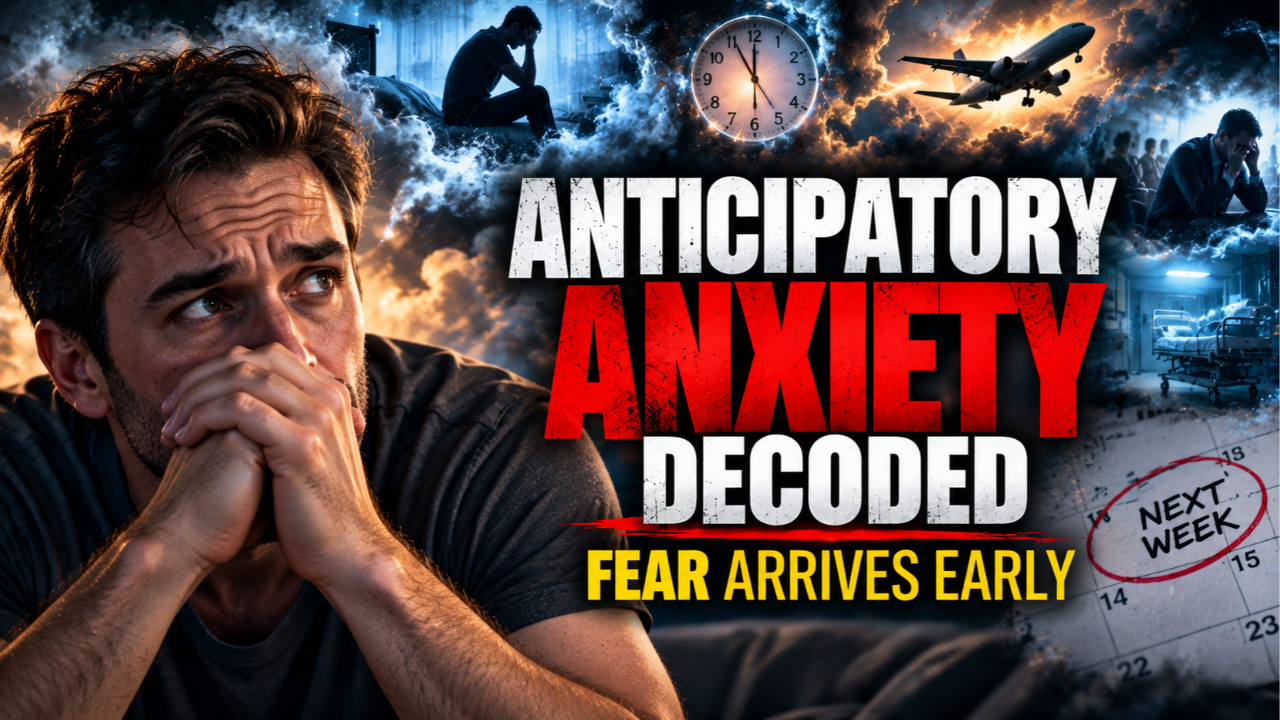
Anticipatory Anxiety Decoded: Why Your Brain Rehearses Disaster
Oct 02, 2026Anticipatory Anxiety Decoded
Anticipatory anxiety is not a character flaw or proof you are broken. It is prediction software firing too early, rehearsing threat before anything has happened. Your nervous system treats an imagined future as if it were already in the room, which is why the chest tightens on a quiet Friday afternoon while the weekend is still empty. Once you see that machinery, the dread stops looking like destiny and starts looking like code you can rewrite.
You know the feeling. Nothing has gone wrong yet. The email has not arrived. The conversation has not happened. Monday is still two sleeps away. And still your mind runs the disaster movie in full colour. Most people call that overthinking. I call it early invoicing: your brain is trying to charge you for a problem that has not been delivered.
Want the full method for dismantling that fear software? Get Anxiety Lied To Me on Amazon.
What Anticipatory Anxiety Is Really Doing in Your Brain
Your brain is a prediction machine first and a truth machine second. It would rather guess wrong early than be surprised late. That design kept your ancestors alive when the bushes moved.
Anticipatory anxiety is the forecast turning into weather inside your body. Heart rate climbs. Shoulders lock. Attention narrows. Thorough preparation gathers facts and chooses one next move. Anxious rehearsal collects imagined scenes and pays for them with cortisol.
Research on uncertainty and threat anticipation shows how the anxious brain stays locked onto what might go wrong, even when the present is safe. See the NIH archive on uncertainty and anticipation in anxiety.
IMAGE1
The Lie That Makes Future Fear Feel Useful
The surface story is flattering. If I worry enough, I will be ready. If I scan every angle, I will not be blindsided. But after three hours of disaster cinema, are you clearer and more capable, or fogged and still no nearer a decision? Anticipatory anxiety rarely improves the plan. It improves the feeling that you are doing something while the real something waits.
This is why willpower lectures fail. You cannot white-knuckle a prediction system into silence by calling yourself dramatic. Shame is rocket fuel for the next loop. You are running software that mistakes rehearsal for protection. If anger is your preferred false rescue, see Anger Decoded. Different costume. Same nervous system trying to regain control.
How Prediction Turns Into a Full Body Alarm
Your brain does not wait for the tiger. It fires when cues suggest the tiger might be near: calendar invites, a partner’s tone, silence in a group chat, or “quick call” in an email subject. Predictors recruit the body. The body then becomes evidence that the fear must be real.
That circular proof is the trap. Sensation becomes story. Story intensifies sensation. The NHS guidance on generalised anxiety describes how worry can become persistent and hard to control.
Friday dread is a cue stack. Weekend means unstructured time; less distraction gives the prediction engine a bigger stage. For some people that stage plays alcohol. For others it plays sugar, scrolling, or sharp words. For many it plays worry.
IMAGE2
Why willpower loses against a future that has not happened
Willpower is a short override, not a lifelong policy against a nervous system that believes rehearsal keeps you safe. People who look calm have built a different first response. They notice the forecast, refuse to treat it as a court summons, and put a concrete move between prediction and spiral.
The American Psychological Association overview of anxiety treats it as a real, patterned response, not a moral failure. Toughness without a redesign is just louder arguing with an alarm that thinks it is doing its job.
The Escalation Nobody Notices Until Sleep Goes
Left alone, anticipatory anxiety expands its territory. Concern before a presentation becomes concern before ordinary emails, then concern about having concern. Intelligence builds better disaster scripts; it does not automatically uninstall them.
Fear of success can sit under the same roof. See Fear of Success. When the ego will not shut up, Higher Self Decoded is the adjacent conversation.
Prefer the complete walkthrough of fear technology? Grab Anxiety Lied To Me on Amazon.
IMAGE3
Why Your Usual Fixes Were Doomed
Positive affirmations shouted over a body expecting catastrophe are noise. Distraction works until 11pm. Avoidance works until the postponed thing arrives with interest. Researching every worst case feels like preparation and functions like fertiliser.
These fixes fail like dry January fails for a cue-routine-reward drinker: they attack the output after prediction fires, leaving cues, meaning, and identity intact.
The Reframe That Simplifies Everything
You are not weak. You are running early-threat software. Anticipatory anxiety is a weather report written by a nervous system that overvalues false alarms and undervalues clear skies. Your job is to stop treating the report as an order.
Ask, “What cue fired, what future scene am I rehearsing, and what reward am I chasing?” Most people discover the reward is a brief sense of control, the feeling of gripping the steering wheel while the car is still in the driveway.
Name the cue. Write the feared scene in one sentence, then write the evidence that exists today. Put your feet on the floor. Use cold water on your wrists. Send one message to a safe person. Walk for ten minutes. Prediction updates through evidence: evidence comes from what you do when the alarm fires.
IMAGE4
Your First Concrete Move Today
Pick one cue: the calendar alert, the silence after a message, or the Friday drop in the stomach. Decide one first move that is almost insultingly small. Put the phone in another room, change rooms before the mental cinema starts, or write one dump sentence and one evidence sentence at bedtime.
Anxiety spikes often crest and fall when they are not fed with more scanning. You do not need to feel heroic. Stay curious long enough to see wanting-for-certainty pass without being obeyed.
If anxiety is severe, persistent, or coming with panic that frightens you, speak to a doctor or qualified professional. A book is a companion for understanding, not a substitute for medical care.
The Question Nobody Asks When the Dread Arrives
Most people ask, “Why can’t I stop worrying?” The better question is, “What did my brain learn to expect from this cue?” Once you inspect it, the dread can still show up, but it stops owning the room.
If you want the full decoding of how anxiety lied its way into your operating system, get Anxiety Lied To Me on Amazon today.
"I used to spend whole weekends paying for Mondays that had not happened yet. Seeing anticipatory anxiety as software gave me my evenings back.", Danielle M., Portland, Oregon
"Craig’s breakdown made me feel sharp again instead of broken. The dread still knocks. It no longer gets the keys.", Tyler J., Charlotte, North Carolina
"I stopped calling worry ‘being responsible’. That one reframe changed how I meet every calendar alert.", Alicia K., Minneapolis, Minnesota
About the Author
 Craig Beck is a former UK broadcaster, certified NLP Master Practitioner, and human behaviour author of more than one hundred books. He writes the Decoded series to take everyday mental traps apart in plain English. Learn more at craigbeck.com/about or explore coaching at craigbeck.com/coaching.
Last updated: 2 October 2026
FAQ
What is anticipatory anxiety in plain English?
It is your brain treating a possible future threat as if it were already happening. Naming the cue and changing your first sixty seconds after it is often more useful than arguing with the feeling.
Why does my anxiety spike before weekends or Monday?
Those hours are cue-rich. Less structure and more mental free space let the prediction engine fill the gap with rehearsal. Change the first move when the Friday drop arrives.
Is anticipatory anxiety the same as generalised anxiety disorder?
Not automatically. Anticipatory anxiety describes early threat prediction; generalised anxiety disorder is a clinical label diagnosed by a professional. If anxiety disrupts sleep, work, or daily life, get medical advice.