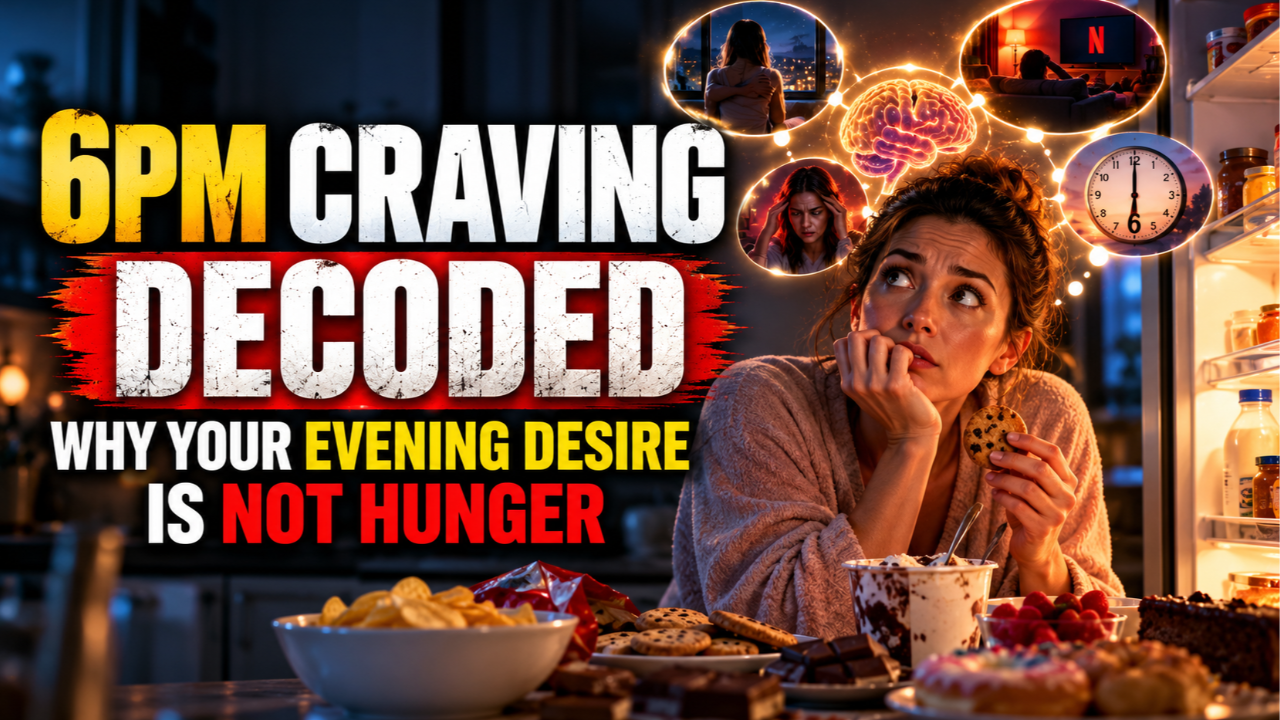
6pm Craving Decoded: Why Your Evening Desire Is Not Hunger
Oct 02, 2026Why Your Evening Desire Is Not Hunger
The 6pm craving is not hunger, weakness, or a mysterious personality flaw. It is a timed reward prediction running in your nervous system. Between late afternoon and the first quiet hour of evening, your brain fires a cue-routine-reward loop that feels like a personal need. Once you see the machinery, the craving stops looking like character and starts looking like software you can rewrite.
 You know the moment. The day is still stuck to your clothes. Your shoulders have not dropped. Somewhere between the school run, the inbox, and the silence that arrives when the house finally exhales, a familiar itch shows up. Not dramatic. Not theatrical. Just a quiet insistence that something is missing and that something has a habit of looking like a pour, a scroll, a snack, or a cigarette of attention you will regret an hour later.
Most people call that moment willpower failure. I call it a schedule. Your brain has learned that this hour is when relief is supposed to arrive, and it will keep sending the invoice until you stop paying it.
Want the full method laid out simply, without jargon and without a pep talk? Get Alcohol Decoded on Amazon.
What Your Brain Thinks 6pm Means
Your brain is a prediction machine, not a moral referee. It builds a map of when tension usually peaks and which move usually lowers that tension fastest. For a huge number of adults, that map has a bright pin at early evening. Work ends. Roles switch. The body is tired. The mind is still spinning. The environment offers a familiar exit.
That exit does not need to be a drink to teach the same lesson. The behaviour can be the fridge door, the phone, the sharp comment, the online cart. The psychology is identical. A cue arrives. A routine fires. A short reward lands. The loop invites itself back tomorrow with better timing and less debate.
If you have ever said, "I just need something to take the edge off," you were not describing a character trait. You were quoting the script the loop wrote for you. And that script gets louder when life gets quieter, which is why the craving often feels strongest in the first peaceful hour of the day rather than in the chaos.
The Lie That Keeps the Loop Alive
The surface story is simple and flattering. You tell yourself you earned this. You tell yourself you are decompressing. You tell yourself one small escape is the adult way to cope. That story is not stupid. It is efficient. It turns a neurological habit into a virtue so you need not inspect the machinery.
Here is the crack in that story. If the evening move truly restored you, you would feel clearer an hour later. Instead, many people feel flatter, more restless, or oddly unfinished. The short reward arrives. The longer bill follows. Then tomorrow's cue arrives right on time, selling the same rescue package again.
This is why fighting the craving with shame rarely works. Shame is fuel. It makes the next escape feel more justified. The behaviour is not proof you are broken. It is proof the reward system is doing the job it was trained to do.
How Reward Prediction Turns Into Desire
Desire is often less about liking and more about wanting. Wanting is the brain's forecast that a hit is coming, a pattern that tracks with how NIH describes reward circuitry and cue-triggered wanting. When the clock, the kitchen light, the sofa, or the sound of keys in a bowl all co-occur with relief often enough, those cues start firing the wanting before you have consciously decided anything.
That is why the craving can feel physical. Your mouth, chest, or hands respond as if the outcome is already underway. You are not imagining it. Prediction can recruit the body. The uncomfortable truth is that a large part of what you call "needing" is rehearsed anticipation wearing a costume called need.
Once you grasp that, the evening stops looking mysterious. It looks mechanical. And mechanical things can be interrupted without a personality transplant. For a deeper look at how anxiety stories hitch a ride on the same machinery, see Anxiety Lied to Me.

Why Willpower Loses at Dinner Time
Willpower is a short override. Useful for not stepping into traffic. Terrible as a nightly lifestyle plan. Even mainstream guidance on APA willpower and self-control treats it as a limited resource, not a moral infinite tank. By 6pm you have already spent a day making decisions, managing people, and suppressing impulses that felt smaller than this one. Asking the override system to win the hardest round after a full shift is like asking a phone on 8 percent battery to run a marathon.
So the loop waits. It is patient. It knows fatigue narrows your options. It knows the story about deserving a break is waiting in the wings. When you white-knuckle through Monday and collapse on Wednesday, you do not prove you lack discipline. You prove the design was wrong.
People who look "strong" from the outside are often just living inside a better design. They removed the easy path to the old routine. They put a different first move within arm's reach. They stopped treating character as the only tool in the drawer.
The Escalation Nobody Notices
Left alone, the evening craving rarely stays polite. It expands. What began as a treat after a hard day becomes the marker that the day is over. Then it becomes the condition for relaxing at all. Identity starts to wrap around it. You become "someone who needs this to switch off." That sentence feels descriptive. It is actually a contract.
Identity is sticky. Once the behaviour is part of who you think you are, quitting feels like exile rather than upgrade. That is why clever people stay stuck longer than they expect. Intelligence helps you build better excuses. It does not automatically dismantle a cue-routine-reward loop.
If this is ringing bells around alcohol specifically, the same decoding lens sits under Alcohol Decoded and the sleepless rebound pattern in Can't Sleep After Quitting Drinking. The brand of escape changes. The software rhyme stays familiar.
Prefer the complete walkthrough in your hands tonight? Grab Alcohol Decoded on Amazon and follow the method end to end.

Why Your Usual Fixes Were Doomed
Moderation rules, dry weeks, and motivational speeches fail for the same reason. They attack the behaviour after the prediction has already fired. They leave the cues intact. They leave the identity intact. They leave the reward story intact. Then they blame you when the old sequence wins.
Counting units while the kitchen still cues the pour is like putting a lock on a door you keep unlocking for comfort. Affirmations shouted over a nervous system that expects relief at 18:05 are noise. The loop does not care how sincere you sounded in the morning.
Failed fixes are useful data. They tell you the fight was aimed at the wrong layer. You were arguing with the output. The training lives in the cue, the first micro-move, and the meaning you attach to relief.
The Reframe That Simplifies Everything
Here is the simplified Decoded frame I want stuck to your fridge. You are not weak. You are running a trained prediction. The craving is a weather report, not a command. Your job is not to hate the weather. Your job is to change what happens when the sky looks like that.
Stop asking, "How do I want this less?" Ask, "What fires at 6pm, what do I usually do in the next sixty seconds, and what reward am I actually chasing?" Most people discover the reward is not the thing in the glass or on the screen. The reward is the brief sense of having pressed pause on being responsible.
Once you see that, you can offer your nervous system a cleaner pause. Not a lecture. A replacement first move that delivers a slice of the same state without rebuilding the trap. Walk the block. Cold water on the wrists. Sit without a device for ten minutes. Text one honest sentence to someone safe. The content matters less than interrupting the automatic routine before it completes.
This is also where identity gets rewritten in small evidence. You do not wait to feel like a different person. You collect proof that you are someone who can meet the 6pm cue without paying the old invoice. One clean evening is not a personality overhaul. It is a data point. Stack enough of them and the prediction updates.
Your First Concrete Move Tonight
Do not redesign your whole life before dinner. That is how people stay stuck in planning. Pick one cue you can name. The time. The room. The feeling in your jaw. Then decide one first move that is almost insultingly small and place it in the path of the old routine.
If the fridge is the cue, put a glass and water bottle where your hand usually goes. If the sofa is the cue, put your trainers by it. If the phone is the cue, charge it in another room for the first twenty minutes after you get in. You are not becoming a monk. You are adding friction to the old path and removing friction from a better first action.
Then watch what happens without drama. Cravings often peak and fall within a short window when they are not fed, which fits how the NHS frames practical ways of cutting down alcohol by changing routines rather than relying on heroics alone. That falling sensation is the loop losing its argument. You do not need to feel heroic. You need to stay curious long enough to see the wanting pass without being obeyed.
If alcohol is part of your evening pattern and you feel unwell when you change it, speak to a doctor or qualified professional. A book is a companion for understanding, not a substitute for medical care.
The Question Nobody Asks at Six
Most people ask, "Why can't I stop?" The better question is, "What did my brain learn to expect at this hour, and who benefits from me never inspecting that lesson?" Once you inspect it, the craving can still show up. A trick you have seen performed can still be staged in front of you. It just stops owning the room.
You can keep treating 6pm like a verdict on your character. Or you can treat it like a decoded appointment with a piece of old software. One of those stories keeps you negotiating. The other gives you a choice that feels like escape rather than sacrifice.
If you want the full decoding of how alcohol hijacks that evening machinery, and how to dismantle the desire itself rather than wrestle it forever, get Alcohol Decoded on Amazon today.
"I finally understood why 6pm owned me. Once I saw the loop, the night stopped feeling like a fight I was destined to lose.", Jenna R., Austin, Texas
"Craig's way of explaining craving made me feel intelligent again instead of ashamed. My evenings are quieter in the best way.", Marcus T., Columbus, Ohio
"I used to think I needed more discipline. Turns out I needed a clearer map. This breakdown gave me that map.", Priya S., Denver, Colorado
About the Author
 Craig Beck is a former UK broadcaster, NLP Master Practitioner, and human behaviour author of more than one hundred books. He writes the Decoded series to take everyday traps apart in plain English, from craving and anger to confidence and identity. His work sits at the crossing of persuasion psychology, lived experience, and practical self-help for adults who are done with motivational noise. Learn more at craigbeck.com/about or explore coaching at craigbeck.com/coaching.
Last updated: 2 October 2026
FAQ
Why does my craving always hit around 6pm?
Because your brain has linked that hour with relief. Clock time, home cues, fatigue, and role-switching all become predictors. The wanting arrives before a conscious decision. Change the first sixty seconds after the cue and the prediction starts to update.
Is the 6pm craving a sign I am an alcoholic?
Not by itself. A timed craving shows conditioning, not a diagnosis. Alcohol can ride that loop, and so can food, screens, or sharp mood shifts. If drinking is involved and you are worried about your health, get medical advice. Understanding the loop still helps either way.
What is the simplest first step tonight?
Name the cue, delay the old routine by ten minutes, and install one easier first move in the same place the habit usually starts. Keep it small enough that pride is irrelevant. You are collecting evidence, not performing heroism.