Can't Sleep After Quitting Drinking? The Real Reason | Craig Beck
Sep 28, 2026Why You Can't Sleep After Quitting Drinking (And How to Fix It)
You can't sleep after quitting drinking because alcohol never gave you sleep in the first place. It gave you sedation, and your brain spent years turning up its own alerting chemistry to fight it. Remove the sedative and that alerting system keeps firing at full volume for a week or two, which is why you lie wired at 2am, damp with sweat, wondering whether you were better off drinking. You weren't. This is repair, not damage. It passes, and there are ways to shorten it.
 Day four. You did the hard part, you got through the evening without pouring anything, you even felt a bit smug loading the dishwasher with nothing but glasses of water in it. Then you went to bed at 11 and here you are at 1.47am, staring at the crack in the ceiling, heart going like somebody is knocking on a door inside your chest. Your legs won't settle. Your mind is replaying a conversation from 2014. And a voice that sounds very much like your own is pointing out, quite reasonably, that you slept fine when you drank.
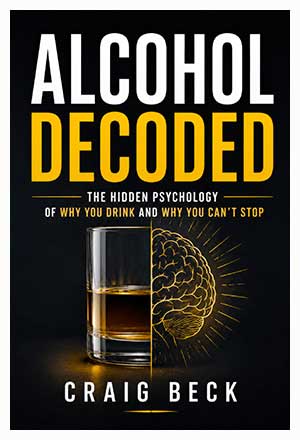
That voice is about to lose the argument, but it needs to be answered properly rather than shouted down. So, this article does two things. It shows you what is happening inside your skull on a sober night, and it gives you the one change that shortens the misery. Everything here is the summary. The whole mechanism, from the 6pm craving to the 3am ceiling, is taken apart chapter by chapter in my book Alcohol Decoded: The Hidden Psychology of Why You Drink and Why You Can't Stop. If you would rather have the full map than the postcard, it is waiting on Amazon.
The Story You Tell Yourself at 2am
Here is what you currently believe, and it deserves a fair hearing because it sounds like common sense. Alcohol relaxes you. A couple of glasses take the edge off, you drift away within minutes of your head touching the pillow, and you sleep through until the alarm. Now you have stopped and suddenly you are a wreck at 3am. Cause, effect. The drink was helping you sleep and taking it away has broken something. The story even comes with a witness. Your partner will confirm you were out cold by 11.15 most nights, snoring like a walrus. It is not a stupid story. It is built on a word that has been mistranslated. The word is sleep, and you haven't been doing it.
If alcohol was giving you good sleep, explain the mornings. Explain waking with a mouth like a car park and a low hum of dread before you have remembered anything to dread about. Explain the two coffees needed to feel human, the nodding off in a 3pm meeting on eight hours of supposed rest, the face in the mirror ten years older than your passport. People who sleep well don't wake up feeling like they have been in a fight. You did, most days, and you blamed your age, your job, the neighbour's dog, anything except the one thing you swallowed every night. And if your fourth sober night feels exactly like the 3am of a drinking night, only earlier and for longer, then the drink was never preventing that wakefulness. It was postponing it and serving it back with interest. You were never sleeping. You were sedated, and then you were in withdrawal, every single night. The sober week didn't invent the problem. It removed the anaesthetic that had been hiding it.
What Quitting Drinking Does to Your Brain in Week One
Your brain runs on two opposing signals, one that calms and one that alerts, and it works hard to keep them balanced. Alcohol turns the calming signal up and mutes the alerting one, which is why the second glass feels like a warm hand on the back of your neck. But a brain is a stubborn thing. When it notices the calming signal being boosted every evening, it compensates by pulling its own calming equipment back and building extra alerting equipment, so that the same dose produces less peace. This is tolerance, and it is also why quitting is so noisy. Stop drinking and you are left with a brain that has too little brake and too much horn, waiting for a sedative that no longer arrives.
The alerting system doesn't know the pub has shut. Think of a nightclub bouncer who has been told, every night for a decade, to expect trouble at 11pm. One quiet Tuesday, no trouble comes. He doesn't go home. He stands there, coiled, scanning the empty street, because that is what he has been trained to do. That bouncer is your nervous system on night four, and the reason your heart is drumming while you lie perfectly still. Researchers find insomnia in somewhere between 36 and 91 percent of people with a drinking problem, against about 10 percent of everyone else, and it shows up at every stage, while drinking, during withdrawal and well into recovery.
The dream backlog
Then there are the dreams. Alcohol flattens the dreaming stage of sleep, the part where your mind files the day and takes the emotional sting out of it. Your brain keeps a tally of what it is owed, and when the alcohol goes it collects all at once. Imagine a postal strike ending and three weeks of letters landing on the mat in a single morning. That is the first fortnight sober: lurid, cinematic, exhausting dreams, night sweats, waking at 4am not sure which country you are in. Around a third of people in early recovery report dreaming that they drank, and the dreams fade as the months pass. The vividness is not a sign that something is wrong. It is the sound of a backlog being cleared.
Two more things have been quietly sabotaged. Alcohol suppresses melatonin, the hormone that tells your body it is night, and it flattens the daily rise and fall of core temperature that sleep depends on. So, in week one you have a brain on high alert, a dream system working double shifts, and a body clock that has forgotten what time it is. Nobody sleeps well through that. Nobody is supposed to.
I earned one confession here, so here it is. On my fifth sober night in 2009 I had a dream so ordinary it was terrifying. I was in my own kitchen, pouring a glass of red, and I felt the relief of it. I woke at 3.20am in soaked sheets, certain I had relapsed, and went downstairs to check the recycling for a bottle. There wasn't one. I stood in the kitchen in my pants feeling like a lunatic, and a small part of me thought, if this is what sober feels like, I'm not sure I want it. That night was the worst of them. It was also the last one that bad.
Why the Nightcap Was Never Helping You Sleep
Let me deal with the myth directly, because it is the one thing standing between you and the other side. Alcohol gets you to sleep faster. That part is true, and it is the whole reason the lie has survived since the Romans. What it cannot do is keep you there in any useful form. As the alcohol clears, usually four or five hours in, sleep gets lighter and more broken, you surface repeatedly, and the second half of the night becomes a patchwork of half-waking and thin, restless dreaming. Sleep scientists who wire drinkers up in a lab see the same shape every time. Fast to drop off, then wreckage after 3am.
So, the nightcap buys you a quick exit from consciousness and charges you the restorative half of the night, the half you can't see and therefore never miss. You wake flat and wired at the same time, and by early evening that tiredness is loud enough to need soothing. Guess what soothes it. The exhaustion the wine created overnight becomes the reason to open the wine again, and the loop is sealed. I wrote about the front end of that loop in why you can't stop drinking, and the short version is that alcohol sells relief from a problem it manufactures.
Want the whole mechanism rather than the summary? Alcohol Decoded is on Amazon in paperback, Kindle and audiobook, and the audiobook is read by me, which is either a selling point or a warning depending on your taste in accents.
The Skill You Deleted Without Noticing
This is the part no article on sober insomnia ever mentions, and it changed the way I thought about my own nights. Falling asleep is a skill. It is a learned transition from doing to not doing, a small daily act of letting go that every child must work out for themselves, usually with a parent in the doorway losing patience. You had that skill once. Then, somewhere in your twenties, you handed it to a chemical. For 10 or 15 or 20 years you have not fallen asleep a single time. You have been switched off, which is a different verb, and the muscle that does the falling has sat idle the entire time.
Picture a pilot who has flown thousands of hours, every one of them on autopilot. One day the system fails and she must land the plane by hand. She is not a bad pilot. She is an out-of-practice one, and the first few landings will be ugly. That is you on a sober pillow. The sensation of lying in the dark, awake, with nothing in your bloodstream to do the job for you, is not a symptom of a broken sleeper. It is the feeling of a skill being relearned, and relearning is always clumsy before it is smooth. Every sober night you get through, however badly, is a landing. They improve. They cannot improve if the autopilot keeps getting switched back on.
Why Trying Harder to Sleep Makes It Worse
Here is the cruel bit of psychology that turns a rough fortnight into a rough year for some people. Sleep is one of the very few things a human cannot do on purpose. You can decide to run, to eat, to phone your mother. You cannot decide to be asleep, any more than you can decide to sneeze. Sleep can only be allowed, and the moment you start trying to make it happen you are doing the one thing that guarantees it won't. Effort is arousal. Checking the clock is arousal. Calculating how many hours you will get if you drop off right now is arousal with a spreadsheet attached.
Your bed makes it worse, and this is pure conditioning. If you spend an hour a night lying there frustrated, your brain quietly pairs the mattress with frustration, the same way it paired the sound of a cork with relief. After a couple of weeks you can be yawning on the sofa and wide awake the second your head hits the pillow, because the bed has become the place where the fight happens. I wrote about how these automatic pairings get built in why your brain reaches for the glass before you have decided to, and the same machinery is now working the night shift against you.
And there is the story. Somewhere around night six you say it out loud for the first time. I'm just a bad sleeper. It sounds like a description, but it behaves like an instruction. A person who believes they can't sleep unaided will reach for aid, and the aid that worked fastest for 20 years is in the fridge. That sentence, more than any craving, turns a fortnight of repair back into a decade of sedation.
The Fixes That Fail Before You Try Them
You have probably tried a few of these already. The first is the small one. Just a glass to help me drop off, not a session, only on work nights. It works, in the sense that you will be unconscious by 11.30. It also resets the bouncer, restores the dream debt, and hands you back the 3am wreckage you were trying to escape, with the added bonus of a reason to feel like a failure. One nightcap is not a compromise. It is the whole habit wearing a small hat. The reasons every moderation deal collapses inside nine days are laid out in how to quit drinking without white-knuckling it, and they apply with extra force at bedtime.
Then there is the lie-in. You slept badly, so you stay in bed until 10 on Saturday to catch up, or you nap on the sofa at 4pm. Both feel like kindness and both drain the pressure your body needs to sleep the following night. Sleepiness is a debt that builds through waking hours, and every hour spent horizontal in daylight is a payment you won't have at midnight. The sleep tracker is another trap. Waking to a screen that scores last night at 54 percent is a fine way to start the day anxious about tonight, and anxiety about sleep is the raw material of insomnia. As for the teas, the special pillows and the rain-noise apps, they are aimed at the wrong target. The problem was never the bedroom. It is a nervous system braced for a fight, and no pillow on earth can talk it down.
What Changes When You Stop Treating the Night as a Test
The shift that ends this is not a technique. It is a reframe, and it goes like this. A rough night in early sobriety is not evidence that sobriety is failing. It is evidence that sobriety is working. The sweats are the bill being settled. The dreams are the filing being done. The 2am wakefulness is the bouncer slowly learning that the trouble is not coming. None of it is damage, and the moment you file it correctly the panic drains out of it, and panic was doing most of the harm. A person lying awake thinking "this is the repair" is in a different body from a person lying awake thinking "I've broken myself."
There is a reason this matters beyond comfort. Poor sleep is one of the strongest predictors of relapse in the first months, stronger in some studies than age, job, marriage or how heavily a person drank. Tiredness itself is bearable. The danger is that an exhausted mind goes looking for the fastest known route to unconsciousness, and it knows exactly where that route is. So, the argument at 2am is the whole war in miniature. Win it by reframing it and the rest of sobriety gets a great deal easier. Lose it by treating a night of repair as proof you are broken, and you hand the fridge its opening.
And this tiredness has a finish line, which the grey drinker's version never did. Most people find the first real improvement in the second or third week, and by the end of the first month the nights are better than anything they had while drinking. Some deeper measures take a few months to settle. But the mornings arrive first, and the mornings are the prize nobody warned you about. Waking without a dry mouth or a flicker of dread, with the day in front of you rather than on top of you, is worth more than anything the drink was pretending to give you.
The First Move You Can Make Tonight
Pick a wake time and keep it seven days a week, no matter how badly the night went. Not a bedtime, a wake time. This is the single lever that rebuilds the body clock alcohol flattened, and it works because it is the one part of sleep you can control. Go to bed only when you are sleepy, not when the clock says so. If you are awake in bed for what feels like 20 minutes, get up, go to another room, sit in low light with something dull, and return only when your eyes are heavy. It feels counterproductive and it is the opposite. You are teaching the bed to mean sleep again, and refusing to give your brain an hour of practice at lying awake.
Get outside within an hour of waking, even if it is grey. Daylight on the eyes is the loudest signal your body clock has, and it needs the volume up right now. Turn the tracker off for a month. And when you wake at 3am, which you will, say the new sentence before the old one gets there. This is the repair. Then do nothing. Don't fight it, don't count it, don't calculate. The NHS has a plain guide to what helps and what doesn't with insomnia, and none of it involves a bottle. One caveat, because I promised never to sell you a fairytale: if you have been drinking heavily every day, stopping abruptly can be physically dangerous, so speak to your doctor before you begin. The book and this article sit alongside that, never in place of it.
"I quit on a Sunday and by Thursday I was convinced I'd made a huge mistake. Reading the chapter on sleep at 4am, sweating, is what kept me from the fridge. Week three I slept through for the first time since college." Melissa R., Grand Rapids, Michigan
"Nine months sober. I used to wake at 3 every single morning and thought that was just me. It wasn't me. It was the wine. I get up before my alarm now and go running, which my wife still finds suspicious." Daniel K., Tucson, Arizona
"The idea that I'd deleted the skill of falling asleep rather than lost the ability changed everything. I stopped panicking about the bad nights and they stopped within a fortnight. Best I've felt in twenty years." Karen L., Asheville, North Carolina
If tonight is going to be the fourth night in a row and you want more than a single article to get you through it, grab Alcohol Decoded on Amazon and read the sleep chapter before bed. It is the one I wish somebody had handed me in 2009, at 3.20am, standing in my kitchen looking for a bottle that wasn't there.
The Question Nobody Asks About Sober Sleep
There is one question that the people who make it through this fortnight all end up asking, and it has nothing to do with sleep. It arrives somewhere around week three, on the first morning you wake rested, and it goes like this. If that is what a night is supposed to feel like, what else have I been calling normal? The greyness you blamed on age. The short fuse you blamed on work. The low hum of unease that you decided was just your temperament. You are about to find out how much of your personality was made of poor sleep, and I can't tell you what the answer will be. I can only tell you that mine was not the one I expected.

About the Author
 Craig Beck is a former broadcaster who spent two decades drinking two bottles of wine a night and a further fifteen working out why. He is now regarded as the world's leading authority on persuasion and human behaviour, a certified NLP Master Practitioner, and the author of more than a hundred books, including the Decoded series. Over a million readers have used his work to understand what is driving their decisions from below the waterline. He has no interest in teaching you theory. He wants to show you how the wiring works, and where the loose connection is.
Last updated 28 September 2026
FAQ SECTION:
Frequently Asked Questions
How long does insomnia last after quitting drinking?
For most people the worst nights are in the first one to two weeks, when the brain's alerting system is still firing at full strength and the dreaming stage of sleep is catching up on years of suppression. Noticeable improvement usually comes in the second or third week, and by the end of the first month most people sleep better than they ever did while drinking. Some deeper measures of sleep quality keep improving for months. If you drank heavily every day, speak to a doctor before stopping.
Why do I wake up at 3am after I stop drinking?
Your brain spent years building extra alerting chemistry to counter the sedative effect of alcohol. When the alcohol is gone, that chemistry keeps firing on schedule, which lands you wide awake in the small hours with a racing heart and a restless mind. It is the same rebound that woke you at 3am on drinking nights, only now it is uncovered rather than delayed. It is a sign of repair, and it fades as the nervous system learns that the sedative is not coming back.
Is it safe to have one drink to help me sleep?
It will get you unconscious faster, but it will also reset the whole cycle. Alcohol fragments the second half of the night, suppresses the dreaming stage your mind needs, and restores the rebound that wakes you at 3am. It also keeps the bed paired with sedation rather than sleep, so the skill of dropping off unaided never gets practised. A single nightcap is the entire habit in miniature. The better move is a fixed wake time, morning daylight, and getting out of bed when you can't sleep rather than lying there fighting it.