

Sunday Dread Decoded: Why Your Stomach Drops Before Monday
Oct 17, 2026Sunday Dread Decoded: Why Your Stomach Drops Before Monday
Sunday dread is your brain starting Monday early. Around mid-afternoon on Sunday, the part of you that scans for threats begins rehearsing the week ahead, and your body answers with the stomach drop, the tight chest and the restless scroll. It isn't weakness or laziness. It is a learned weekly alarm, and it is often an honest signal about how you feel about the life waiting for you on Monday morning.
 It starts at about four o'clock. The light goes a bit grey, somebody asks what's for tea, and the theme tune of a Sunday evening programme drifts out of the telly like a countdown clock. Your stomach drops a floor. Nothing has happened. You are on the sofa in your joggers with a brew, and yet part of you has already left the house, sat through the Monday meeting and opened two hundred unread emails.
So, you do what everyone does. You check the work inbox to get ahead and instantly wish you hadn't. You scroll the news, then the group chat, then a stranger's kitchen renovation, anything to stop the clock. You stay up far too late, bargaining with the weekend for one more episode, then lie in the dark doing sums about how much sleep you'll get if you drop off right now. Why does a day off end up feeling like a waiting room? And why does the dread arrive a good seventeen hours before the thing you're dreading?
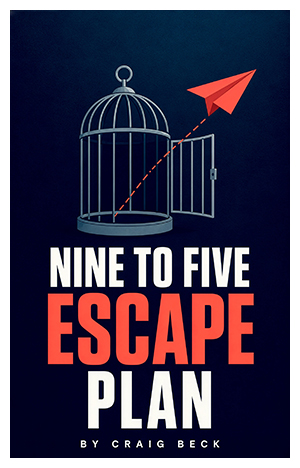
Want the full method for building a working life you don't need to brace for every Sunday night? Get Nine to Five Escape Plan: How to Escape the Rat Race on Amazon.
The Comfortable Story You Tell Yourself About Sunday Night
Ask anyone about their Sunday dread and you'll hear the same reassuring shrug. Everyone hates Mondays. I'm a bit tired. It's my boss, it'll calm down after Christmas. There is a whole industry of mugs and memes built on the idea that the Sunday scaries are simply part of being a grown-up, like back pain and council tax. If everybody suffers it, the logic goes, there's nothing to look at.
But the story has a crack running straight through it. Ask yourself how Monday morning goes once you are in it. For a lot of people, by half past ten it's fine. Not wonderful, but fine. The meeting happens and somebody brings biscuits. The worst part of the week was the evening before it, when nothing was happening at all. Sunday dread is not a reaction to Monday. It is a reaction to a prediction of Monday, and predictions are made by your brain, not by your boss.
And there's a stranger detail still. Researchers following adults over fifty in England found that people who felt anxious on a Monday had around 23 per cent more of the stress hormone cortisol in hair samples taken up to two months later than people whose anxious day fell elsewhere in the week. The effect showed up in retired people too. As the researchers explain in Scientific American's write-up of the Monday stress research, some people may get anxious on Mondays so routinely that it becomes an automatic bodily response, one that keeps running after the original trigger has gone. That isn't a job problem. That is software.
What Sunday Dread Is Doing to Your Brain and Body
Your brain is a prediction machine. Its main job isn't to make you happy. It's to keep you alive, partly by running tomorrow in advance so nothing catches you off guard. When it forecasts a threat, it doesn't wait politely for the threat to arrive. It gets the body ready now. Your heart rate nudges up, your breathing gets shallower and your system shifts away from rest and digestion. That's the stomach drop. Your gut is one of the first places stress shows up, which is why the NHS lists stomach problems alongside headaches, muscle tension and constant worrying among the common symptoms of stress, and why Sunday night anxiety so often lives in your belly before it reaches your head.
The trouble is that your brain can't tell the difference between a lion in the long grass and a quarterly review on Tuesday. Both get filed under danger, and uncertainty makes it worse. A known problem can be planned for. An unknown inbox is a dark room, and the threat system hates a dark room. There's a name for this, anticipatory stress, which down the pub means you're paying the bill before the meal has even arrived. One study that checked in with hundreds of people ten times across a day found that when stress hit, those who had forecast a stressful day felt noticeably worse than those who hadn't. You can read the study on how forecasting a stressful day changes the way stress lands on the NIH's PubMed Central. Expecting a bad week changes how the week feels when it gets there.
If dread visits you on other days too, my breakdown of anticipatory anxiety goes wider. Sunday dread is its weekly, clockwork cousin.
The Sunday Loop: Bracing, Scrolling and Bargaining With the Weekend
Every habit runs on a cue, a routine and a reward, and Sunday dread is a habit wearing a mood's clothes. The cue is often absurdly small, like the light changing, the roast going cold, the Countryfile theme or a school uniform drying on the radiator. The routine is whatever you do to manage the feeling. For some people it's bracing, the inbox check and the rehearsal of every awkward conversation the week might hold. For others it's escape, the endless scroll at an hour when you should be asleep.
The reward is relief, or at least the illusion of it. Checking the emails gives you a flicker of control. Scrolling numbs the feeling for a few minutes. Staying up until one in the morning feels like stealing back a slice of the weekend. Your brain records each one as something that helped, and reaches for it again next Sunday. Psychologists call this negative reinforcement, which means a behaviour gets rewarded because something unpleasant briefly goes away. The cost lands later. You wake up on Monday tired, wired and already behind, which proves to your brain that Monday was every bit as dangerous as it predicted.
Then the loop starts to creep. The dread used to arrive at teatime on Sunday. Now it turns up after lunch. Give it a year and the first twinge arrives on Saturday night, halfway through a perfectly nice dinner. Saturday becomes recovery from the week and Sunday becomes a waiting room for the next one, so the weekend shrinks to about nine usable hours. Some people fill every one of those hours so there's no room to feel anything, the trap I unpicked in Busyness Decoded. Others make grand plans to change everything, starting Monday, and if that sounds familiar, my piece on the I'll start on Monday bargain explains why that promise keeps getting broken.

Why the Usual Sunday Scaries Fixes Keep Failing
The internet is full of Sunday scaries cures, and most are versions of the same idea. Run a bath, light a candle, do a Sunday reset with a colour-coded planner. None of that is harmful. But it treats the alarm like a bad smell you can cover with something nicer. The threat system doesn't care about your scented candle. It's still running the forecast underneath, and the minute the bubbles go flat the forecast is back.
The second fix is getting ahead. You clear twenty emails on Sunday night so Monday feels less of a cliff edge. It works for about an hour, but it teaches your brain that work can walk into your living room whenever it likes. You haven't reduced the threat. You've invited it round for tea.
The third fix is anaesthetic. A large glass of wine with Sunday dinner, then another, then a foggy Monday that makes everything harder. Relief poured from a bottle is a loan with horrible interest, and the NHS is plain that leaning on alcohol, cigarettes, gambling or drugs to relieve stress can feed poor mental health. The fourth fix is the pep talk. You tell yourself to be grateful you have a job and to pull yourself together. Shame is a terrible motivator. It doesn't switch the alarm off. It tells the alarm it was right to worry about you.
If you're tired of losing one day in seven to dreading the other six, Nine to Five Escape Plan sets out the full playbook for building a working life you don't need to escape from every weekend, and it's waiting for you on Amazon.
Your Sunday Dread Is a Message, Not a Malfunction
This is where the whole thing turns. Sunday dread is not a fault in your wiring. Your brain is doing exactly what it was built to do, which is to look at the week coming and report back on how safe it feels. The report is unpleasant, but it is honest. Every Sunday afternoon your nervous system fills in a little survey about your life, and the stomach drop is the score.
That means there are two quite different conversations to have with it. For some people the alarm is mostly habit, a rhythm learned over decades that keeps firing after the reason has faded, as that research on retirees hints. For them, the work is to retrain the rhythm. But for a lot of people, the dread is reporting something true. It is saying that the life waiting on Monday morning is one you are bracing against rather than living. No amount of bath salts will argue with that, and nor should it.
That's the heart of Nine to Five Escape Plan. Most people aren't living. They're surviving on autopilot from Monday to Friday and praying for a weekend that vanishes before it begins. The rat race is a cage with better lighting, and the bars stay invisible because everyone around you is behind them too. The book's argument is that the problem isn't money, your boss or your background. It's who you've been listening to, and whether you're ready to stop being a passenger in your own life. You can hear the same idea in its blunter form in my piece on escaping the rat race and living a purpose-driven life.
I know this one from the inside. For years I was in a job that paid enough to keep me trapped and little enough to keep me grateful, and I treated the Sunday stomach drop as the price of being a grown-up. It took me far too long to see that a feeling everyone shares can still be telling you the truth. None of this means handing in your notice on Monday morning. Escape plans are built, not leapt. And if the thought of changing anything makes the dread louder, notice that too, because sometimes we stay put because the cage is familiar, which I explore in my piece on the fear of success.
Your First Small Move: Give Sunday Dread an Appointment
Your first move isn't quitting, and it isn't forcing yourself to feel cheerful. It's taking the dread out of the shadows and giving it a time slot. This Sunday, at around three o'clock, before the feeling usually peaks, sit down with a notebook and a cup of tea for twenty minutes. Write down the three things about the coming week that your stomach is most worried about. Be precise about each one, whether it's the meeting, the person, the deadline or the commute. Vague dread is a fog. Written dread is a list.
Then go down that list and give each item one of two labels. Either it's a solvable problem for this week, or it's part of the life you're in. For the solvable ones, write the first small action and the day you'll take it. Your threat system settles when a problem has a plan and a time, because the dark room now has a light switch. For anything marked as part of the life you're in, don't try to fix it on a Sunday. Instead, book thirty minutes on a Tuesday or Thursday evening to work on your way out of it, whether that's a side project, a new skill or a sum about what you'd need to earn to change things.

Add two house rules for the rest of the evening. The work inbox stays shut until Monday, and the phone sleeps outside the bedroom. Then give your dread a score out of ten and write it at the top of the page. Do this for four Sundays and compare the numbers. Dread tends to lose some of its teeth once it has an appointment, and whatever is left over tells you what needs to change. If Sunday dread has tipped into persistent anxiety, low mood or struggling to cope day to day, please speak to your GP or a qualified therapist alongside any self-help. If you'd rather work through it one to one, my coaching page explains how, or try my hypnosis session for decreasing stress on the evenings the alarm won't settle.
The Question Nobody Asks About Sunday Dread
People spend years asking how to stop feeling bad on Sunday nights. Very few ask what the feeling has been trying to tell them. We treat the stomach drop as an inconvenience to be managed, when it may be the most honest voice in the house, delivering the same message every week to someone who keeps hanging up on it.
So, what would your Sunday afternoon feel like if Monday belonged to you? And if the answer makes your chest loosen a little, how long are you willing to keep paying one day in seven for a life you only half want?
Ready to stop bracing for Monday and start building your way out? Pick up your copy of Nine to Five Escape Plan: How to Escape the Rat Race on Amazon today and start drawing up a working life worth waking up for.
"Every Sunday around four I'd get this knot in my stomach and spend the whole night on my phone. Writing the worries down and booking time for my side business changed that. A year later I work four days a week for myself, and Sundays feel like mine again." (Jennifer L., Boise, Idaho)
"I thought hating Sundays was part of being an adult. Realizing the dread was telling me something made me finally start the plan I'd talked about for ten years. The knot in my stomach is mostly gone, and my kids get a dad who's present on the weekend." (Marcus T., Raleigh, North Carolina)
"I used to check work email in bed every Sunday night and then lie awake for hours. Now the inbox stays closed and the phone stays in the kitchen. My husband says I'm a different person on Monday mornings." (Denise R., Tucson, Arizona)
Frequently Asked Questions About Sunday Dread
Why do I feel anxious on Sunday nights?
Because your brain starts running Monday in advance. As the weekend winds down, your threat system forecasts the week ahead, and uncertainty about what's waiting makes that forecast feel dangerous. Your body responds as if the threat were already here, with a tight stomach, restlessness and trouble settling. Habits like checking work email or scrolling late bring brief relief, which teaches your brain to repeat the whole cycle the following Sunday, often starting a little earlier each time.
Is Sunday dread a sign I should quit my job?
Not automatically. Sometimes it's a learned weekly rhythm that keeps firing out of habit, and calmer Sunday routines can soften it. But if the dread is strong, regular and tied to the work itself, it's worth listening to rather than silencing. That doesn't mean handing in your notice on impulse. It means taking the feeling seriously and building a realistic plan, one step at a time, towards work you don't need to brace against.
How do I stop the Sunday scaries?
Give the dread an appointment instead of letting it run the evening. Spend twenty minutes on Sunday afternoon writing down what you're worried about, plan a first step for anything solvable and book time in the week to work on the bigger stuff. Keep the work inbox closed until Monday and charge your phone outside the bedroom. Score the feeling each week, and notice which changes make the biggest difference to the number.
About the Author
 Craig Beck spent years behind a microphone as a UK broadcaster before he stepped away from the nine to five to build a working life of his own. He is a certified NLP Master Practitioner and the author of more than a hundred books on human behaviour, freedom and change, from quitting alcohol to decoding the everyday habits that keep capable people stuck. His work skips the motivational fluff and shows readers the machinery underneath. Find out more on his about page.
Last updated 15 October 2026.