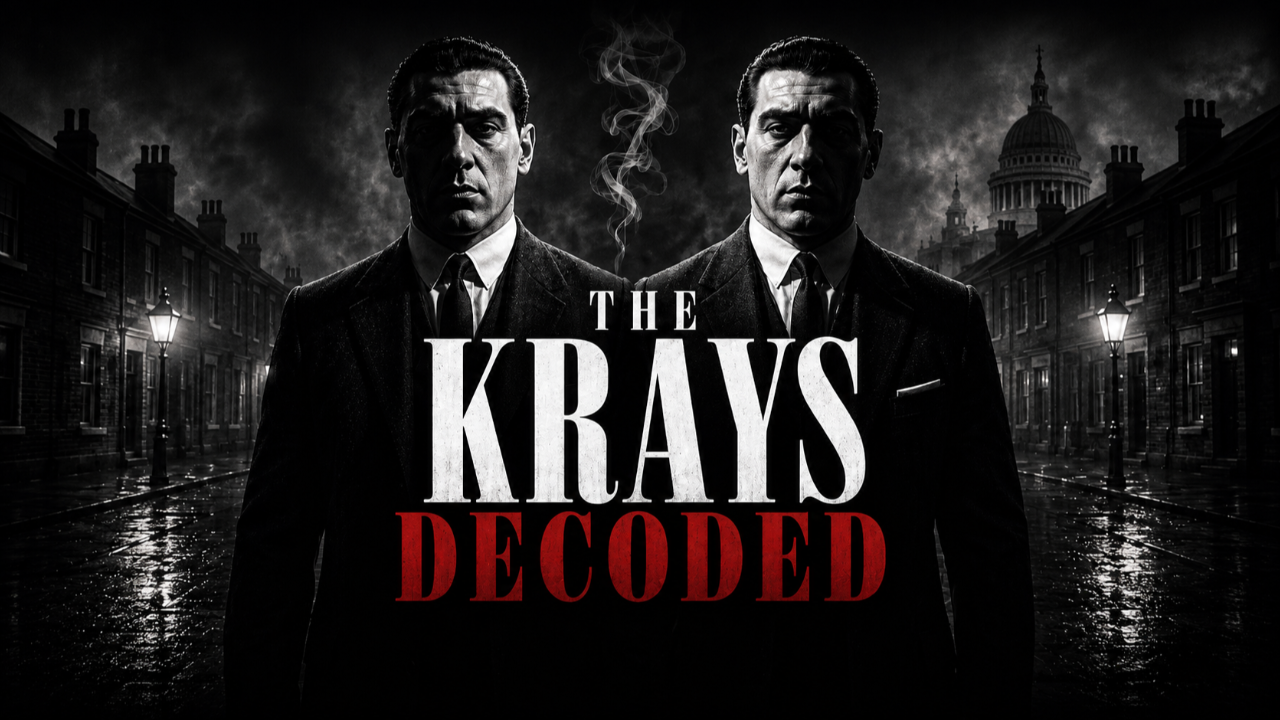
The Krays Decoded: True Story of the Gangster Twins Who Ruled 1960s London
May 28, 2026The Krays Decoded: Inside the Minds of London's Twin Gangsters
Ronnie and Reggie Kray were identical twin brothers from Haggerston in East London who built the most feared organised crime outfit Britain has ever produced. Born on 24 October 1933, they ran a Bethnal Green gang known as the Firm, controlling protection rackets, nightclubs, armed robbery and contract violence across 1960s London. Ronnie, a diagnosed paranoid schizophrenic, shot George Cornell dead in the Blind Beggar pub in 1966. Reggie stabbed Jack McVitie to death in a Stoke Newington basement in 1967. Both were jailed for life in 1969. Neither walked free again as a healthy man.
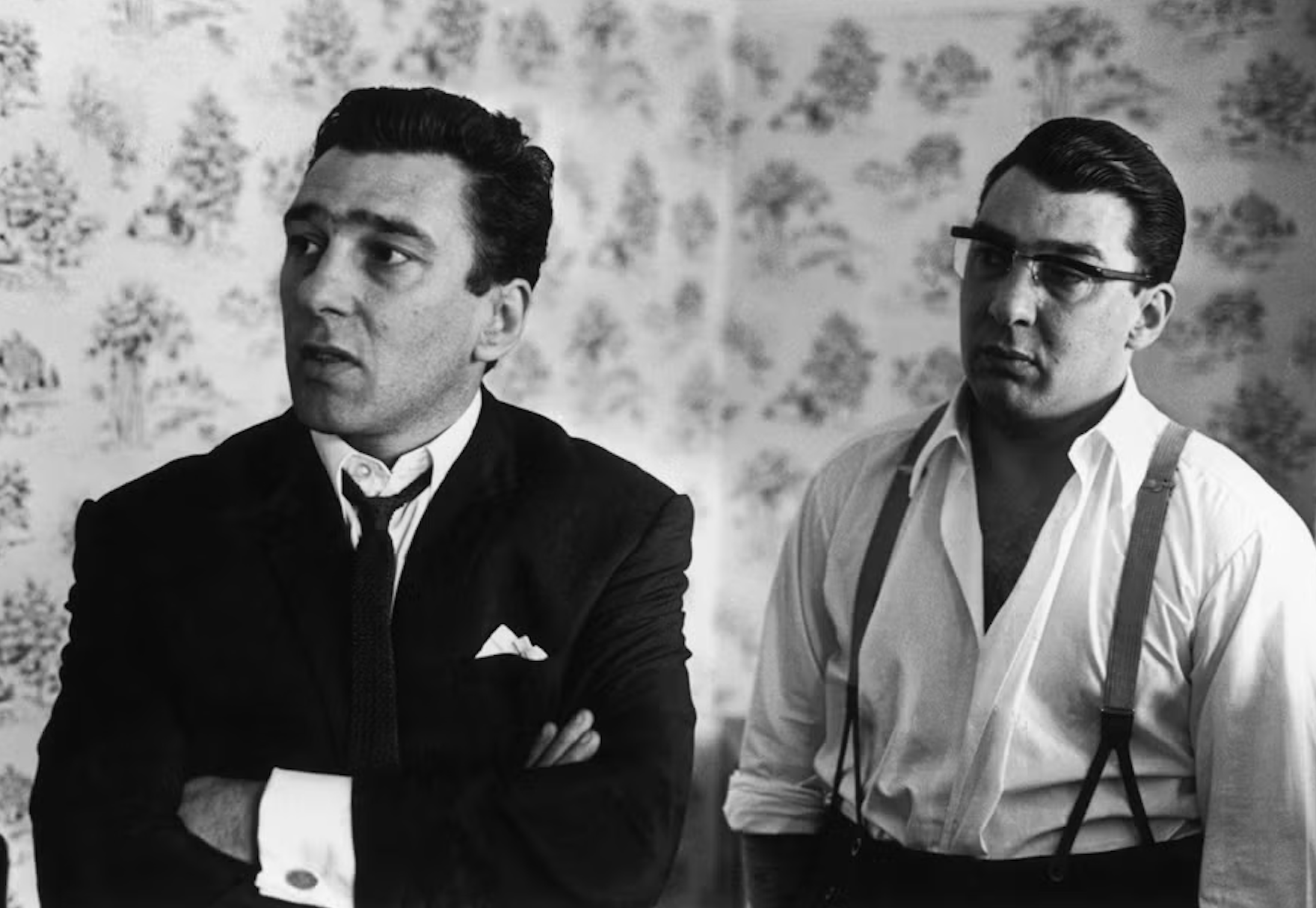
 You already know the headlines. You have seen the tailored suits, the cigarettes, the David Bailey photographs of two boys staring down the lens like wolves dressed up for a wedding. What nobody bothers to tell you is why a pair of twins from a two-up two-down terrace ended up running the most violent firm in postwar Europe. That is what we are pulling apart here, piece by piece, until you see the wiring behind the legend.
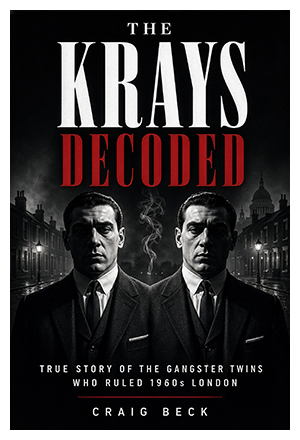
Want the full forensic breakdown of how two East End kids became Britain's most notorious twin killers? Pick up The Krays Decoded on Amazon and read it tonight.
Who Were Ronnie and Reggie Kray
On the surface the Krays were a working-class success story gone wrong. Two boys from Vallance Road, born in poverty, raised by a doting mother called Violet, drilled by a hard father who drank and avoided the wartime call-up. They were amateur boxers as teenagers, both of them quick on their feet, both of them touted as future professionals. By their late teens the boxing gloves were off and the knuckle-dusters were in. By their mid twenties they were already feared. By their thirties they were household names mixing with film stars, Members of Parliament and Hollywood royalty.
Reggie was the cleverer of the two, the planner, the one with a sliver of charm that could pass for warmth. Ronnie was the engine, the volatile half, the brother nobody else could control. They were stitched together from the cradle. They dressed alike, drank alike, fought alike, and when Ronnie's mind began to fracture, Reggie chose to follow him into the dark rather than abandon him. That decision is the central tragedy of the whole story. It is also the moment psychology stops being a footnote and starts being the entire plot.
The East End That Forged Two Monsters
Vallance Road in the 1930s and 1940s was a hard place to be soft. The streets ran on hierarchy and respect, and respect was won with fists. The Blitz had pasted itself across the East End by the time the twins were six years old, and they grew up among ruined houses, rationing, and men who came home from the war damaged in ways nobody dared name. Violence was the local dialect. Their grandfather, Jimmy "Cannonball" Lee, was a bare-knuckle fighter. Their father stayed away from the family to dodge conscription, leaving Violet to raise three boys on her own. She worshipped Ronnie and Reggie. She told them, often, that they were special.
That maternal adoration sounds harmless on paper. It is anything but. When a developing child is told he is exceptional and cannot do wrong, and that message is never balanced by correction, you get the seedbed for grandiose narcissism. Add a culture where the only respected men are the men nobody dares hit, and you have given a young brain a single template for adulthood. Be hard. Be feared. Be loved by your mother and untouchable by everybody else.
And then, in 1942, a small but possibly decisive event. Ronnie and Reggie were brawling, as twins do, and Ronnie took a serious blow to the head. Some biographers have argued ever since that this injury, or the diphtheria he had suffered as a baby, contributed to the psychiatric collapse that would arrive in his twenties. We will never know for certain. What we do know is that by his late teens, Ronnie was already showing signs of paranoia, mood swings, and an appetite for violence that ran deeper than the cultural average, even in Bethnal Green.
The Twin Bond That Became a Loaded Gun
 Identical twins share more than DNA. They share a sense of self that most of us cannot imagine. From the moment they can recognise faces, each twin sees a mirror walking around independently. The boundary between "me" and "him" never settles into the firm wall the rest of us take for granted. Psychologists call the dangerous version of this enmeshment folie à deux, a shared madness, where one disturbed mind seeds delusions in another. The Krays did not have textbook folie à deux. What they had was its close cousin. Ronnie's increasingly disordered worldview became Reggie's reality because Reggie could not bear to abandon his brother.
That bond explains things that look mad from the outside. When Ronnie shot Cornell in front of a barful of witnesses, Reggie was furious for about ten minutes, then loyal again within an hour. When Ronnie demanded that Reggie commit his own murder to "even the score", Reggie eventually did it, hating every second. The pull of the twin was stronger than self-preservation. Stronger than law. Stronger than love. Most violent men can be untangled from the people around them. The Krays could not be untangled from each other.
Inside Ronnie's Broken Brain
In 1958 Ronnie was transferred from Wandsworth Prison to Long Grove Mental Hospital in Surrey, where psychiatrists diagnosed him as a paranoid schizophrenic and certified him insane. He believed people were trying to poison him. He heard voices. He suffered crippling episodes of suspicion that would convert, without warning, into rage. He was prescribed stemetil, a heavy sedative, and would rely on it for the rest of his life. Take the pills and Ronnie was functional. Skip the pills and you had a man capable of any cruelty, with no internal brake.
Paranoid schizophrenia does not turn a normal person into a killer. Most people who have it never harm anybody. But pair it with childhood violence, untreated grandiosity, organised crime infrastructure, a brother willing to clean up after you, and unlimited access to firearms, and you have a recipe nobody has yet matched in British criminal history. Ronnie also had an appetite the East End barely tolerated in his era. He was openly bisexual, which in the 1950s and early 1960s was illegal and socially toxic. Some psychologists have argued that his cruelty was, in part, a violent overcompensation for the shame the culture forced on him. Cornell, the man he shot in the Blind Beggar, had reportedly called Ronnie "a fat poof" days earlier. That sentence cost a man his life.
For the deeper dig into Ronnie's schizophrenia, Reggie's reluctance, and the people the twins bought, bullied and broke, The Krays Decoded is waiting for you on Amazon.
The Dark Triad in Tailored Suits
If you have read my other psychological profiles you already know the shape of the dark triad. Psychopathy, narcissism, Machiavellianism. The three engines of organised harm. Most criminal personalities lean on one of them. The Krays, between them, ran all three at full throttle.
Ronnie was the psychopath. Not in the lazy tabloid sense. In the clinical sense. He showed almost no empathy, no remorse, no genuine guilt. He could shoot a man in a pub at half past eight and be eating his mother's stew by ten. He once said, "I'm a businessman with a touch of the gangster about me", which is one of the most quietly chilling sentences ever spoken by a murderer, because it tells you he genuinely saw himself as the protagonist of his own film. He was also extraordinarily narcissistic. The mirrors. The photo shoots. The need to be seen with Judy Garland and Frank Sinatra Jr. The need to be feared in Bethnal Green and admired in Mayfair. Ronnie wanted to be loved as a god and submitted to as a king.
Reggie supplied the Machiavellianism. He was the strategist, the calculator, the one who understood politicians, business interests and PR before the term was fashionable. He courted the Conservative peer Lord Boothby, ensuring photographs that made the press too nervous to print serious accusations for years. He bought silence with money and favours. He read people. He understood that fear and gratitude are the two currencies that buy total loyalty. If you want to understand how dark psychology really operates in the wild, the Krays are a live, suited, smiling case study.
The Blind Beggar and the Hat
The two murders that finished them were not strategic. They were psychological breakdowns dressed up as gangland business.
George Cornell was a member of the rival Richardson gang, but that was not why Ronnie shot him on 9 March 1966. Ronnie shot him because Cornell had insulted him, and because Ronnie, mid-paranoid episode, needed to demonstrate to himself, his twin and his Firm that he was untouchable. He walked into the Blind Beggar in Whitechapel at around half past eight, drew a 9mm Mauser, and put a bullet into Cornell's forehead at close range. The jukebox stuck on a single repeating note. Witnesses ran. Ronnie strolled out into the night.
Eighteen months later, in October 1967, Reggie killed Jack "the Hat" McVitie in the basement flat of a flat in Stoke Newington. McVitie was a low-level associate who had taken money for a hit and failed to deliver. Ronnie wanted him punished. He wanted Reggie to do the punishing, because Reggie had not killed anyone yet and Ronnie could not stand the imbalance. Witnesses said Reggie tried to shoot McVitie first. The gun jammed. So, Reggie stabbed him in the face, the neck and finally the chest until the knife was buried up to the handle. McVitie's last words, before the gun jammed, were a plea to be allowed to leave through the window. The flat smelled of beer and panic. Reggie was crying when it was over. Then he was loyal again. Loyal to the man who had just made him a murderer.
The Slow Collapse of the Firm
Detective Superintendent Leonard "Nipper" Read had been hunting the Krays for years and getting nowhere. Witnesses recanted. Juries trembled. Lawyers vanished. The Firm's reach was wide and the fear it generated was real. The crack appeared because of the psychology rather than the policing. Members of the Firm, watching Ronnie deteriorate and Reggie unravel after the suicide of his wife Frances Shea in 1967, began to think the unthinkable. The twins were no longer untouchable. They were just unstable. Unstable bosses get their men killed. Unstable bosses get betrayed.
By May 1968 the Yard had enough. The arrests came in coordinated dawn raids. The trial at the Old Bailey in 1969 lasted 39 days, the longest in British criminal history at that point. Both brothers were convicted of murder and sentenced to life with a recommendation that they serve at least 30 years. Ronnie was eventually transferred to Broadmoor in 1979, where he died of a heart attack in March 1995. Reggie died of bladder cancer on 1 October 2000, released on compassionate grounds eight weeks earlier, never having tasted unrestricted freedom again.
Their mother Violet had died in 1982, attended at her funeral by her cuffed, escorted boys. She believed to her last breath that Ronnie and Reggie were good lads who had been treated unfairly. That, more than anything else in the story, tells you how completely the Krays manipulated even the people who loved them most.
What the Krays Teach You About Reading Real People
The Krays are a working diagram of how a charming, dangerous personality wins your trust. The same patterns play out in boardrooms, churches, kitchens and bedrooms across the world right now. Charm is the loudest warning sign and the one most people ignore. Generosity from a man who has no business being generous is rarely generosity at all. It is investment. It is a leash being lengthened until the moment somebody pulls it tight.
Watch for the men whose stories never quite cohere. Watch for the ones whose followers all sound suspiciously alike when they describe them. Watch for the rage that flickers under the smile when a reflection is questioned. The Krays radiated all three signals, openly, for years, and London chose to read them as character rather than warning. True crime hooks us because the patterns repeat, and because every reader knows, somewhere underneath, that the next predator they meet will not be wearing a name tag.
The Question Nobody Asks About the Twins
Here is the question the documentaries skirt around. Without Ronnie, would Reggie have ever killed anybody? The honest answer is probably not. Reggie had the temperament for villainy, the appetite for money, the love of intimidation. But Reggie also had Frances, briefly, and a few flickers of a life that might have been ordinary. The murder of Jack McVitie was, more than anything, an act of fraternal compliance. Reggie killed because Ronnie demanded it. He stabbed a pleading man in the face because his twin could not stand being the only killer in the family.
That is the heart of the Krays. Not gangland glamour. Not London at swing. A man with a broken brain dragging his identical mirror into hell, because the bond was tighter than morality, sanity or self-interest. They were born together, they offended together, they were buried within five years of each other. And the worst of it is that, given the same start, the same mother, the same brother, the same head injury and the same diagnosis, most of us would not be brave enough to swear we would have chosen differently.
Want the full story stripped to the bone? Grab The Krays Decoded on Amazon and find out what the documentaries never had the nerve to print.
"I have read a dozen books on the Krays and this one made the others feel like Wikipedia entries. Craig gets into the heads of these men in a way nobody else has. I finished it at three in the morning."
Tracy Wilkes, Charlotte, NC
"Beck does not write true crime. He writes psychological autopsy. By chapter four I understood Reggie better than I understand some of my own family."
Daniel Murphy, Portland, OR
"You think you know the Krays. You do not. This book reframes everything you thought you understood about Ronnie's mind and Reggie's choices. Buy it."
Lisa Brennan, Austin, TX
About The Author
 Craig Beck is widely regarded as the world's foremost expert on persuasion and human behaviour. A certified NLP Master Practitioner, former UK broadcaster, and bestselling author of more than one hundred books, he has spent two decades reverse engineering the question of why people say yes. More than a million readers across the globe have used his work to understand the hidden mechanics of influence, decision-making and motivation. He does not teach theory. He shows you, plainly and without flinching, how the wiring of humanity really works.
Last updated 28 May 2026.
FAQ
Did Ronnie Kray really have schizophrenia?
Yes. Ronnie was formally diagnosed with paranoid schizophrenia at Long Grove Mental Hospital in 1958 and certified insane. His symptoms included auditory hallucinations, profound paranoia, and rapid mood swings that could shift into uncontrolled violence. He took stemetil, a heavy sedative, for the rest of his life. When he stopped taking it, his behaviour deteriorated sharply, and most of the worst Kray incidents trace back to gaps in his medication. By the time he was transferred to Broadmoor in 1979, his condition had been deepening for more than two decades.
How did the Kray twins finally get caught?
Detective Superintendent Leonard "Nipper" Read led a dedicated Scotland Yard squad that quietly gathered witnesses willing to testify, including members of the Firm who had grown tired of Ronnie's instability and Reggie's grief-driven recklessness after his wife's suicide. Arrests came in coordinated dawn raids in May 1968. The Old Bailey trial in 1969 ran 39 days, the longest criminal case in British history at that point. Both twins were convicted of murder and sentenced to life with a minimum recommendation of 30 years behind bars.
Were the Kray twins really as glamorous as the films suggest?
Their image was carefully manufactured. They wore Savile Row suits, courted celebrities, posed for David Bailey, and ran fashionable Mayfair nightclubs. The reality underneath was squalid. Their operations relied on extortion, brutal beatings, arson and murder. Most of the people around them lived in fear, not friendship. The 1990 Peter Medak film and the 2015 Tom Hardy version both lean into the suit-and-cigarette aesthetic. The truth was bloodier, sadder and far more clinical. Glamour was the marketing. Violence was the product.