Jack The Ripper Decoded: Inside The Mind Of A Victorian Monster
May 29, 2026Jack The Ripper Decoded: Inside The Mind Of A Victorian Monster
Jack The Ripper was the unidentified killer who murdered at least five women in the Whitechapel district of London between August and November 1888. Despite owning the most famous criminal nickname in history, no man was ever charged. Modern psychological profiling suggests he was almost certainly a working-class English man from the East End, somewhere between his late twenties and early forties, with the cold detachment of a developed lust murderer. He was not a royal physician, an American quack, or a caped gentleman. He was the empire's most ordinary disappointment, dressed up by legend into something he never was.
 For over a hundred and thirty years, the world has been hunting the wrong man. The cape. The doctor's bag. The plummy voice in the fog. Every generation paints him a fresh costume. The truth has never worn one. The man we should have been looking for would have walked past you on the way to the bakery without you ever turning your head. That, more than any of the gore, is the part that stays.
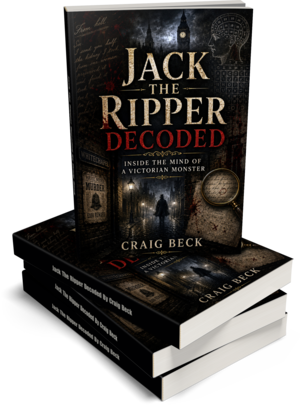
Want the full story? Grab Jack The Ripper Decoded: Inside The Mind Of A Victorian Monster on Amazon and walk these streets with the women he chose, and the wiring of the man who chose them.
Who Was Jack The Ripper
Jack The Ripper is the press-coined nickname given to the unidentified man who killed five women, possibly more, in the streets around Whitechapel and Spitalfields in the autumn of 1888. The five canonical victims were Mary Ann (Polly) Nichols, Annie Chapman, Elizabeth Stride, Catherine Eddowes, and Mary Jane Kelly. Each had her throat cut. Four of the five were brutally mutilated. Two had organs removed and carried away. The killings stopped abruptly after Mary Kelly's death on the ninth of November 1888, leaving a case file that has never closed and a name that has refused to leave the language.
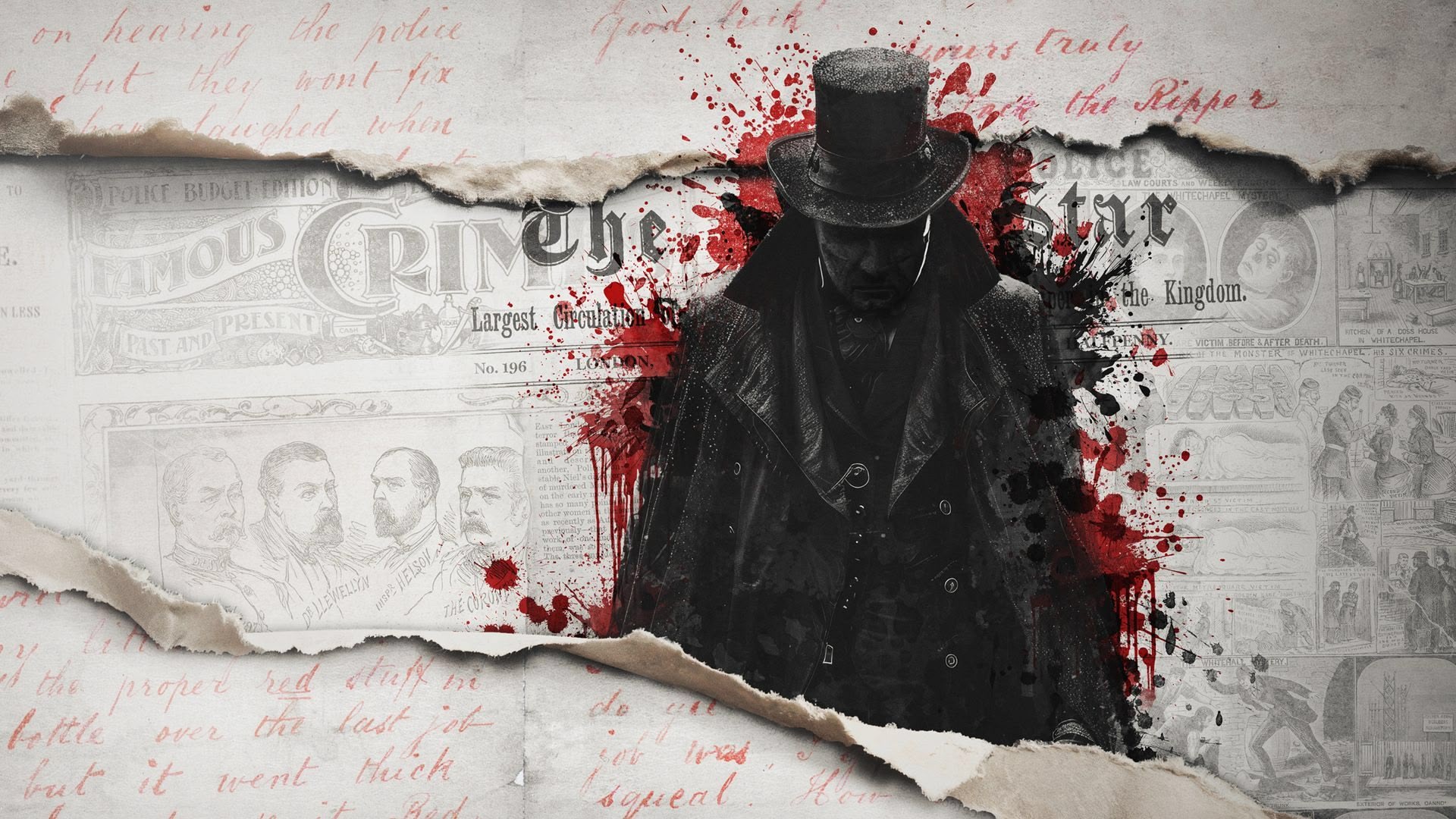
The nickname itself was almost certainly the work of a journalist. A letter signed "Jack the Ripper" arrived at the Central News Agency on the twenty-seventh of September 1888, written in red ink, boasting in a giggling fairground voice. Senior officers at the Yard, including Chief Inspector Frederick Abberline, came to believe within a year that the letter was the work of a reporter trying to keep his story alive. By the time anyone realised, the brand had taken. The killer had a name. The case had a face. The face was an inkstain.
The Whitechapel That Built A Predator
You cannot understand the killer without understanding the parish that grew him. The Whitechapel of 1888 was not the gaslit Gothic dreamscape of the cinema. It was a heaving, noisy, working-class district of around seventy-six thousand souls packed into less than half a square mile. The lodging houses held more than eight thousand people a night, in rooms partitioned with brown paper, at fourpence a single bed. Average male life expectancy at birth was barely thirty years. Around a quarter of children born into the worst streets did not see their fifth birthday. Tuberculosis, dysentery, and rickets ran through the population in a rolling wave that never quite stopped.
Predators do not appear in random places. They appear in habitats prepared for them. The killer chose this parish because the parish offered him perfect cover. High concentrations of vulnerable women working alone at night. Inadequate lighting. Narrow yards. Tolerant landladies who had learned long ago not to ask. A police force stretched to breaking point. He could move through those streets with the easy freedom of any other tradesman walking home, and that, alongside whatever was wrong inside his head, is why he kept walking out of every alley clean.
The Dark Triad In A Victorian Coat
If you want to grasp the wiring of a serial killer, you start with what modern psychology calls the Dark Triad. Three traits that, when stacked together, remove almost every human brake on violence. Psychopathy strips out empathy and remorse. Narcissism inflates the self until other people exist only as scenery. Machiavellianism adds the cold strategic patience that lets a man plan a kill, execute it, and walk through a constable's torchlight ten minutes later with his hands in his pockets. The Whitechapel killer was, by every available reading of his work, fluent in all three.
Modern criminology, including the long body of work by the FBI's Behavioral Analysis Unit, has shown that lust killers tend to share a developmental fingerprint. Severe childhood trauma, particularly emotional and sexual abuse, social isolation, and an early fusing of violent fantasy with sexual arousal are the soil this kind of man grows out of. The killer of those autumn women would almost certainly have been showing the warning signs by the time he was a teenager. Cruelty to animals. Sexual humiliation hoarded into private grievance. Long lonely fantasies that escalated until the inside of his head was no longer a safe place to live.
If you have ever wondered how a man can murder a stranger and then go home for tea, the answer sits inside the Dark Triad. The same mental machinery that lets a confidence trickster cheat a widow out of her savings, scaled up several notches and given a knife. The same architecture I have spent two decades studying inside the world of persuasion and human behaviour, only here it has slipped its leash entirely.
How Jack The Ripper Hunted His Victims
His modus operandi was almost embarrassingly simple, which is why it worked. He approached women on the street, in the small hours, in places where nobody else was likely to be. He spoke softly. He was not, by any witness account, threatening on first impression. He carried a small parcel under his arm, wrapped in cloth or newspaper, that several witnesses noted in different sightings. The parcel held his blade and probably a clean rag. He paid his sixpence, or pretended to. He was led, in every case, into a yard or an alley the woman thought was safe. The whole transaction took perhaps two minutes from approach to threshold.
What happened next happened fast. He cut the throat first, deeply and decisively, severing the carotid arteries from left to right in most cases. The woman could not scream. She was unconscious within ten seconds and dead within a minute. Then, with whatever time the street allowed him, he opened the abdomen and worked. The cuts were rough in places, suggesting a man with a sharp tool but limited training. The cuts were precise in others, suggesting someone who had handled animal carcasses, possibly a butcher, a slaughterman, or a meat porter. He took organs when he could and left them when he could not. He walked away calmly, blood almost certainly on his cuffs, and disappeared into the rhythm of a city that did not look up.
Curious about the moment-by-moment psychology behind each murder? Jack The Ripper Decoded takes you inside every killing, including the one in the small back room that nobody else has dared describe in this much detail.
The Five Women The Headlines Erased
For over a century, the five women have been treated as scenery for the killer's portrait. Polly Nichols, Annie Chapman, Elizabeth Stride, Catherine Eddowes, Mary Jane Kelly. Their names are recited like a list of crime scenes rather than people. The press of the day called them all prostitutes, and the label has stuck for over a century. The truth, when you bother to look, is far more human and far more painful. Most of them had been respectable working-class wives and mothers before drink, grief, and the ruthless economics of the East End pulled them under.
Polly had been a printer's wife, the mother of five children, before her marriage collapsed. Annie had been the wife of a coachman in service to a wealthy household in Windsor before the death of her twelve-year-old daughter from meningitis broke both her and her husband. Liz had buried a stillborn daughter in Sweden long before she came to England. Kate had been hop picking in Kent the week before she died, with the man who loved her quietly waiting for her at a lodging house. Mary Kelly had once been dressed in silk in a Knightsbridge brothel, and had been dragged, in a year, down to a small back room behind Dorset Street.
This kind of restoration of the victims, the slow late return of their names, is part of what separates honest true crime from the older voyeur genre. They were people. The killer did not see them as people. The legend that came after him pretended they were not people. The work of a serious account is to refuse both lies. Recent research has finally begun to establish their lives in the historical record, and the picture is nothing like the headlines told you.
The Letters That Built A Legend
The autumn of 1888 produced more than seven hundred letters claiming to be from the killer. Most were from cranks, drunks, religious fanatics, and bored boys with too much time. Three of them stand out. The Dear Boss letter, written in red ink, signed Jack the Ripper, almost certainly the work of a journalist. The Saucy Jacky postcard, which referenced the double event in language anyone reading the morning papers could have managed. And the From Hell letter, sent to George Lusk of the Mile End Vigilance Committee, accompanied by half a human kidney preserved in spirits of wine.
The From Hell letter is the only one most modern researchers think might be real. It is barely literate, addressed crudely, scrawled in pencil. The kidney, when examined by Dr Thomas Openshaw at the London Hospital, was found to be that of an adult woman with Bright's disease, a condition Catherine Eddowes had also suffered from. Whether or not the killer wrote it, the package shows the strangest thing about this case, which is that the killer was beginning to read about himself in print and to enjoy what he saw. The grandiose narcissism that lives at the heart of every lust murderer's profile feeds on attention. The autumn of 1888 fed him a banquet.
Why Jack The Ripper Was Never Caught
The simplest answer is that the police of 1888 had no playbook for this kind of killer. Detective work, in the late Victorian period, ran on three rails. You questioned the dead person's enemies. You watched their associates. You waited for someone with a grudge to talk. Almost every murder in England in those years was domestic. Catching a man who had no connection to his victims, who chose them at random off the streets, who walked away clean, was a problem the Yard had no method for. The first generation of modern profilers would not arrive for another ninety years. The full archive of the original case papers, autopsy reports, and witness statements shows just how badly the system was outmatched.
The wider answer is that he had perfect camouflage. He was, almost certainly, English. Almost certainly, white. Almost certainly, working class or lower middle class. Almost certainly, a man whose name appeared in a parish rent book under a small unremarkable surname, paying his landlady on time, eating his bread at the same baker as the women he killed. Sir Charles Warren resigned the day before Mary Kelly was killed. Sir Robert Anderson took over the case and, two decades later, claimed the killer had been the Polish Jewish hairdresser Aaron Kosminski, although the evidence against Kosminski has never quite stood up. The Yard's three favourite suspects, named in a private memo by Sir Melville Macnaghten in 1894, included a barrister who drowned himself in the Thames and a Russian fraudster who was in a French prison during the killings. None of the three is a clean fit. The case, in the strict sense, was never solved.
What The Ripper's Story Teaches Us About Predators Today
If you take one piece of practical wisdom out of the Whitechapel autumn, take this. Predators rarely look like predators. The cape, the cane, and the doctor's bag are pure cinema. The men who do this kind of harm, in any century, walk into your office, your school gates, your dating apps, and your church coffee mornings looking exactly like the rest of the room. The danger is not in the obvious stranger. The danger is in the polite quiet man your instincts wave through because nothing about him sets off the older parts of your brain.
The warning signs that modern psychology has learned to look for since 1888 are the warning signs the killer's neighbours would have spotted, had they known what to watch for. A pattern of small cruelties to animals or weaker people in childhood. A tendency to lie casually, even when the truth would do. A flatness around the eyes when other people are upset. A grandiose sense of self that does not match the man's actual achievements. A grudge against women, or against authority, that hardens with age into something colder. None of these on its own makes someone a killer. Stacked together, they are the inheritance the Whitechapel killer probably wore his whole life. If you are ever close enough to someone to see all three of them lining up, take a quiet step back, and learn from the parishes that were too busy to look. Reading more about the psychology of predators is one of the cheapest pieces of self-defence available.
The Question Nobody Asks About Jack The Ripper
The question every documentary asks is who was he. The question almost nobody asks is why we still care. The killings ended in November 1888. The bodies have been in the ground for over a hundred and thirty years. The streets where they fell have been bombed flat, rebuilt, redeveloped, and rebranded. And yet the case sells more books, films, and walking tours every year than it did in 1889. Why?
The honest answer is that the Whitechapel killer left a gap at the centre of his story, and the gap is, on some level, a mirror. Every reader who has ever pulled a Ripper book off a shelf has been quietly hoping to look into that gap and see something other than themselves looking back. We do not, on the whole. The mirror keeps showing the same thing. A small, dirty, ordinary man with a knife, a private appetite, and the particular kind of luck that lets monsters walk away. The legend has been doing his work for him for over a century, dressing him up, ennobling him, royalising him, exoticising him, anything to avoid the simpler, sadder truth. He was one of us. The autumn of 1888 was a long, ugly lesson in what a city does when it cannot find the killer it is looking for. The lesson keeps repeating, in every new district, in every new century, by every new hand.
If this article has pulled at something in you, the full breakdown is waiting. Pick up Jack The Ripper Decoded on Amazon and meet the man, the women, and the city that made all three of them possible.
Reader Reviews
"I have read every Ripper book on the market over the last twenty years. This is the first one that made me feel I understood the man rather than just the murders. The psychology chapters are extraordinary."
Marianne Kovac, Phoenix, Arizona
"Beck writes like he is sitting across the pub from you. I finished the audiobook in two days. The chapters on the women are the most respectful, human portraits of them I have come across."
Daniel Hartley, Asheville, North Carolina
"As a retired clinical psychologist, I was sceptical of yet another Ripper book. This one earned its shelf space. The Dark Triad analysis is sharp without being academic, and the writing is genuinely beautiful."
Frances Whittaker, Burlington, Vermont
Frequently Asked Questions
Was Jack The Ripper ever identified?
No. Despite hundreds of suspects, thousands of witness statements, and over a century of investigation, no individual has ever been definitively identified as the Whitechapel killer. Senior officers privately favoured suspects including Aaron Kosminski, Montague John Druitt, and Michael Ostrog, but none of the three holds up under close examination. The case file at the National Archives officially remains open. Modern DNA claims surrounding a shawl from the Eddowes scene have failed peer review. The honest answer is that we do not know who he was, and we very probably never will.
How many women did Jack The Ripper kill?
The five canonical victims are Polly Nichols, Annie Chapman, Elizabeth Stride, Catherine Eddowes, and Mary Jane Kelly, all killed between the thirty-first of August and the ninth of November 1888. The official Whitechapel murders file at Scotland Yard contained eleven names, including Martha Tabram, Rose Mylett, Alice McKenzie, the Pinchin Street torso, and Frances Coles. Most modern researchers accept five as the firm count, with a sixth, Tabram, often included as an early possible victim. The wider eleven are debated and very probably represent a mixture of his work and other unrelated killings.
Why is Jack The Ripper still so famous?
Three reasons. First, the killer was never caught, leaving a permanent unsolved mystery the public can keep solving for itself. Second, the press of 1888 invented one of the most marketable criminal nicknames in history, and the brand has been doing his work ever since. Third, the case became the template for every later serial murder investigation, including Bundy, Sutcliffe, and BTK. The Whitechapel autumn was the first modern serial-killer hunt, and the world has been hunting in its shadow ever since.
About The Author
 Craig Beck is widely regarded as the world's foremost expert on persuasion and human behaviour. A certified NLP Master Practitioner and former UK broadcaster, he has spent more than two decades reverse-engineering the question of why people say yes to the things they should walk away from. He is the author of over one hundred books, with more than a million readers across the globe using his work to understand the hidden mechanics of influence, decision making, and motivation. He does not teach theory. He shows you how the wiring of humanity actually runs, and what to do once you can see it.
Last updated: 7 May 2026