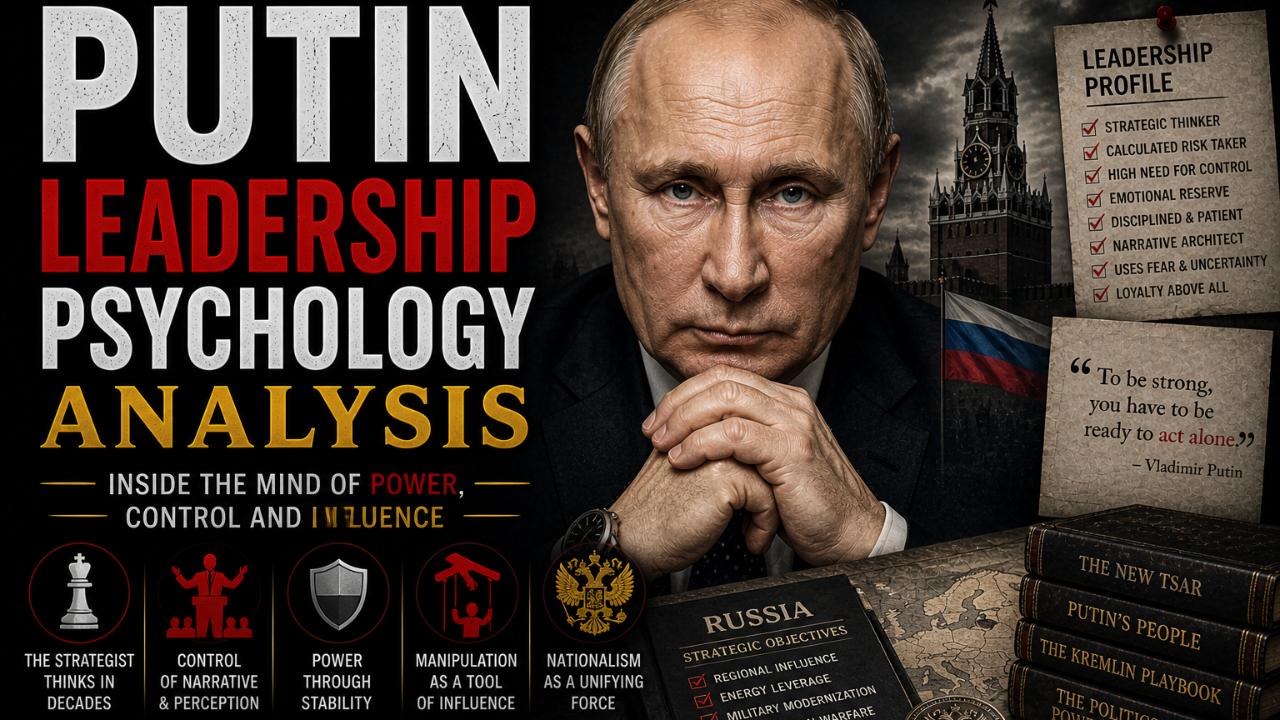
Vladimir Putin Leadership Psychology Analysis Decoded | Craig Beck
May 03, 2026Vladimir Putin Leadership Psychology Analysis
Vladimir Putin's leadership psychology runs on three engines. Controlled identity, calibrated unpredictability, and the strategic use of fear. He sells voters, allies, and rivals a coherent national story that places him at its centre, then keeps everyone slightly off-balance about how he will react. The result is power that rarely needs to shout. People supply the threat themselves, because his face and his silences give them just enough material to imagine the worst.
That is the heart of any honest reading of him. The mask is never the man. The mask is a tool, used with the precision of a stage hypnotist and the patience of a career intelligence officer. Shirtless horseman, ice-calm statesman, wounded patriot, avenging strongman. Different costumes, the same underlying objective. Control the frame before anyone else gets a turn at it.
Power is rarely held by force alone. It is held by narrative, emotional conditioning, and making millions of people feel that resistance is either pointless or dangerous. Putin did not become one of the most studied leaders on earth by being merely authoritarian. Plenty of authoritarians bark. He understood something more useful. People do not just obey fear. They obey certainty, especially the kind dressed up as inevitability.
Want the full breakdown? Pick up Putin Decoded: What the World's Most Feared Leader Knows About Human Nature on Amazon. The book lays bare every psychological lever he pulls.
Who Is Vladimir Putin Beneath the Costume Changes
Vladimir Vladimirovich Putin was born in October 1952 in Leningrad, the city that survived a 900-day Nazi siege less than a decade earlier. His parents had buried an older brother during the blockade. His father had taken shrapnel for the Red Army. The household he entered was not one that cried about feelings. It was one that buried them with a shovel and got on with life. That kind of upbringing leaves a recognisable flavour on a child. It teaches that softness costs lives, that endurance is identity, and that the world owes you precisely nothing.
By his teens he was scrappy, undersized, and obsessed with judo, a sport that punishes ego and rewards leverage. By his twenties he was a KGB officer in Dresden, watching the Berlin Wall fall through a frosted office window while his colleagues burned files. He has spoken openly about how the Soviet collapse felt to him. Not as liberation. As humiliation. That single emotional fact deserves its own neon sign in any honest read of him. Humiliated young men carry their wounds into middle age, and middle-aged men in power tend to redecorate the world to match.
The Putin who emerged from Boris Yeltsin's chaotic Russia in 1999 was already fully formed. Disciplined, watchful, measured. A man who had learned in intelligence work that warmth is a leak and ambiguity is a weapon. The public would meet many faces over the next two decades. The man behind those faces seems to have stayed remarkably stable, because the operating system never had to change. It was set in concrete years before he ever sat at a presidential desk. The biographical record reads, in places, like a training manual for a personality type that prefers shadows to spotlights.
The Childhood That Built a Cold Operator
Most psychological autopsies of leaders start with childhood, and the temptation is to find one wound and call the case closed. Resist that. People are not vending machines where you insert deprivation and receive tyranny. What childhood does is set the early calibration. Whether the world is safe. Whether emotion is allowed. Whether trust is rewarded. Putin's early calibration ran on scarcity, control, and the unspoken family knowledge that the wolf is always at the door.
You can see the residue in the adult. He keeps a small circle. He does not improvise on camera. He treats interviews the way a chess player treats a clock, every move costed in advance. There is also a documented relationship with formal hierarchy that goes far beyond ordinary respect for institutions. Hierarchy gave him stability. It gave him a path out of a tough courtyard in Leningrad. He does not just believe in order. He believes order is what stands between civilisation and the same kind of chaos his parents survived.
That is the part Western observers often miss. They see authoritarianism as a personal flaw. He sees it as a moral position. Different starting point, very different fight. Decoding public figures properly means meeting them where their psychology really lives, not where you would prefer it to live.
The Dark Triad in a Tailored Suit
Three traits, when stacked, account for an enormous proportion of dangerous leadership. Psychopathy, the absence of guilt and a high tolerance for inflicted pain. Narcissism, the demand to dominate the story and remain the central figure in any room. Machiavellianism, cold strategic manipulation that treats people as moves on a board. Psychologists call this cluster the Dark Triad, and you can read it across Putin's career, though it presents in muted form rather than theatrical excess.
The psychopathic edge shows in how casually he accepts collateral damage. Civilians in conflict zones, dissidents poisoned with rare substances, journalists who fall from windows. The pattern is too long to be coincidence and too varied to be a subordinate going rogue. The narcissism shows in the staged photo opportunities, the bare chest on horseback, the carefully timed displays of physical prowess into his late sixties. The Machiavellian thread shows everywhere. He plays foreign leaders against each other, dangles concessions he never intends to honour, and turns negotiation itself into a slow form of attrition.
This combination is precisely why ordinary diplomacy keeps misfiring on him. The Western model assumes counterparts share a baseline of reciprocity. Manipulators of his type do not negotiate the way ordinary people do. They negotiate to identify your weaknesses, then return to those weaknesses later when it suits them.
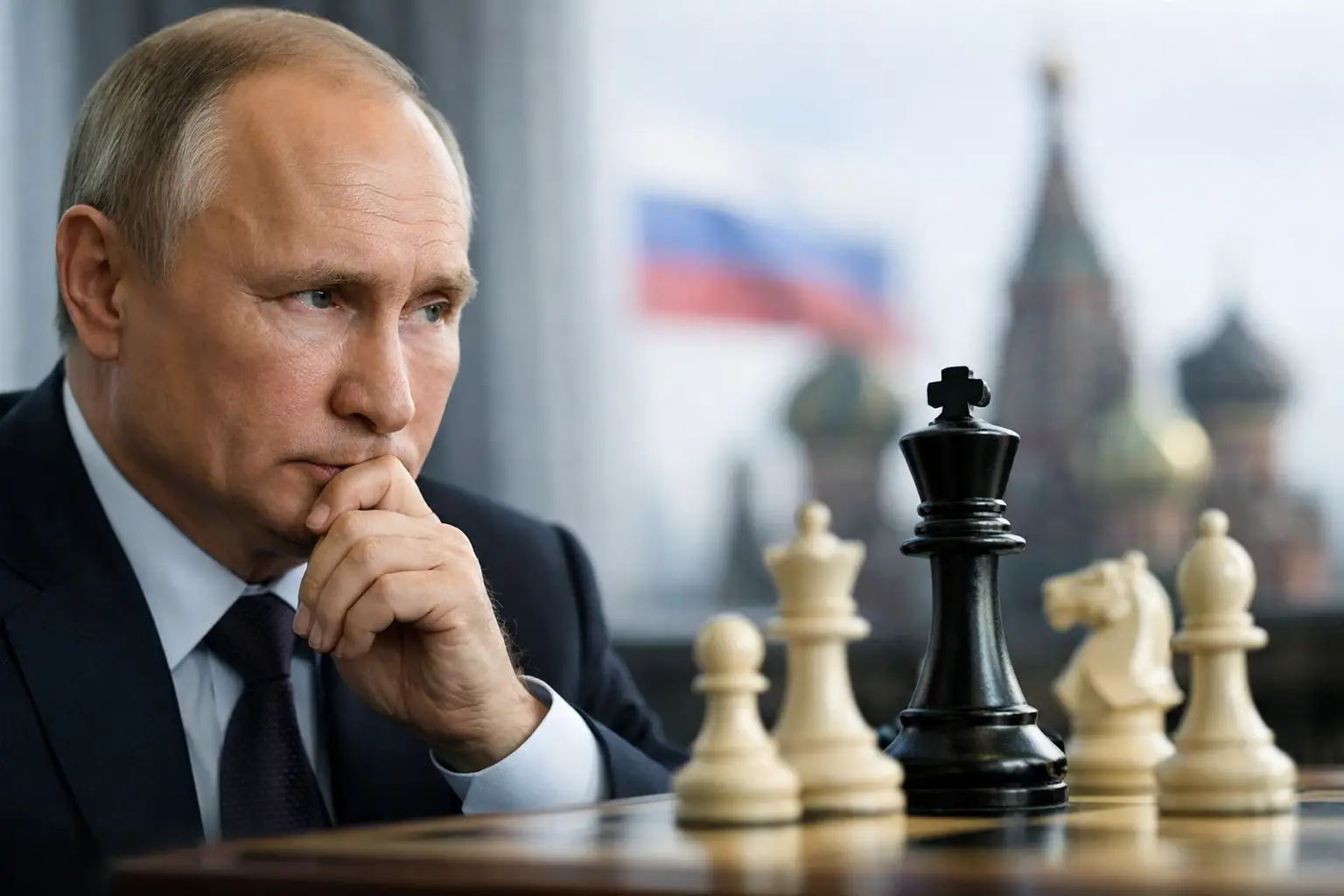
How Vladimir Putin Controls a Nation Without Constant Force
The crude version of authoritarian rule is tanks in the street. The more durable version is something subtler. Putin's system runs on three layers, working in concert. The man, the myth, and the machine.
The man projects very little spontaneity in public, which costs him warmth but buys him gravity. The myth is the disciplined patriot who can absorb pressure without blinking, the leader who looks hardest to rattle in a world that feels unstable. The machine is the engine room. Networks of patronage, selective punishment, controlled media, and a security apparatus that makes loyalty profitable and dissent unaffordable. You do not need universal love when you can manufacture universal caution.
This is where his use of identity becomes critical. He does not sell policy the way a Western politician does. He sells a recovered self. After the post-Soviet collapse, millions of Russians felt stripped of status, stability, and meaning. Putin moved into that emotional vacuum and offered to rebuild the national mirror. Compare him with a noisier populist like Donald Trump, and you see two very different ways of pulling the same lever. Trump dominates by saturation. Putin dominates by restriction. Both work, but restriction tends to last longer, because it leaves the audience hungry rather than exhausted.
If you want the full operating system, get Putin Decoded on Amazon. It maps every move he uses to keep a continent guessing.
The Architecture of Fear and Loyalty
Fear is the easiest tool in the leadership toolkit, and the worst when used carelessly. Putin uses it carefully. He rarely threatens directly. He lets stories do the threatening for him. A poisoned dissident in a London hotel. An oligarch found cold in a Surrey home. A jailed activist who happens to die just before a politically inconvenient appeal. These events leak into the bloodstream of public consciousness and do most of the silencing work without needing a press release.
This pattern is straight out of the operant conditioning playbook. You do not need to punish every dissenter. You need to punish enough of them, visibly, so the rest discipline themselves. The genius of the model is that the silenced majority believes its silence is voluntary. They tell themselves they are not afraid. They are simply being sensible. That is a far more stable political settlement than naked terror.
Loyalty inside the inner circle works on the same logic in reverse. Reward dependence. Promote the loyal but mediocre over the brilliant but independent. Make every person near the top realise that their wealth, status, and security are not really theirs. They are leased. The lease can be revoked at any moment. Once you understand that, you can read the body language of every Russian official in a public meeting. They are not aides. They are hostages with stock options.
The Halo of the Disciplined Patriot
One of his most underrated tools is the cultivated stillness. He is hard to read. He does not fidget. His micro-expressions are remarkably flat, which forensic body-language analysts have noted again and again. That flatness creates a vacuum. Audiences project into it. Anxious populations see calm competence. Adversaries see cold menace. He benefits from both readings, because both produce caution. Stillness, in a leader, is a form of theatre that pretends not to be theatre.
Compare that with the noisier strongmen of history, the ones who shout and gesture and overplay every emotion. Loud authoritarians wear their followers out. Quiet ones become objects of fascination. The audience leans in instead of pulling back. They keep watching for the next clue, the next subtle shift, the next half-smile that might mean something. By the time they realise the leader has been telling them precious little, the spell has already done its work.
There is also a Nietzschean undertone in how he frames his rule. He does not apologise for using power. He treats power as natural, as the proper expression of national vitality. That worldview lands hard in countries that feel humiliated. It tells citizens that their willingness to be ruthless is a virtue, not a flaw. History has watched this script before, and it never ends quietly.
What Putin Teaches You About Spotting Manipulators
You do not need to run a country to find this material useful. The same architecture appears in boardrooms, marriages, and friend groups, scaled down but psychologically identical. Three habits travel well. First, watch what someone does with ambiguity. Manipulators love it. They cultivate it. They speak in ways that allow them to deny what they implied two days later. Honest people, by contrast, prefer clarity even when clarity is awkward.
Second, watch how they handle disagreement. Healthy authority tolerates pushback because it knows pushback is information. Manipulative authority treats pushback as personal injury and starts looking for ways to punish it. Third, notice what they reward in the people around them. If the most loyal voice gets the best chair, and the most accurate voice goes quiet over time, you are looking at a system that will eventually run on flattery and fear.
That last point is the warning bell. Once a leader, in any setting, surrounds themselves with people who agree out of self-preservation, reality testing collapses. Behavioural studies on dominant personalities consistently show that high-narcissism authority figures degrade the quality of information they receive, then make worse decisions while feeling more confident than ever. That is the hidden tax on rule by intimidation. It looks decisive in the short term and turns delusional in the long term. Reading deeper on persuasion is one of the cleanest defences against this pattern.
The Question Nobody Asks About Vladimir Putin
The lazy question is, why is Putin so dangerous? The better question is, why does his style keep working on hundreds of millions of people? The honest answer is uncomfortable. Human beings, under stress, prefer certainty to truth. They prefer order to fairness. They prefer a strong story to an accurate one. Putin reads that preference like a sheet of music.
That is also why Western critics keep underestimating his durability. They assume that exposing his lies will weaken him. It rarely does, because his followers are not buying the lies as facts. They are buying them as identity. Once a story becomes part of how a person sees themselves, contradicting the story feels like an attack on the self. Reasoned counter-evidence simply bounces off. Serious analysts at think tanks like Brookings have been making this point for years, and it still gets ignored every electoral cycle.
The other question worth chewing on is closer to home. Where in your own life do you reach for a strong story when an accurate one is available? Not on his scale, of course. But the same wiring sits in all of us, and once you can spot it in yourself, you become much harder to herd. The most dangerous leaders are not the ones who lie loudly. They are the ones who tell you a story you would already prefer to believe.
What Readers Are Saying
"This is the first book that made me understand Putin without sounding like a Cold War cliche. Beck cuts through the noise and shows you the operating system. I have already lent it to three colleagues." Ethan McAllister, Austin, Texas
"I thought I knew enough about Russia. Then I read Putin Decoded and realised I had been watching the surface for years. The chapter on calibrated stillness changed how I read every news bulletin." Sophia Greene, Boston, Massachusetts
"Beck writes like he is talking to you across a kitchen table. The psychology is precise without being academic. The sort of book you finish and immediately want to discuss." Marcus Whitfield, Denver, Colorado
Ready to read the full case study? Putin Decoded: What the World's Most Feared Leader Knows About Human Nature is on Amazon now in paperback, Kindle, and audiobook. Worth the price for the inner-circle chapter alone.
5. FAQ SECTION:
Frequently Asked Questions
Is Vladimir Putin a textbook psychopath?
Most clinicians who have written about him stop short of the full diagnosis, partly because diagnosing someone you have never met is poor practice. What is clear is that he displays many traits associated with the high-control, low-empathy end of the personality spectrum. Strategic remorselessness, comfort with collateral damage, and an unusual ability to compartmentalise emotional content. Those traits do not by themselves prove psychopathy. They do explain why ordinary moral arguments tend to slide off him without leaving a mark.
What is Vladimir Putin's IQ and does it matter?
No verified IQ score exists in the public record. Estimates floated online are speculative. What you can verify is that he is highly verbal, retains technical detail well, and has shown long-game strategic patience over more than two decades. That combination is more dangerous than raw intelligence. A clever leader without patience burns out. A patient operator with above-average intelligence and total emotional discipline keeps winning rounds long after his opponents have lost interest.
How can I avoid being manipulated by leaders like Vladimir Putin?
Start with the wiring rather than the man. Notice when you crave certainty more than truth. Notice when you prefer a leader who promises restored pride to one who admits complexity. Manipulators feed on those moments. Build the habit of asking what evidence would change your mind, then go looking for it. People who can answer that question are nearly impossible to recruit emotionally. People who cannot are already halfway captured.
About the Author
 Craig Beck is widely regarded as the world's foremost expert on persuasion and human behaviour. A certified NLP Master Practitioner, former UK broadcaster, and bestselling author of more than one hundred books, he has spent two decades reverse-engineering why people say yes. Over a million readers around the world use his work to understand the hidden mechanics of influence, decision-making, and motivation. He does not deal in theory. He shows you, in plain language, how the wiring of humanity really fits together.
Last updated: 2 May 2026