Ted Bundy and the Psychology of Charm: A Killer's Mask | Craig Beck
May 02, 2026Ted Bundy and the Psychology of Charm
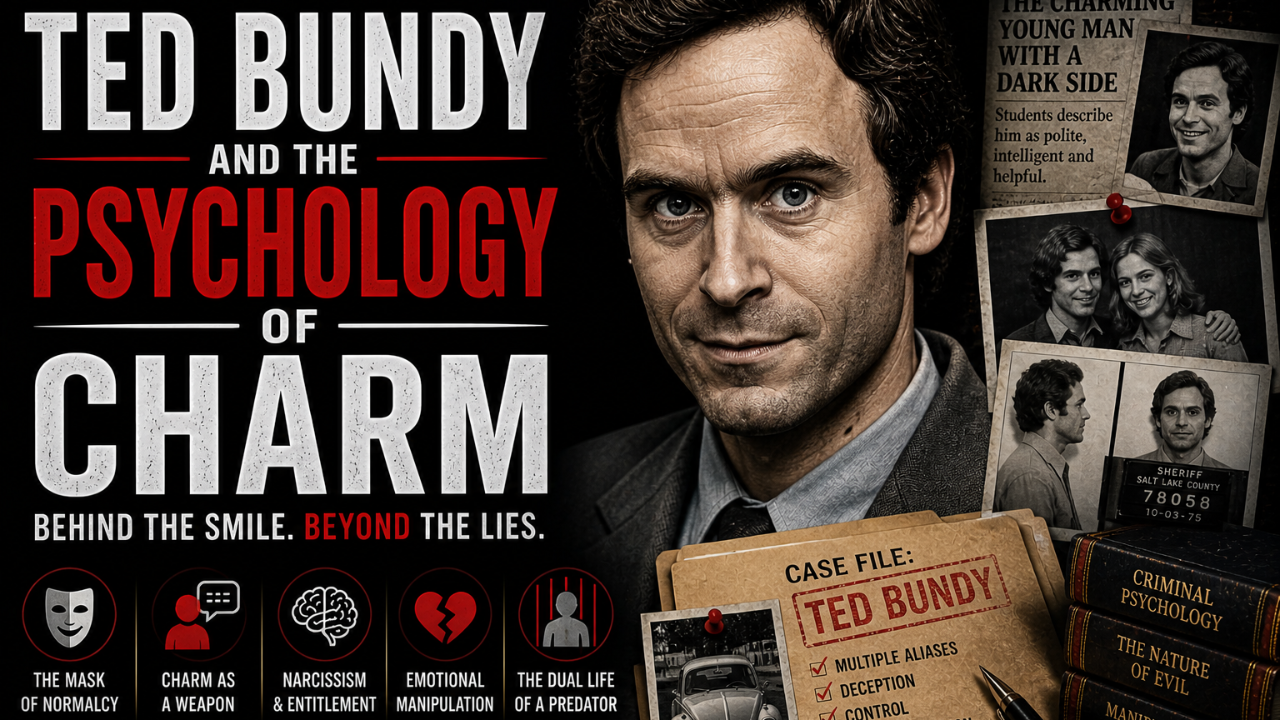
Ted Bundy used the psychology of charm as camouflage. He weaponised social fluency, good looks, and verbal confidence to lower his victims' defences before he killed them. Bundy was not a criminal genius. He was a skilled performer who understood that human beings rarely assess danger logically, and that warmth, eye contact, and a polite request can override the instinct to flee, even in people who pride themselves on being careful.
 Most accounts of Ted Bundy get the story wrong in the first five minutes. They settle for the lazy version of a "monster who looked normal" and call the matter closed. That conclusion teaches you nothing useful and lets predators keep working in plain sight. The interesting part of his story is not that he hid. It is how trust gets weaponised in any social setting, by anyone willing to study people the way he did. Once you see the mechanism, you cannot unsee it.
By the time Bundy was electrocuted in Florida in 1989, he had confessed to thirty murders across at least seven states, and investigators believed the real number was higher. He had also slipped his handcuffs twice, talked his way past witnesses, and convinced strangers to help him carry victims to his car. The man understood persuasion at a level most professional negotiators never reach. So, the question worth chewing on is not how he did it. It is why people kept letting him.
Want the uncut breakdown? Grab Ted Bundy Decoded: Inside The Dark and Dangerous Mind of a Serial Killer on Amazon. Every chapter peels another layer off the mask.
Who Was Ted Bundy and Why Charm Was His Weapon
Theodore Robert Bundy was born in November 1946 in Burlington, Vermont. His mother was unmarried and 22 years old, which in the cultural climate of the time was treated as a scandal worth hiding. For years he was raised believing his grandparents were his parents and that his mother was his sister. The lie was clumsy, and when the truth eventually surfaced, something inside the boy curdled. That sense of betrayal seeded a lifelong relationship with deceit. Lying did not feel wrong to him. It felt familiar, like the ordinary weather of a household he could not quite trust.
He grew up bright, articulate, and physically attractive. Teachers liked him. Girls liked him. Law professors later wrote glowing recommendations. He volunteered on a Seattle suicide hotline alongside Ann Rule, the future crime writer and former police officer. Rule, a woman with sharp instincts and a trained ear for menace, would say openly that she never picked up the slightest whiff of danger from him. None. That fact alone tells you most of what you need to know about the limits of intuition when someone has been studying you the whole time.
You do not become Ted Bundy by accident. He cultivated charm with the discipline of a professional athlete training a muscle. He watched, he mirrored, he adjusted, and he learned what made strangers relax. By the time he started killing in his late twenties, his social toolkit was sharper than most therapists' bedside manner.
The Childhood That Built a Predator in a Suit
Look closely at any serial offender's early years and you will usually find one of three patterns. Physical violence at home. Sexual abuse. Or a quieter rot, where a child grows up emotionally invisible inside a household full of secrets. Bundy's history leans heavily towards the third, with hints of the first stirred in. There are accounts of a violent grandfather, of cruelty to small animals, and of a young boy obsessed with knives, once placing them in a circle around the body of a sleeping aunt. None of that, on its own, manufactures a killer. It does, however, build the scaffolding.
Researchers studying violent offenders have long pointed to attachment failures and shame as quiet engines of cruelty. A child who learns young that the truth is dangerous, that warmth is conditional, and that adults can rewrite reality at will, often grows up internalising one terrifying lesson. People can be rewritten. If people can be rewritten, they can also be used. That cognitive shortcut, harmless in a salesman, becomes lethal in a sadist.
Bundy began stealing in his teens. He shoplifted, he peeped through windows after dark, and he discovered that watching a stranger without their knowledge gave him a thrill ordinary social life never delivered. Voyeurism for him was not a passing curiosity. It was rehearsal. The fantasy life he constructed behind those windows would, years later, be enacted on real women. Forensic psychologists know the curve well. Voyeur to stalker to predator is a documented escalation, and Bundy walked it almost as a textbook example.
The Dark Triad Hiding Behind a Friendly Smile
Three traits, when stacked together, account for a frightening proportion of human cruelty. Psychopathy, which is the absence of empathy and remorse. Narcissism, which is grandiosity, entitlement, and a need to dominate the story. Machiavellianism, which is cold, strategic manipulation. Psychologists call this cluster the Dark Triad, and Bundy lit up all three corners.
The psychopathy showed in his complete failure to feel anything resembling guilt. In interviews, he discussed bludgeoning women with the casual tone of a man describing a fishing trip. The narcissism showed in his decision to act as his own attorney, in his contempt for judges, and in his apparent belief that he could outrun the entire American legal system on charisma alone. The Machiavellian thread tied it all together. He planned. He chose isolated locations. He varied his methods. He used props, including a fake plaster cast on his arm, to bait sympathy from women in public spaces. Predators rarely overpower first. They disarm first, and Bundy was a master of the disarm.
This cluster is precisely why so many decent people misread him. We expect cold, manipulative people to feel cold. We expect entitled people to come across as arrogant. The Dark Triad does not announce itself with horns and a cape. It announces itself with a clipboard, a soft voice, and a problem you might want to help with.
How Ted Bundy Hunted Women Without Triggering Alarms
Bundy's modus operandi was elegant and repeatable. He would approach a young woman in a public place, often a campus, a park, or a beach. He would wear a sling or use crutches and ask for help carrying books or a sailboat to his Volkswagen Beetle. Once she was close to the car, he would strike her with a crowbar and drive her to a remote spot where he could attack her at length. The killings were sexual, sadistic, and ritualistic. He returned to some of the bodies multiple times, an act forensic profilers regard as one of the clearest markers of compulsive sexual sadism.
What made the method work was not the violence. It was the approach. Public, visible, polite. He counted on three social pressures working in his favour. The pressure to be helpful, especially in young women conditioned to caretaking. The pressure to be polite, especially when refusing feels rude. And the pressure to override gut instinct in favour of social appearances. Predators have always known how to weaponise these reflexes, and Bundy may have been the most chilling student of them on record.
His choice of car was no accident either. The Volkswagen Beetle looked friendly, unthreatening, almost cartoonish. It had nothing in common with the windowless van of horror movie shorthand. Even the vehicle was an extension of the same operating principle that ran through every other part of his life. Make the dangerous thing look safe.
If you want to see how he picked his victims, what he said to them, and the precise moments he flipped from suitor to attacker, grab the Ted Bundy Decoded book on Amazon. It walks you through the full playbook beat by beat.
The Halo Effect That Kept Him Free for Years
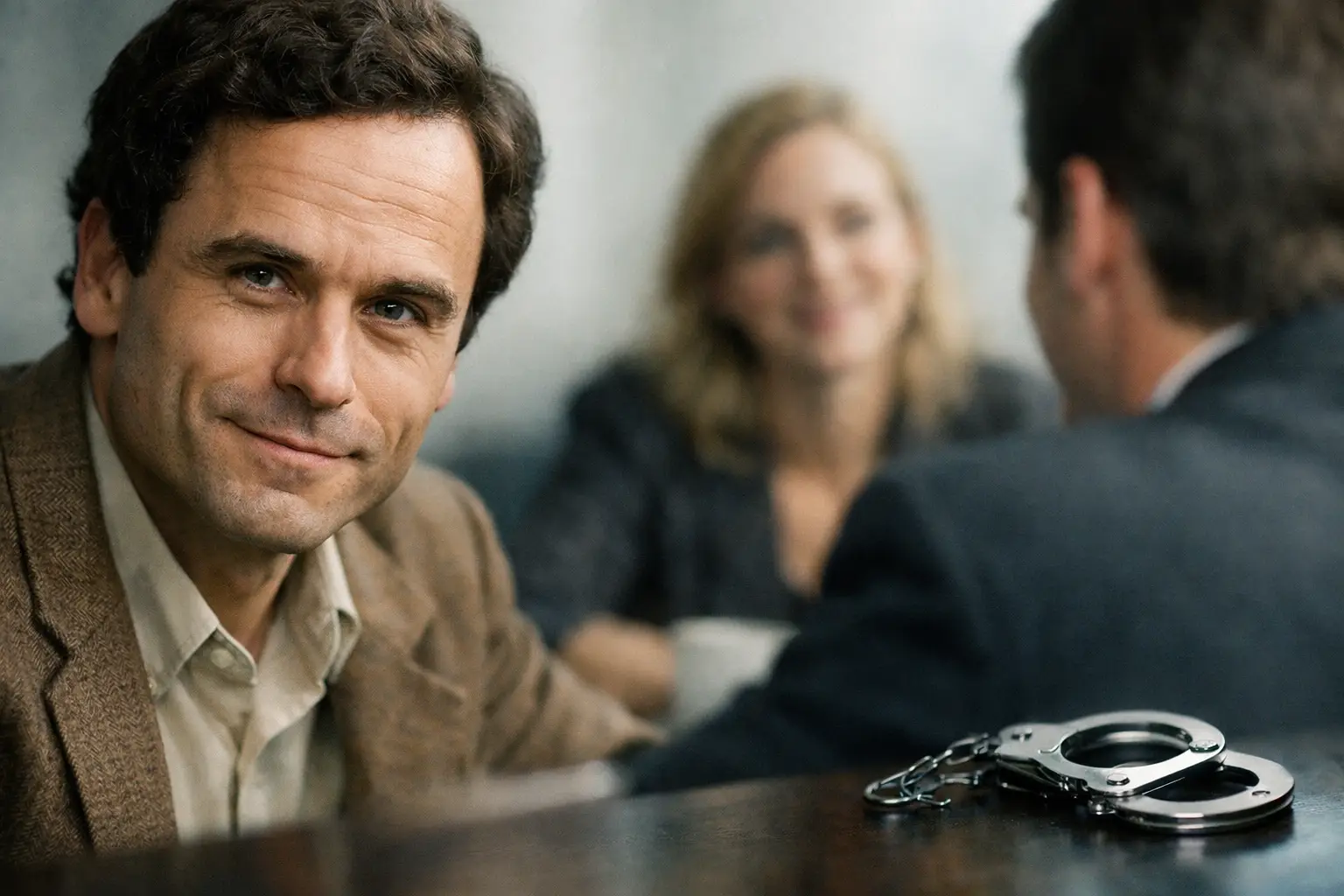
If you only learn one psychology term from the Bundy story, make it the halo effect. This is the well-documented bias where attractive, articulate, or confident people are assumed to also be moral, honest, and safe. The bias runs underneath conscious thought, which is what makes it so dangerous. Even when an interaction feels off, the brain quietly defends its first impression rather than upgrading the threat.
Bundy benefited from this bias at every turn. Police questioned him, then released him. Witnesses described his eyes as warm. Female jurors smiled at him in court. Judge Edward Cowart, who eventually sentenced him to death, famously told him he would have made a fine attorney, and that he bore him no personal animosity. Read that line again. A judge who had just heard the evidence of necrophilia and decapitation went out of his way to compliment the killer.
The same bias that protected Bundy in the 1970s still operates in your office, your dating app, and your social feed. Confident speakers are mistaken for honest ones. Symmetrical faces get treated as kinder. Polished communicators are handed trust they have not earned. None of that means every charming person is a predator. It means charm alone is not evidence of character. Decoding people properly takes a different lens, one that ignores the surface and reads pattern over time.
The Capture That Came Too Late
Bundy's downfall came less from forensic brilliance and more from his own arrogance. After two prison escapes, including a now infamous leap from a Colorado courthouse window, he made his way to Florida in 1978. There, in a single night at the Chi Omega sorority house at Florida State University, he attacked four women, killing two and leaving the survivors with horrific injuries. Weeks later, he abducted and murdered 12-year-old Kimberly Leach, the youngest victim attributed to him.
The Chi Omega attacks left bite marks on the body of one of the victims. That single act of arrogance, biting a woman in a frenzy, gave investigators dental impressions that matched Bundy's distinctive teeth. Forensic odontology evidence helped seal his conviction. He had spent years choosing weapons that left untraceable wounds, then betrayed himself with his own mouth.
His final years on death row read like a study in narcissistic collapse. He gave a long interview to evangelist James Dobson the day before his execution, blaming pornography for what he had done. The performance was vintage Bundy. Externalising blame, manufacturing sympathy, and reframing a sadist as a tragic figure of circumstance. The FBI's behavioural research on serial offenders has long noted this pattern of strategic remorse, where the apology itself is yet another tool aimed at the listener.
What Ted Bundy Teaches You About Spotting Predators
You do not need to live in fear to take Bundy's lessons seriously. You need a slightly cleaner read on people. Three habits tend to do most of the work. First, watch for inconsistencies between someone's words and their behaviour over time. Manipulators perform sincerity. They rarely sustain it. Second, take your discomfort seriously, even when you cannot articulate it. The body often clocks danger before the conscious mind catches up. Third, lower the social cost of saying no. Most predators feed on politeness. People who can decline without apologising are far less interesting to them.
This is why forensic psychology beats pop true crime every time. The popcorn version of the Bundy story leaves you entertained but no safer. The psychological version, the one that asks why he worked, gives you tools you can carry into the rest of your life. Reading true crime through a psychology lens turns the genre into a self-defence course rather than a horror reel.
The final piece of the puzzle is humility about your own judgement. Smart people are not immune to manipulation. In some studies, they are more vulnerable, because they trust their reasoning more than their gut. Behaviour-sequence analyses of serial offenders repeatedly show that intelligent victims rationalised away early warning signs out of a desire not to seem rude or paranoid. That hesitation is the very thing predators count on.
The Question Nobody Asks About Ted Bundy
The popular question is always, how did he get away with it for so long? The better question is, what made so many otherwise decent, clever people unable to see him? The honest answer involves something most of us would rather not admit. Trust runs on shortcuts. We walk through the world handing out provisional credibility based on appearance, accent, posture, and confidence. We must, because there is not enough time to interrogate every stranger on a sidewalk. The shortcut is mostly fine, until someone learns how to pose as the kind of person we are wired to trust.
That is the disturbing legacy of Ted Bundy. He proves that the architecture of human trust has known weak points and that any sufficiently motivated predator can study them. Compare him with Jeffrey Dahmer, who relied more on isolation and intoxication than on charm, and you start to see that there is no single template for evil. There are different doors into the same dark room, and Bundy walked through the one labelled "friendly".
The other question worth sitting with concerns you. What would it take, in your daily life, to start trusting your own warning signals more than your fear of being rude? That single shift, made consistently, would have saved several of his victims. It is also one of the few defences that works against the future Bundys, the ones we have not heard of yet, who are right now building their own version of the same charm machine in front of someone who wants to be helpful.
What Readers Are Saying
"I have been reading about Bundy for twenty years, and Craig Beck still found angles I had never seen. The chapter on the halo effect alone changed how I read people at work." Marissa Holloway, Phoenix, Arizona
"This is the first true crime book that gave me something useful instead of just a sick fascination. My teenage daughter is reading it now and we are talking about it together." Daniel Ortiz, Cleveland, Ohio
"Beck writes like a friend at a pub, but the psychology is razor sharp. I could not put it down. Already pre-ordered the next one." Rebecca Lin, Sacramento, California
Ready to read the full case study? Ted Bundy Decoded: Inside The Dark and Dangerous Mind of a Serial Killer is on Amazon now in paperback, Kindle, and audiobook. Worth the price for the chapter on his courtroom theatrics alone.
Frequently Asked Questions
Was Ted Bundy genuinely charming, or did people invent that after the fact?
The charm was real and contemporaneous. Co-workers, ex-girlfriends, professors, and even police officers described him as warm, articulate, and unusually socially fluent long before any crimes came to light. Ann Rule, who worked beside him on a Seattle suicide hotline, wrote that she found him gentle, kind, and self-effacing. Charm was not a posthumous narrative invented by documentary makers. It was the working tool that made his crimes possible in the first place.
Did Ted Bundy have a high IQ?
Bundy's measured IQ was reportedly around 124, which sits in the bright-normal range, well above average but not exceptional. Popular culture has inflated him into a genius, partly because the alternative is uncomfortable. The truth is that an averagely clever man with strong social skills and total emotional detachment can do more damage than a brilliant one with a conscience. His real edge was psychological, not intellectual, and that is what makes the case so unsettling.
What is the single biggest lesson from the Ted Bundy case?
The biggest lesson is that personality is a performance, and confident performances are the easiest to misread. Predators often present as friendly, helpful, and even vulnerable. Treat charm as data, not as evidence of character. Watch behaviour over time. Take your discomfort seriously. The people most resistant to manipulation are the ones who refuse to confuse social polish with moral substance, and who say no without flinching.
About the Author
 Craig Beck is widely regarded as the world's foremost expert on persuasion and human behaviour. A certified NLP Master Practitioner, former UK broadcaster, and bestselling author of more than one hundred books, he has spent two decades reverse-engineering why people say yes. Over a million readers around the world use his work to understand the hidden mechanics of influence, decision-making, and motivation. He does not deal in theory. He shows you, in plain language, how the wiring of humanity really fits together.
Last updated: 2 May 2026