Harold Shipman and the Psychology of Evil Behind Trust | Craig Beck
May 05, 2026Harold Shipman and the Psychology of Evil
Harold Shipman was a British general practitioner who murdered at least 215 of his own patients between 1975 and 1998, making him one of the most prolific serial killers in recorded history. The Shipman Inquiry concluded the true figure may sit closer to 250. He killed using lethal injections of diamorphine, exploiting the unconditional trust patients placed in their family doctor. His psychology reveals a chilling blend of grandiosity, emotional detachment, and quiet control, all hidden behind the mask of respectability.
 Most people look at Harold Shipman and ask the wrong question. They want to know how a doctor could kill so many patients without being caught. That question matters, but it skims the surface. The harder question, the one that crawls under your skin and stays there, is this. What kind of mind can wear the costume of trust so completely that even mourning becomes a useful disguise?
Here is where the story stops being conventional true crime and starts becoming a brutal seminar in human psychology. Shipman was not a chaotic monster lurking in a back alley. He was disciplined, respectable, and socially decorated. He understood authority, ritual, and perception. He knew that if you look like the answer, people stop questioning the problem. He turned that insight into a weapon, and the weapon worked for nearly a quarter of a century.
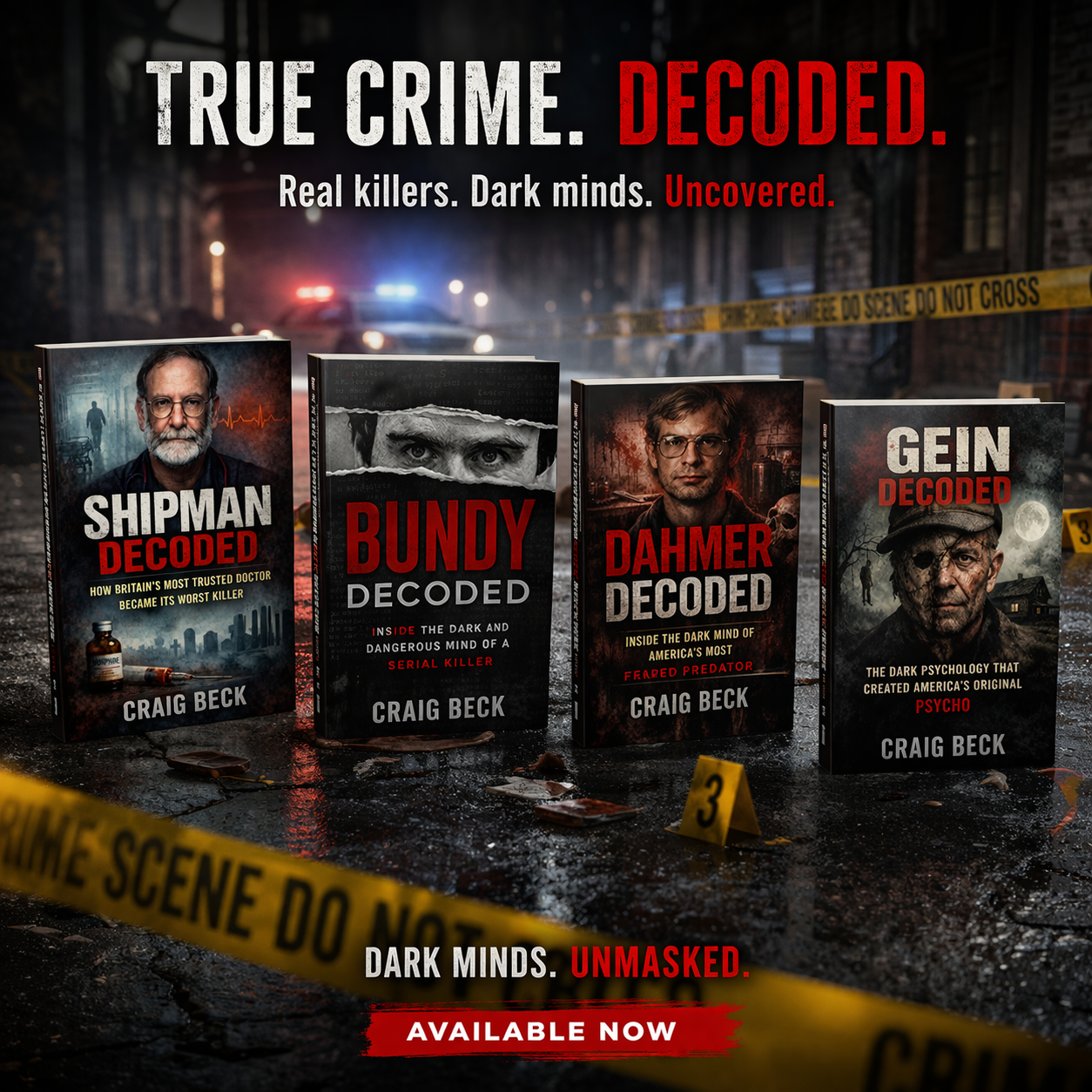
If you want the unflinching breakdown of how a quiet doctor murdered hundreds while signing his own death certificates, Harold Shipman Psychological Profile: The Killer Doctor walks you through every layer of his mind, available now on Amazon.
Who Was Harold Shipman, the Doctor Patients Trusted
Harold Frederick Shipman was born in Nottingham in 1946, the second of four children in a working class family. His mother, Vera, was the gravitational pull of his early life. When she died of lung cancer in 1963, the seventeen year old watched the family doctor administer morphine in her final weeks to ease her pain. That image, the calm professional with the syringe, would echo through his entire adult career. The reverence he held for his mother bled into a strange reverence for the chemical that gave her relief, and later for the act of administering it himself.
He studied medicine at Leeds University, married a young woman called Primrose Oxtoby, and became a respected family doctor in West Yorkshire and later Hyde, Greater Manchester. By every external measure he was a model citizen. He sat on local committees. He turned up to community events. He knew his patients by name and remembered their grandchildren. The town saw a hardworking GP with a tidy beard and a brisk bedside manner. What it did not see was a man who had been quietly lethal since the early 1970s.
The Childhood That Shaped a Future Killer Doctor
Childhood is not destiny, but it is often the blueprint. In Shipman's case, two threads stand out. The first was his mother's death and the morphine that softened it. The second was a sense of intellectual superiority that began early and never left him. Teachers described him as bright but socially detached. Classmates remembered a boy who preferred to keep his own company, who carried a small private smile that suggested he knew something nobody else did.
Bereavement at seventeen can fracture a young mind in many directions. For most teenagers it produces grief, anger, or a long quiet ache. For Shipman it appears to have produced something colder. He saw, in his mother's final weeks, a doctor with absolute authority to alter another human being's experience of life and death. That authority did not frighten him. It fascinated him. The doctor was the calm centre of a storm that was killing the most important person in his world. To a boy already inclined toward control, that role looked less like service and more like power.
Across the body of psychology based biography, you see the same pattern in different costumes. The early imprint becomes the adult template. With Shipman, the syringe became sacred and the role of the dispensing doctor became the only mask that ever fit him properly. He spent the rest of his life rehearsing it.
The Dark Triad Hidden Behind the Stethoscope
Forensic psychologists describe a cluster of traits called the Dark Triad. Psychopathy strips out empathy and remorse. Narcissism inflates self importance and treats other people as supporting characters. Machiavellianism brings cold strategy and a willingness to manipulate without flinching. Most adults carry shadows of these traits in small, manageable doses. In rare individuals they fuse into something dangerous. Harold Shipman was almost a textbook example, although he never produced the loud, theatrical version most people picture.
His narcissism was understated and corrosive. Colleagues recalled how he loved correcting younger doctors, how he carried a dismissive air with anyone he considered beneath him, how he treated junior staff and pharmacists like irritations. His psychopathy showed in the absence of guilt around death certificates. He signed them with the brisk efficiency of a man stamping invoices. His Machiavellianism revealed itself in his record keeping. He altered patient files to support his cover stories, sometimes adjusting medical histories after the patient was already dead, building a paper trail that pointed neatly away from him.
What made his version of the Dark Triad lethal was its packaging. He did not shout. He did not bully. He did not flirt with notoriety. He looked dependable, and dependable people are rarely audited. If you spend any time studying why serial killers keep fooling us, you see the same pattern again and again. The most effective predators understand camouflage better than they understand cruelty.
How Harold Shipman Selected and Murdered His Patients
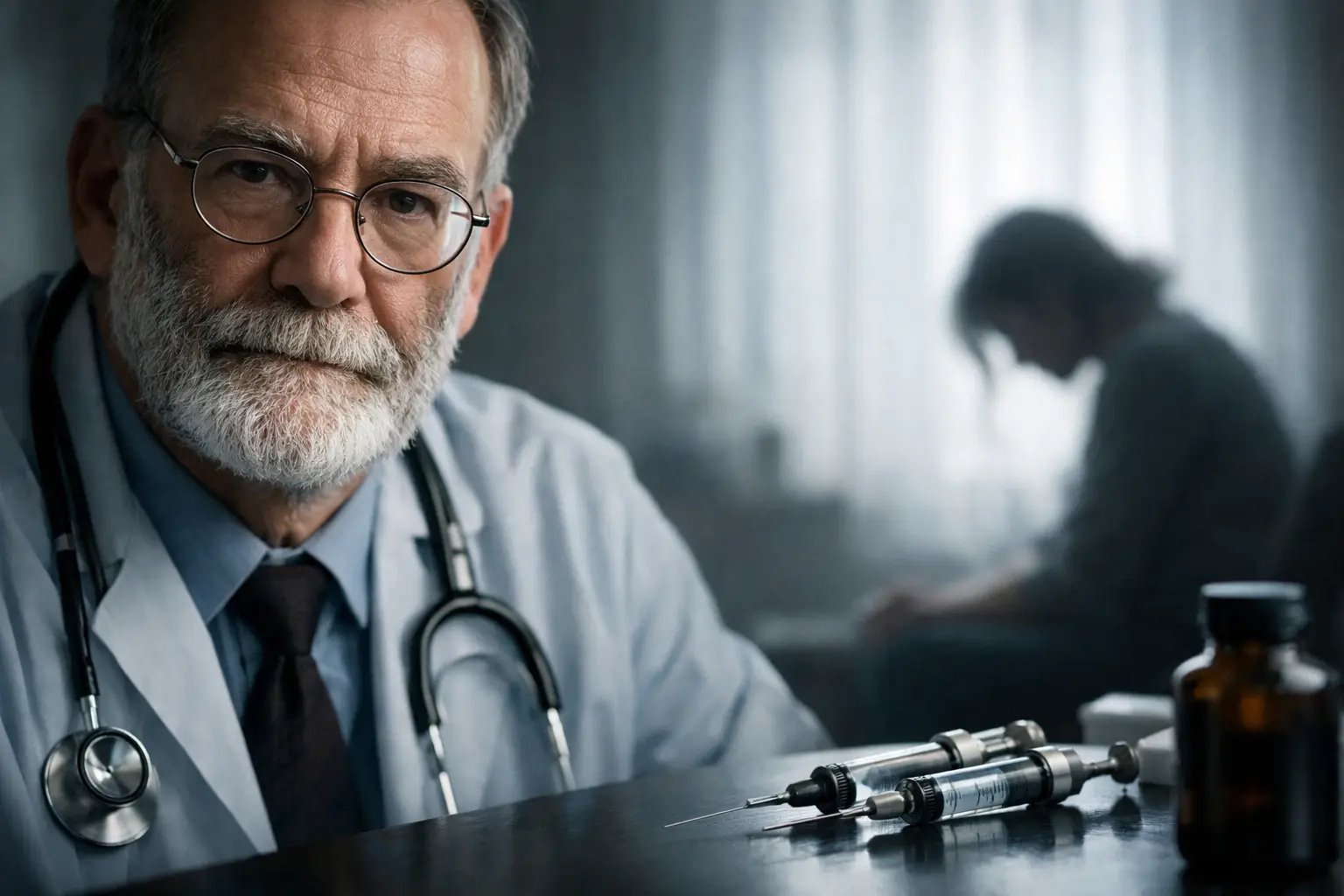
Shipman's victim profile was disturbingly consistent. The vast majority were elderly women living alone, many of whom adored him. He visited them in their homes, often on the pretext of a routine check, sometimes invited in for a cup of tea. He carried his medical bag with its small glass vials and the practised calm of a man who had done this before. Diamorphine, the medical name for heroin, became his weapon of choice. A lethal dose can be administered in seconds and produces a death that mimics the natural decline of an elderly body.
He often sat with the body for a few minutes after death. Sometimes he made a phone call to a relative, breaking the news with the same composed voice he used for prescriptions. On occasion he stayed long enough to alter the patient's medical record, inventing chronic conditions that would make sudden death look unsurprising. He then signed the certificate himself and recommended cremation, which conveniently destroyed the evidence. By the late 1990s, undertakers in Hyde had begun to notice that an unusual number of Shipman's patients seemed to die fully clothed, sitting upright in chairs, in the middle of the afternoon.
The pattern points to the mechanics of his routine. Most natural deaths in elderly patients happen at night, in bed, after a period of decline. Shipman's victims dropped during home visits, in normal clothes, with no warning. The signal was visible long before anyone joined the dots. The system trusted him so completely that the dots stayed apart for over two decades.
Ready to step further inside the case? Harold Shipman Psychological Profile: The Killer Doctor is the deeper dive, and it will reframe how you read trust forever.
The Forged Will That Finally Unmasked Him
Arrogance is often the trait that finishes a long career of deceit. Shipman's downfall began in June 1998 with the death of Kathleen Grundy, an 81 year old former mayor of Hyde and one of his patients. She was wealthy, sharp minded, and showed no sign of decline. Days after her death, a will surfaced leaving her entire estate, around 386,000 pounds, to Shipman himself. Her daughter, Angela Woodruff, was a solicitor. She read the document, looked at the typing, and knew immediately that something was wrong.
Mrs Grundy's body was exhumed. Toxicology found a fatal level of diamorphine. Police obtained the typewriter from Shipman's surgery and matched it to the forged will. Once the investigation widened, the bodies kept coming. Other exhumed patients showed the same chemical signature. By the time of his trial in October 1999, the case against him had become overwhelming. He was convicted in January 2000 of fifteen murders, although the subsequent inquiry concluded he had likely killed at least 215 people, with another 45 deaths considered suspicious.
The forged will is the part of the story that students of human behaviour return to most often. After decades of careful, almost invisible killing, why did he gamble everything on a clumsy document any solicitor could spot? The most plausible answer is that grandiosity finally outran discipline. He had grown so confident in his ability to control narratives that he assumed nobody would dare challenge his version of events. That is the moment when many serial offenders make the mistake that ends them. They believe their own myth.
What the Shipman Inquiry Exposed About Authority
The Shipman Inquiry, chaired by Dame Janet Smith, produced six volumes of findings between 2002 and 2005. Its conclusions reach far beyond one rogue doctor. The Inquiry exposed how a system built on professional courtesy could be bent into a shield. Coroners did not question the same GP signing dozens of unusual death certificates. Cremation forms were countersigned with little scrutiny. Pharmacists noticed Shipman ordering large quantities of diamorphine but assumed legitimate clinical use. The institutional reflex was to defer, never to investigate.
You can read the Inquiry's published volumes through the UK National Archives, and the BBC's coverage of his conviction sits on the BBC News archive. The findings rebuilt how British coroners review GP deaths and led directly to revalidation requirements that still shape NHS practice today. None of those reforms bring back his victims, but they exist because one man proved how easily a respected role could be turned into a hunting licence.
The deeper lesson is psychological. Authority is a persuasion shortcut. The brain treats credentials as evidence of character, and the moment that shortcut takes over, scrutiny falls asleep. Robert Cialdini, the godfather of modern influence research, identified authority as one of the six core levers that move human behaviour. Shipman did not need to study Cialdini. He intuited the principle and lived inside it.
Why Evil Rarely Looks the Way You Expect
There is a comforting myth that truly dangerous people must look obviously disturbed. The myth survives because it protects us from a darker truth. Some of the most destructive individuals look stable, composed, and highly functional. They are the office colleague who runs the charity collection. They are the neighbour who waves you in at the school gate. They are the man in the white coat with the steady voice and the diary full of appointments.
Shipman was not effective because he looked unhinged. He was effective because he looked like the safest person in the room. Compare him with someone like Ted Bundy, whose charm was loud and almost theatrical, or Dennis Nilsen, who hid behind the dull rituals of a civil service job. Different costumes, the same trick. Each man understood that the camouflage of normality is more powerful than the armour of menace. Bundy seduced. Nilsen blended. Shipman healed.
Friedrich Nietzsche warned that whoever fights monsters should take care not to become one, and that if you stare into the abyss long enough, the abyss stares back. Shipman is the rare case where the monster never had to fight anyone. He simply walked into living rooms with a smile, a leather bag, and a syringe, and the abyss wore a tweed jacket. That is why the case still chills anyone who reads it carefully. It rewires what you assume about safety.
The Question Nobody Asks About Harold Shipman
Most coverage focuses on what Shipman did. The braver question is why so many capable, well meaning people around him failed to see it. Receptionists noticed the patterns. Undertakers commented on the strange uniformity of his patients' deaths. A neighbouring GP, Dr Linda Reynolds, raised the alarm in 1998 after spotting the unusual cremation certificate volume. Her concerns were initially dismissed by the local coroner's office as too speculative to act on. Months later, after Kathleen Grundy died, the same suspicions became undeniable.
The uncomfortable truth is that institutions protect themselves before they protect the public. Bureaucracies are allergic to scandal, and a respected GP killing patients in a quiet northern town threatened a great deal more than one practice. To investigate properly meant questioning a profession that had insulated itself from challenge. Shipman exploited that allergy with surgical precision. He understood that calm authority is rarely interrupted, and he kept his voice down for twenty four years.
If you take one thing from his story, take this. Persuasion is not always loud. It is often a stethoscope, a soft voice, and a confident signature on a piece of paper. Anyone studying real influence eventually arrives at the same conclusion. The most powerful manipulators do not perform power. They wear it like a uniform and let the rest of the world fill in the gaps. To explore that machinery further, the best books on dark psychology are a useful next stop.
What Readers Are Saying
Marcus Reynolds, Denver, Colorado: "I have read a stack of true crime books over the years and most of them just rehash the headlines. This one explains why Shipman was able to do what he did. The chapter on authority bias alone is worth the price of admission."
Sarah Whitman, Charleston, South Carolina: "Craig Beck has a way of writing about dark subjects without ever feeling exploitative. He treats the victims with respect and uses the case to teach you something useful about human nature. I bought it on a Sunday and finished it before lunch on Monday."
James Caldwell, Portland, Oregon: "If you have ever wondered how a serial killer hides in plain sight for decades, this is the book. The psychology is sharp, the storytelling is gripping, and the lessons translate into everyday life."
If understanding evil is the only real defence against it, your next move is the full study. Harold Shipman Psychological Profile: The Killer Doctor is on Amazon now, and it finishes the story this article only opens.
About The Author
 Craig Beck is the world's foremost expert on persuasion and human behaviour. A certified NLP Master Practitioner, former broadcaster, and bestselling author of more than one hundred books, he has spent two decades reverse engineering why people say yes. More than a million readers around the world have used his work to understand the hidden mechanics of influence, decision making, and motivation. He does not teach theory. He shows you how the wiring of humanity really fires.
Last updated 5 May 2026.
FAQ
How many people did Harold Shipman murder?
Shipman was convicted of fifteen murders in January 2000, but the official Shipman Inquiry led by Dame Janet Smith concluded he killed at least 215 patients, with another 45 deaths considered suspicious. Most experts believe the true figure sits between 215 and 260, which would make him the most prolific serial killer in modern British history. The exact total will never be known because so many of his victims were cremated before suspicion arose, leaving no toxicological evidence to recover years later.
Why did Harold Shipman kill his patients?
No single motive explains it, and Shipman never confessed or offered an explanation. The likeliest psychological drivers were a need for absolute control, an attachment to morphine that traced back to his mother's death, and a grandiose belief that he had the right to decide who lived and died. He took no obvious sexual or financial gratification from the killings, which is rare among serial offenders. His drive appears to have been internal, ritualised, and rooted in the role of the all powerful doctor.
How was Harold Shipman finally caught?
His arrest was triggered by a clumsily forged will. After Kathleen Grundy died suddenly in June 1998, a document appeared leaving her entire estate to Shipman. Her daughter, a solicitor, recognised the forgery, contacted police, and Mrs Grundy's body was exhumed. Toxicology revealed a lethal dose of diamorphine. The investigation expanded rapidly, more victims were exhumed, and Shipman was charged with fifteen murders. He was convicted in January 2000 and hanged himself in his prison cell in January 2004.