Why True Crime Hooks the Human Mind: The Dark Truth | Craig Beck
May 04, 2026Why True Crime Hooks the Human Mind
Why does true crime hook the human mind so completely? Because the format forces your brain to do three things at once. It rehearses danger from a safe seat. It decodes deception you might face in real life. And it imposes order on chaos that quietly terrifies you. True crime is not a morbid hobby. It is a survival simulation dressed up as entertainment, and your obsession with serial killers, missing persons and unsolved murders is your nervous system attempting to protect you, even when the price of that protection is a creeping anxiety you never bargained for.
 That answer might sound dramatic. It is also accurate. The pop culture explanation says people love true crime because they enjoy a puzzle and crave a tidy ending. That story is half right and mostly lazy. It misses the deeper machinery underneath. So, let us pull the bonnet off and look at the engine, because what is happening when you press play on yet another documentary at one in the morning is far stranger than mere curiosity.
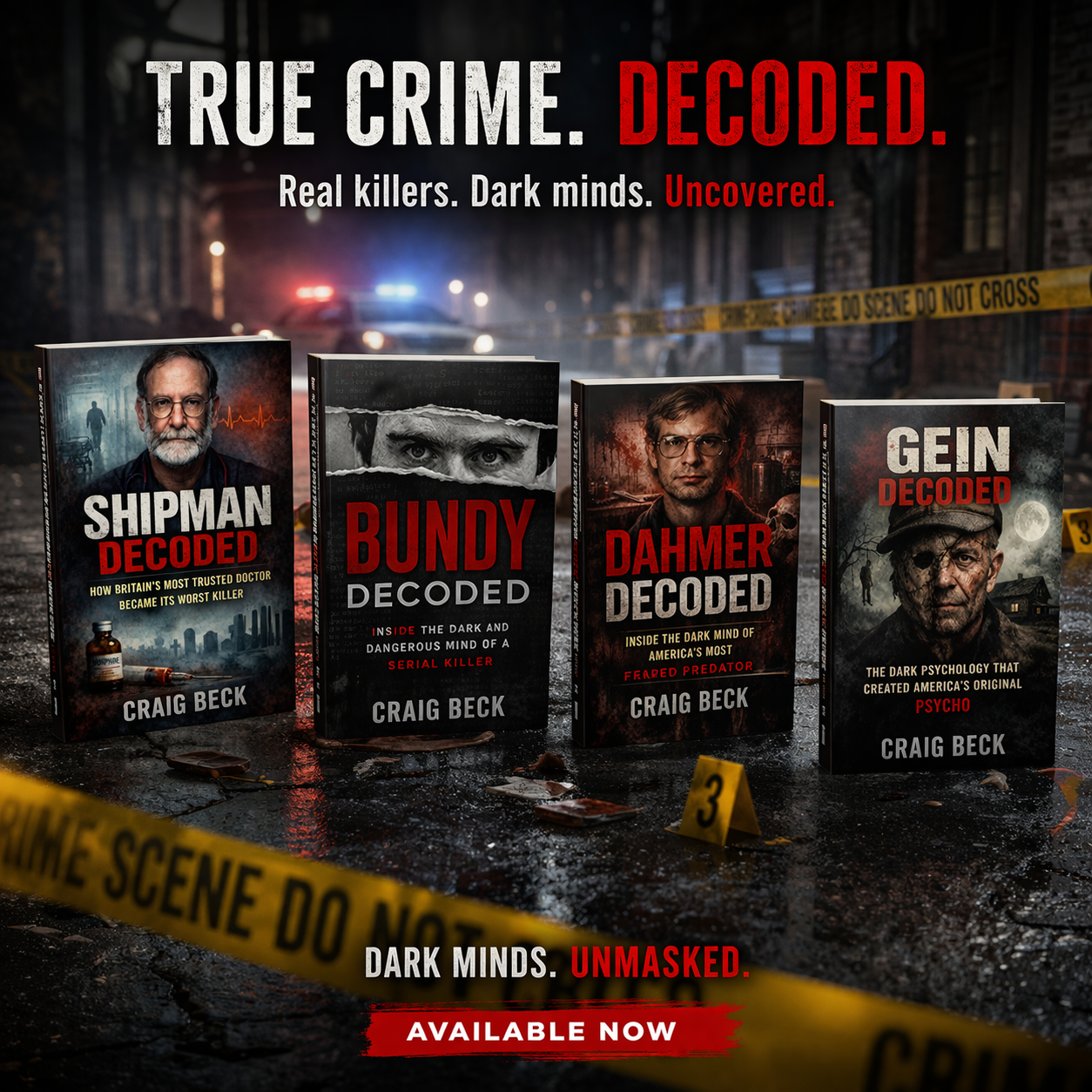
Want to see the dark triad operating in pinstripes and a stethoscope? Read Harold Shipman: Psychological Profile of the Killer Doctor on Amazon, and meet a man who killed more patients than most diseases.
The Survival Wiring You Did Not Know You Had
Long before anyone binge-watched a documentary, your ancestors lived in a world where the wrong stranger near the campfire could mean the difference between waking up and not. Their brains evolved to scan every face for threat, memorise patterns of betrayal and study the warning signs of predators. You inherited that hardware. It still hums quietly in the background of your modern life, even when the only predator near you is a pigeon eyeing your sandwich on a park bench.
True crime feeds that ancient circuitry. Each case becomes a low stakes drill for high stakes situations you hope you never face. When you watch a charming neighbour reveal himself as a killer, your brain quietly files the data. Charm without warmth. The sudden temper. The reasonable explanation that does not quite add up. You are building a personal library of red flags, and the format keeps shipping fresh material every week without ever sending you an invoice.
This is why people often confess they find true crime relaxing, a sentence that sounds completely unhinged on its face. They are not relaxed by the violence. They are relaxed by the feeling of control that the study creates. The brain loves resolved uncertainty. A case with a confession, a sentence and a clear motive feels safer than ambiguous everyday life. You leave the screen thinking, I see how that works now. I would catch it earlier. That hit of false competence is half the addiction.
How True Crime Hooks the Human Mind Through Threat Rehearsal
Cognitive psychologists have a term for what happens when you imagine a frightening scenario in detail without living through it. They call it threat rehearsal. The brain treats vivid imagination as a kind of practice run. Athletes use the same mechanism deliberately, walking through races mentally before they happen so the body recognises the choreography on the day. True crime hijacks that same system, often without your permission, and that is where the obsession really begins.
When you follow a case, your mind asks the questions every potential victim should ask. Why did she trust him. What did the family miss. Where was the moment to walk away. These are not idle puzzles. They are protective rehearsals wearing a documentary mask. Research summarised by the American Psychological Association notes that women especially gravitate toward this kind of storytelling because it offers vicarious lessons about avoiding harm.
That information has real value. Predators rarely leap out of bushes. They live next door, share custody, fix the boiler, run the local choir, work in the next office and walk children to school. True crime forces you to picture danger wearing the most ordinary face possible, which is the only useful face to picture, because the cinematic version has never matched reality. The horror in the everyday is the horror you must learn to read.
The Dark Triad in Plain Sight
Here is where true crime stops being fluffy and turns properly educational. Most cases that obsess audiences feature offenders who score high on what psychologists call the dark triad. Psychopathy. Narcissism. Machiavellianism. No empathy, an inflated sense of self, and a cold strategic willingness to use other people as instruments. You meet that combination in the office, on dating apps and at family gatherings far more often than you meet it in a police interview room.
True crime delivers a free masterclass in spotting it. The flat affect that does not match the words. The story that mutates subtly each time it is told. The performance of grief that feels staged. The charisma that turns out to have no warmth behind it. Once you have studied a few cases through that lens, you begin to recognise smaller versions of the same pattern in your own life. The boss who lies smoothly. The friend who only ever needs. The partner who weaponises charm and calls it love.
That recognition is uncomfortable, which is why so many people resist it. It is far easier to believe predators are exotic creatures than to accept they are usually ordinary people with broken empathy circuits and well honed manipulation skills. The audience that learns to see this clearly is harder to fool. That alone is reason enough to keep paying attention, provided you do it with a touch of detachment and a steady eye on your own reactions.
When Your Nervous System Picks Up the Tab
There is a price tag on this education, and most viewers never read it. Your brain is hopeless at calculating real world probability when emotion is loud. Watch enough cases of strangers turning out to be killers and you begin to feel that strangers are the threat. The real figures, tracked by agencies like the FBI, point relentlessly toward people the victim already knew. Partners. Former partners. Family members. Acquaintances. The cinematic stranger in a van is the rarest version of the story, despite being the most filmed.
If you binge for hours every night, you are not becoming sharper. You are becoming more anxious, more suspicious, and possibly less able to read situations accurately. Hypervigilance is exhausting. It taxes sleep. It darkens mood. It can quietly turn relationships sour because every small inconsistency starts to feel sinister. The wisdom you were chasing slips into a low grade dread that no podcast warns you about, and you stop noticing how much energy you spend bracing for things that are not coming.
That does not mean you should switch off. It means you should watch how the genre lands inside you. If you finish an episode feeling curious, more alert to manipulation and a little wiser about people, the trade is fair. If you finish it scanning the bedroom door, struggling to trust anyone new, or replaying worst case scenarios involving your loved ones, your nervous system is overpaying for the lesson. The body keeps the bill.
If this thread has pulled you in and you want a proper case study in calm, smiling evil, Harold Shipman Decoded: The Killer Doctor is on Amazon now and goes far deeper than any documentary will dare.
Why The Boring Suspects Terrify Us Most
The cases that stay with audiences are rarely the lurid ones. They are the cases involving the trusted figure. The doctor who killed patients with calm professional smiles. The volunteer with the impeccable reputation. The neighbour everyone described as polite and helpful right up until the police tape went up. These stories haunt us because they puncture the most comforting lie human beings tell themselves, which is that evil announces itself.
It does not. It blends in. It pays parking tickets, mows the lawn, attends the school play and remembers your birthday. The horror of the boring suspect is that you cannot easily scan for them. You only see them once it is far too late, and even then their families and colleagues often refuse to see it for weeks. Denial has more loyalty than truth. People will defend a comfortable illusion right up until it is dug out of a back garden, and sometimes for years afterward.
That is the engine running underneath the most powerful psychological case studies, and it is the territory most worth exploring. You learn far more from one charming insider who turned predatory than from a dozen flamboyant criminals. The unremarkable monster is a better teacher, because the unremarkable monster is the version most likely to walk through your everyday life. If you want to follow that thread, the true crime archive on this site is built around exactly that question.
The Ethics Line Nobody Wants To Draw
True crime has a grubby underside that fans pretend not to notice. The same format that can teach awareness can also exploit grief. Real families lose real people. Their worst days are then repackaged as content, often without consent, scored with ominous music and edited for cliffhangers. The audience gets a thrill. The relatives get a pile of intrusive messages and the permanent sense that their loved one now belongs to strangers.
That does not make the genre wrong. It makes it serious. A thoughtful viewer asks a better question than was that gripping. The better question is whether the work treated victims as people or props, whether it offered insight or only spectacle, whether it informed your understanding of behaviour or simply played your nerves like a piano. Plenty of productions fail that test, and you can feel the difference once you start looking for it. Quality announces itself within ten minutes.
The work that endures is the work that respects the dead. It studies the psychology, names the patterns and refuses to turn suffering into popcorn. The same standard applies to psychological biographies. Stories told for understanding, not for cheap shock value. If a piece of true crime leaves you wiser about people, it has earned its place. If it leaves you only entertained, you should ask who paid for that entertainment, because somebody always does.
What Your Favourite Case Reveals About You
Here is the question most fans never ask. Why this case. Why does that one detective story grip you and not another. Why does the missing student haunt you while the missing executive does not. Why are you obsessed with confessions, or cold cases, or cases involving children, or cases featuring charm based predators. Your answer is data about your own mind, and it is more useful than the case itself ever could be.
Some viewers are drawn to deception. They have been lied to in ways that still echo, and the format lets them rehearse a smarter version of themselves who would have spotted it sooner. Others are pulled toward justice. They have been wronged or watched someone be wronged, and they need the story to end with consequences. Others gravitate to survival narratives, because some part of them is quietly asking how to avoid becoming a footnote in someone else's case file.
None of that is shameful. All of it is useful, if you let it be. The trick is to watch with one eye on the screen and one eye on yourself. What patterns are pulling you in. What does that say about your fears, your boundaries and your history with trust. The audience that asks those questions gets something more valuable than entertainment. They get a quiet, ongoing tutorial in the most expensive subject any of us ever studies, which is people.
The Mirror Most Viewers Refuse To Look Into
True crime, used well, is not a window into criminals. It is a mirror for the audience. The cases that grip you, the moments that disturb you, the killers you cannot stop reading about, every bit of it tells you something about your own psychology that you might not be willing to admit out loud. That is why some people feel mildly embarrassed describing their viewing habits. The shame is misplaced. The self reflection it points to is worth keeping, even when it is uncomfortable.
So, the next time a case wraps its hand around your attention, resist the small, lazy question of who did it. Ask the bigger one. What does this story reveal about human behaviour, and where in my own ordinary, well lit life am I missing the same patterns. The viewer who can answer that has stopped consuming the format and started learning from it. And once you cross that line, you cannot unsee what is right in front of you. People become readable in a way they never were before, which is the strangest and most useful gift this whole dark genre will ever hand you.
Ready to watch the dark triad operate in scrubs and a quiet bedside manner? Get Harold Shipman: Psychological Profile of the Killer Doctor on Amazon and decode the most prolific killer Britain has ever produced.
About The Author
 Craig Beck is the world's foremost expert on persuasion and human behaviour. A certified NLP Master Practitioner, former UK broadcaster and bestselling author of more than one hundred books, he has spent two decades reverse engineering why people say yes, why they say nothing, and why some of them say goodbye in ways that end up in court files. More than a million readers across the globe have used his work to understand the hidden mechanics of influence, decision making and motivation. He does not teach theory. He shows you how the wiring of humanity works.
Last updated: May 4, 2026
What Readers Are Saying
"I have read more true crime books than I would care to admit, and most leave me feeling slightly grubby. Craig Beck's stuff is different. He treats the psychology like a forensic case rather than entertainment. I came away understanding manipulators in my own life, not only on the page." Marisa Hollings, Tampa, Florida.
"I picked up the Shipman book on a whim and finished it in two evenings. Beck writes the way a clever uncle would explain things in a quiet pub. Smart, honest and occasionally very funny, even when the subject matter is bleak." Devin Aldridge, Boulder, Colorado.
"Most authors in this space rehash Wikipedia. Beck digs into the why. After reading three of his books, I see people at work differently. That is rare and weirdly useful." Tasha Renworth, Pittsburgh, Pennsylvania.
Frequently Asked Questions
Why does true crime hook the human mind more than other genres?
Because true crime activates survival circuitry that no fictional story can reach. Your brain treats real cases as data, not entertainment, and that data feels protective. You scan for warning signs, study deception, and rehearse decisions you hope you never face. The format offers the illusion of safer judgement in a world where danger usually wears a familiar face. That mix of fear, curiosity and pattern recognition is far stronger than fiction can deliver, which is why people often binge in ways they never would with a thriller.
Is it unhealthy to be obsessed with true crime?
It depends on how it lands inside you. If you finish a documentary feeling curious, calmer and a little wiser about behaviour, the format is doing useful work. If you finish it sleepless, suspicious of everyone you meet, and replaying worst case scenarios about your family, your nervous system is paying too high a price. Watch your own reactions, not only the screen. The genre becomes unhealthy when vigilance starts to outrun information and your sense of risk no longer matches the world you live in.
What can true crime teach you that ordinary psychology books cannot?
True crime shows behaviour at its extremes, and extremes reveal mechanics that ordinary life hides. You see manipulation, denial, charm and ego operating without their usual social brakes. Those same forces exist in milder forms in offices, families and relationships. Studying the loud version sharpens your eye for the quiet version, which is the version most likely to affect you. That practical recognition is the real prize hiding inside the genre, and most viewers never claim it because they keep treating the stories as entertainment.