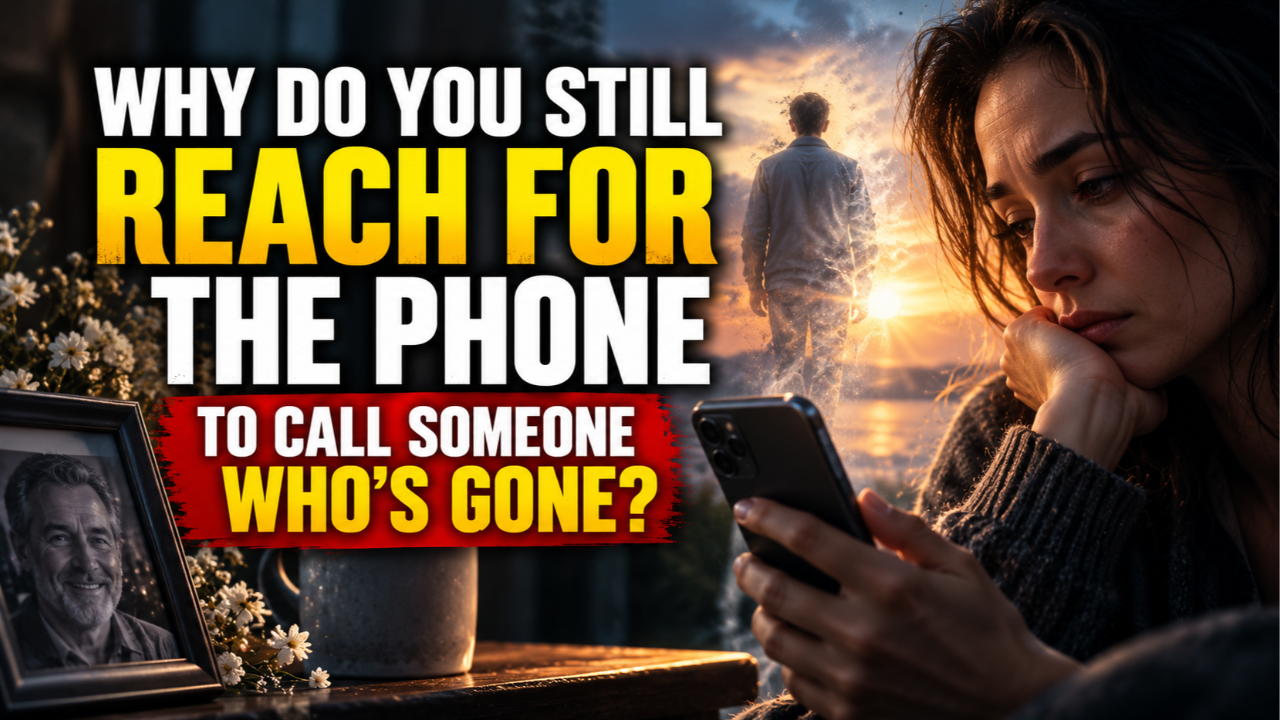
Why Do You Still Reach for the Phone to Call Someone Who's Gone?
Oct 25, 2026Why Do You Still Reach for the Phone to Call Someone Who's Gone?
If you still reach for the phone to call someone who's gone, nothing inside you has broken. Your brain spent years building a map of the world with that person in it, and maps don't redraw themselves overnight. The reach is an old prediction firing on schedule. It's one of the most common grief habits there is, and underneath it sits love that hasn't yet been told where to go.
 It tends to happen somewhere ordinary. You're in the supermarket and you see the biscuits she always bought, or the daft magazine he pretended not to read, and your hand is halfway to your pocket before the rest of you catches up. Then comes the drop, that lift-shaft feeling in the stomach, as the fact of the loss arrives all over again. There's nobody to ring. There hasn't been for months, and somehow a part of you still hasn't heard the news.
And it isn't only the phone. You put out two mugs on a Sunday morning. You hear a ridiculous story at work and file it away, thinking he'll love this one. Some people still lay a place at the table, or keep a voicemail they can't delete and can't bear to play. So, if you know they've died, and you do know, why does part of you keep behaving as though they'll pick up?
Want the full story behind the comfort in this article? Get The Light Beyond: Unveiling The Secrets of The Afterlife on Amazon.
The Story You Tell Yourself About the Phone Call
The story most grieving people tell themselves is quietly frightening. You decide the reaching means you're not coping. You think you should be further along by now, that a sensible adult doesn't forget a death, and that every slip proves something in your head has come loose. Plenty of people keep it secret from everyone, because saying "I nearly texted Mum yesterday" out loud feels like admitting you've lost the plot.
There's often a second story underneath, which is that the habit is keeping the wound open. Friends mean well when they tell you it's time to let go, and you start to wonder whether setting that place at the table is a kind of refusal. As if you're failing a test of acceptance that everyone else has passed.
But look at when the reaching happens. It rarely shows up when you're thinking about the death. It shows up when you're not thinking at all, halfway through an errand, half awake, or laughing at something on the telly. Confusion about the loss would appear when you're focused on it. A habit appears when you're on autopilot. That's the crack in the story, and it tells you exactly what kind of machinery you're dealing with.
What Grief Is Doing to the Map in Your Brain
Your brain doesn't wait for the world to happen. It predicts it. Over years of shared breakfasts, phone calls and terrible jokes, it built a detailed model of reality with your person written into the foundations. They're the one who answers at seven on a Thursday. They're the chair on the left. All of that is compiled into the map, the way you find the light switch in a dark hallway.
Grief researchers describe two kinds of knowledge pulling in opposite directions. One part of you remembers the hospital and the funeral. Another, older part holds a deep belief that this person is a permanent fixture, someone who is always there even when they're out of the room. Neuroscientists who study bereavement suggest grieving is a form of learning, and that the learning takes time and a lot of real-world experience before the map catches up. Until it does, the old prediction keeps firing.
That's why the reach feels so physical. You aren't choosing to forget. Your habit system, the part of the brain that runs your morning routine without consulting you, hasn't received the update yet. It's like a sat nav that keeps telling you to turn into a road that has been closed. It's working from the last map it was given, and nobody has driven the new route often enough to redraw it.
The Habit Loop That Keeps Laying Their Place
Every habit runs on a loop of cue, routine and reward, and grief habits are no different. The cue might be a time of day, a song playing in a shop, or news they'd have had opinions about. The routine is the reach, the second mug or the joke filed away for later. For years the reward was them: their voice, their laugh and the feeling of being known by someone. That reward was so reliable that your brain wired the loop deep.
Now the loop runs and the reward never arrives. Here's the cruel twist. A missing reward doesn't switch a habit off straight away. In the short term it can make the brain search harder, which is why some days you feel more pulled towards them, rather than less. Anniversaries, birthdays and Christmas pile on extra cues, so the reaching spikes just when you thought the worst was behind you.
Over time the pattern can spread into avoidance. You stop going to the café you used to visit together. You leave the phone face down so you won't see their name in your contacts. You stop telling anyone the stories you saved, so the jokes pile up with nowhere to land. None of this means you're failing at grief. It means the loop is still looking for the person it was built around.

Why Clearing Their Things Away Didn't Stop the Reaching
The most common fix is to remove the cues. People delete the number, box up the coats and move the furniture so the empty chair stops staring at them. If that helps you, fine. But it rarely stops the reaching, because the habit doesn't live in the coat or the chair. It lives in you. You can clear every drawer in the house and still find your thumb hovering over their name the moment something good happens.
The second fix is willpower. You tell yourself to snap out of it, and you feel a jolt of shame every time the habit fires. That shame is the real problem. It turns a harmless reflex into evidence that you're broken, and shame makes people withdraw from the very friends who could help. The third fix, for a lot of people, is a bigger glass of wine in the evening to soften the edges. It works for an hour, then borrows the calm back with interest, and the NHS lists alcohol among the things to avoid when you're coping with grief after bereavement.
Then there's the advice to move on, which often lands like an instruction to stop loving someone. Each of these fixes treats the habit as the enemy, and fighting your own love is a fight you can't win and shouldn't want to.
Ready to see where that love might be heading? Grab The Light Beyond: Unveiling The Secrets of The Afterlife on Amazon and read the reunion accounts for yourself.
Love With Nowhere to Go
Here's the reframe at the heart of all this. The reach for the phone is not a malfunction. It's love, travelling its usual route and arriving at a door that's no longer where it used to be. The bond didn't stop when their heart did. It's still here, fully loaded, looking for somewhere to land. That's why the moment hurts so much. In that split second, you're feeling the full size of what you had.
When I gathered the near-death accounts for The Light Beyond, one detail kept coming back. People from very different walks of life, many of whom had never believed in anything beyond the grave, described meeting loved ones who had died before them. A grandmother, a father, a friend lost years earlier. They described people they knew, waiting for them, along with an overwhelming sense of being loved and of never having been alone.
You don't need to settle the big question to take something from that. Whatever you believe, those accounts suggest the connection you're feeling might not be pointed at an empty space. The habit assumes the line is dead. Many people who came close to death reported the opposite, that the bond was intact and the love was waiting on the other side. If you'd like to go deeper into those experiences, I've written about what really happens when you die separately.
And if your worry is more about your own death than theirs, that's a different beast, and my piece on the evidence for life after death is a better place to start. For now, notice the shift. The reach for the phone stops being proof of what you've lost and becomes a sign of what's still there. That's a very different thing to carry around a supermarket.
A Small First Move: Let the Habit Finish Its Sentence
So, instead of fighting the reach, let it finish. The next time your hand goes for the phone, pause for one slow breath and say what you were going to say. Say it out loud, in your head, or type it into a note. Tell them about the biscuits, the parking ticket or the ridiculous thing your boss did. The habit wanted to deliver a message. Give it somewhere to deliver it, and the loop completes instead of crashing into a wall.
Do the same with the place at the table, but on purpose. Choose one meal a week, a Sunday breakfast perhaps, where you set out their mug or light a candle and give yourself ten minutes with them. Grief researchers call this kind of ritual a continuing bond, and it gives the old love a doorway rather than a dead end. On the other days the habit tends to quieten, because it knows there's a time and a place where it's welcome.

Keep the saved jokes too. Start a notebook or a voice memo called something like Things I'd Have Told You. Now and again, share one with someone who knew them. Grief is lonely partly because everyone is too polite to mention the person, and you can be the one who breaks that silence.
Be gentle with the timeline. These habits usually soften over months rather than weeks, and they may never disappear completely, which is fine. If the grief feels stuck, if you can't get through the day, or if you've had thoughts of not wanting to be here, please talk to your GP or contact Cruse Bereavement Support, because a book can be a companion to that help but never a substitute for it.
The Question Nobody Asks About the People We Lose
Everyone asks how you're coping. Hardly anyone asks what you'd tell them if they picked up. That may be the most useful question of all, because the answer is usually small. You'd tell them you found the old photo. That the grandkids are taller. That you finally understood what they meant about the garden. These aren't the words of someone who can't accept a death. They're the words of a relationship carrying on in a new form.
People nearing the end of life often say that love was what mattered most, and you can read more about that in the top regrets of the dying. So, the next time your thumb hovers over their name, you could ask a softer question than why you can't get over this. You could ask what the love wants to say today, and whether you might let it say it.
Want the full picture of what the people who came back saw waiting for them? Order The Light Beyond: Unveiling The Secrets of The Afterlife on Amazon today and keep it close for the days the reaching comes back.
"My husband died two years ago and I was still making him a cup of tea most mornings. I honestly thought I was losing my mind. Now I make his tea on Sundays on purpose and talk to him while it goes cold, and the rest of the week feels lighter." (Donna K., Tulsa, Oklahoma)
"I kept Dad's number in my phone and felt guilty every time I nearly rang it. Reading about people meeting their families during near-death experiences changed how I feel about that reach. I started a notebook of things to tell him, and I share them with my brother." (Marcus J., Spokane, Washington)
"After I lost my best friend I stopped going anywhere we used to go. Understanding that the habit was love looking for her helped me walk back into our coffee shop. I cried the first time and laughed the second." (Leanne P., Columbus, Ohio)
Frequently Asked Questions About Grief Habits
Why do I keep reaching for the phone to call someone who has died?
Because your brain built its picture of the world with that person in it, and it updates slowly. Calling them was a habit triggered by cues like a time of day, good news or a familiar shop. The part of you that remembers the death and the part that runs your routines learn at different speeds. Until the habit system catches up, the old prediction keeps firing. It's a normal part of grieving, and it reflects how close you were.
Is it normal to still set a place at the table for someone who has died?
Yes, it's very common, especially in the first year or two. Laying a place, buying their favourite food or making their drink are routines your brain repeated thousands of times. Many people find comfort in keeping one of those rituals on purpose, such as a weekly meal where they remember the person. That kind of continuing bond can be healthy. It only becomes a concern if it stops you living your own life or keeps you from other people.
When should I get help for grief that won't ease?
Most grief softens gradually, though it can come in waves for a long time. It's worth seeing your GP if you've had a low mood for more than two weeks, if you can't manage everyday tasks, or if months have passed and the pain isn't easing at all. The NHS describes this as prolonged grief. Bereavement charities such as Cruse offer free support, and if you ever feel unsafe, contact urgent help straight away.
About the Author
 Craig Beck spent years as a UK broadcaster, which taught him to talk plainly about the things most people only think about at three in the morning. He is a certified NLP Master Practitioner and the author of more than a hundred books on human behaviour, persuasion, addiction and the big questions about life and death. His work skips the motivational noise and shows readers the machinery behind their habits. Find out more on his about page, explore one to one coaching, or read more about The Light Beyond on his site.
Last updated 21 October 2026.