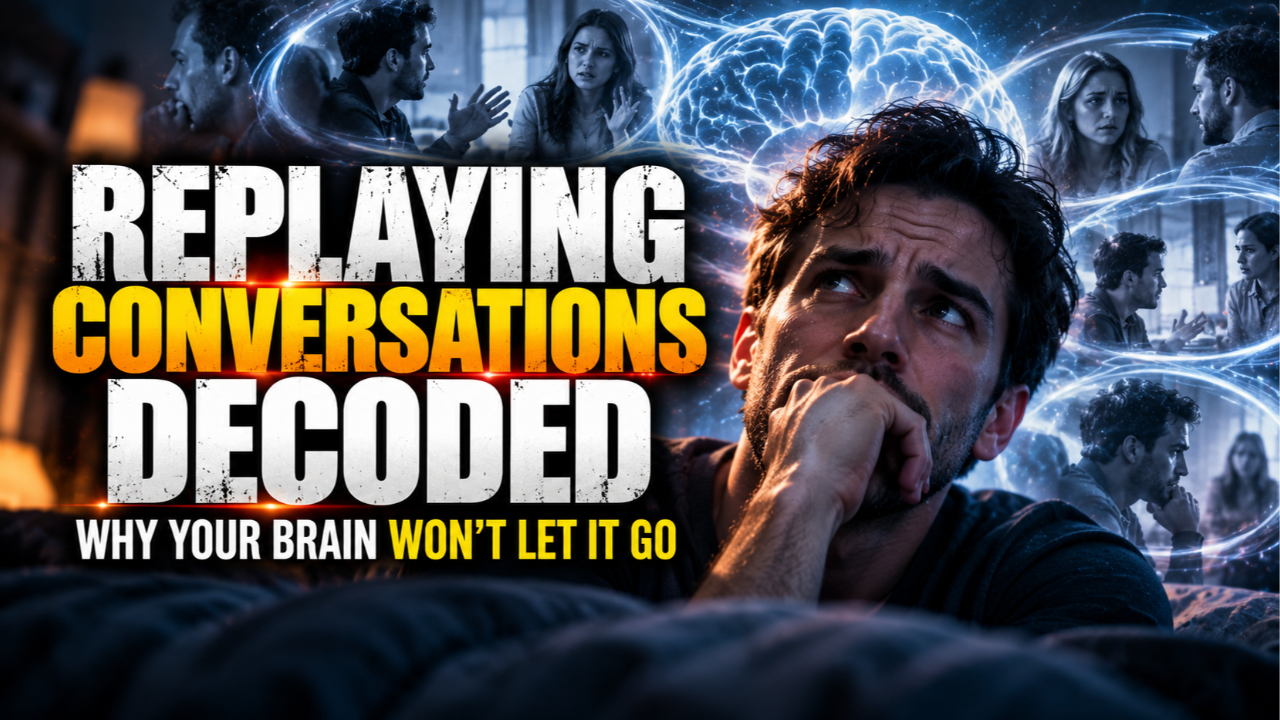
Replaying Conversations Decoded: Why Your Brain Won't Let It Go
Oct 21, 2026Replaying Conversations Decoded: Why Your Brain Won't Let It Go
Replaying conversations in your head is your brain running a safety review nobody asked for. After any social moment, an old threat system checks whether you embarrassed yourself, upset someone or put your place in the group at risk. It rehearses what you should have said so you're ready next time. The trouble is that it judges you far more harshly than the other person ever did, and it rarely knows when to stop.
 You're halfway home from a perfectly nice evening when it starts. Somebody mentioned their new job, and you made a joke about their boss that got a polite laugh and half a second of silence. By the time you've parked the car, that half second has grown into a full scene. By the time you're brushing your teeth, you've watched it eleven times from three camera angles, and the other person looks faintly wounded in every version.
And it isn't only parties. It's the meeting where you talked too long, or the moment you said "you too" when the waiter told you to enjoy your meal. Your mind files them all under unfinished business and drags them back out the second the room goes quiet. So, why does a brain that can't remember where you left your keys keep a perfect recording of every awkward sentence you've said since 2009?
Want the full method for switching off the late night replay? Get Anxiety Decoded: How to Stop Overthinking and Start Living on Amazon.
The Story You Tell Yourself About Replaying Conversations
The story most people believe is simple. You replay conversations because you're socially awkward, and the replay is your conscience doing its job. If you stopped checking, you'd blunder through life offending everyone and never noticing. So, the cringe feels like a fair price for being decent.
There's a grain of truth in it, because people who replay tend to notice moods and read rooms. But the story falls apart the moment you check the replay against reality. When strangers chat and then compare how much they thought they were liked with how much they were liked, the same pattern keeps turning up. We consistently underestimate how warmly other people see us after a conversation. Psychologists call it the liking gap, and it means your private review of the evening is wrong in a predictable direction.
The person you're convinced you offended went home thinking you were good company. If they're replaying anything, it's something they said, which you've already forgotten. Everyone at that table drove home running their own reel of mistakes, and nobody was watching yours. So, the replay has little to do with conscience. It's a machine reading from a faulty gauge.
What Replaying Conversations Is Doing to Your Brain
For most of human history, being liked by your group was a survival issue. Fall out with the tribe and you got left behind in a world full of things with teeth. So, your brain evolved to treat social slip ups as serious threats, and that ancient wiring still runs on the same old settings. A clumsy comment at a barbecue gets processed with some of the urgency once reserved for a rustle in the long grass.
In Anxiety Decoded I describe how the brain treats a passing thought like a charging predator, and the replay is that same reflex pointed backwards. Your mind is running a simulation. It takes the conversation, rewinds it and tests alternative versions to find the line you should have used. Researchers who study overthinking have found that socially anxious minds put extra effort into this kind of deliberation, especially into the better outcome they missed. In plain English, your brain is rehearsing for a rematch.
Rehearsal is a decent tool when there's a next performance. If you're giving a best man's speech on Saturday, running it in the shower makes sense. But nobody is going to rewind Tuesday's meeting and let you have another go. So, the simulation runs and runs, searching for a solution to a problem that closed hours ago, and your body pays for it with a racing heart and a pillow that seems to get hotter by the minute.
The Replay Loop: How One Awkward Line Becomes a Week of Cringe
Every stubborn habit runs on a loop of cue, routine and reward, and the replay is no different. The cue is a quiet moment, the drive home, the shower, the dark bedroom. The routine is the replay itself, cross examining every word and hunting for evidence that someone now thinks less of you. The reward is the sneaky part. Each pass gives you a tiny hit of relief, the feeling that you're dealing with the problem and you'll be ready next time.
That relief doesn't last, which is why the loop restarts. Ten minutes later a new angle occurs to you, perhaps she wasn't smiling at all, perhaps she was being polite, and the whole investigation reopens. Over time the loop stops waiting for the evening to end and starts reviewing you live, so half your attention is on the conversation and the other half is filming it for later. That's when people start to feel awkward for real, because nobody can be relaxed and fun while running their own security camera.
Then the loop begins to shape your diary. You start rehearsing scripts before events, the cousin of this habit that I took apart in Anticipatory Anxiety Decoded. You send the morning after text that says sorry if I was a bit much last night. You decline the next invitation. And the critic who narrates the replay gets louder, the same voice I wrote about in Negative Self-Talk Decoded. A quick check on one comment ends up deciding who you see and how much of yourself you show them.

Why Telling Yourself to Let It Go Never Works
The standard advice is to let it go and stop thinking about it. It sounds sensible until you try it, because telling your brain to stop thinking about something is the fastest way to put it on a loop. The harder you push a thought away, the more often your mind checks whether it's still gone, and every check brings it back. You end up lying in the dark trying not to think about the joke, which is still thinking about the joke.
Reassurance is the next fix. You text a friend to ask whether you seemed weird, and the answer comes back, of course not, you were great, and you feel better for about forty minutes. But you've taught your brain that the replay was important enough to need outside help, so it hands you a bigger worry next time. Reassurance works like a painkiller that makes the injury grow.
Then there's the old social lubricant. Plenty of people discover that a few drinks quieten the inner commentator, and they're right, for the length of the evening. The next morning the volume comes back doubled, with gaps in the memory for your mind to fill with the worst possible version of events. If you've ever woken with that hot dread about what you might have said, you've met the replay at full strength. Scrolling until you fall asleep has the same flaw. It pauses the tape without ever ejecting it.
Ready for the full method that turns the late night review into a closed file? Get Anxiety Decoded: How to Stop Overthinking and Start Living on Amazon and stop giving free reruns to conversations that ended hours ago.
The Replay Is a Rehearsal for a Show That Already Closed
This is where the whole thing turns. The replay is evidence of a threat system doing its job too well, and nothing more. Your brain has no interest in punishing you. It's trying to protect you from a danger that doesn't exist, using a method built for a world where one bad impression could cost you your place by the fire. Once you see that, the question stops being did I upset her and becomes why is my alarm going off over a joke about somebody's boss.
I learned this the hard way in radio. After a live show I'd drive home replaying a fluffed link or a clumsy question to a guest, sometimes for the whole evening. One night I finally asked my producer about a moment I'd been chewing on for days. She looked at me blankly. Nobody had noticed it, and the guest had sent a thank you card. I was the only person in the country still listening to that show.
The replay also loves to dress itself up as a character trait. You decide you're an overthinker, a worrier, someone who was born anxious. Yet the NHS describes the worry that comes with social anxiety as something that turns up before, during and after social situations, which tells you it's a pattern your nervous system runs, and patterns can be retrained. Software that was installed can be rewritten. If the fear underneath is rejection itself, my fear of rejection hypnosis session is a gentle place to start.
Your First Small Move: Close the File
When the replay starts, don't argue with it and don't try to shove it away. Ask it one question instead. Is there anything I need to do about this? Now and then the answer is yes, perhaps you were sharp with a colleague and a quick word would clear the air. If so, write that one action down with a time attached, send the text at ten tomorrow, and you've given the simulation the solution it was hunting for.
Usually the answer is no. Then say, quietly or in your head, file closed. It sounds daft, but naming the moment tells your brain the review is finished and the case has a verdict. If the replay comes back, and it will at first, you don't reopen the investigation. You notice it, say file closed again and go back to whatever you were doing. Each time you do that, you're teaching the old software that this alarm has no task attached.
Then give the evening a fair edit. Your replay only ever shows the clumsy bits, so deliberately call up three moments that went well, the story that got a proper laugh, the person who asked for your number, the friend who hugged you at the door. Think of it as fact checking a recording that was edited by your most nervous employee.

Try it for two weeks and keep a rough note on your phone of how long each replay lasts. Many people find the reruns shrink from hours to minutes, because the loop loses its reward once the review stops producing anything. If the replaying is keeping you awake night after night, or you've started avoiding people altogether, please speak to your GP or a qualified professional alongside any self-help. It's far more common than the voice in your head would have you believe.
The Question Nobody Asks About Replaying Conversations
When you replay a conversation, whose face is doing the judging? For a lot of people it's a parent who winced at the dinner table, a teacher who made an example of them, or a group of kids who laughed at the wrong moment years ago. The replay is often addressed to an audience that left the building decades ago and somehow kept the best seat in the house.
If you stopped performing for that old audience, who would you be in a conversation? Perhaps a little louder. Perhaps funnier. Perhaps someone who says the odd clumsy thing, laughs about it and moves on, which happens to be how the people you like most behave. The replay has spent years trying to keep you safe. It might be time to find out what you're like when you're free.
Ready to stop rerunning the past and start enjoying the conversation in front of you? Pick up your copy of Anxiety Decoded: How to Stop Overthinking and Start Living on Amazon today and find out how quiet your head can be.
"I used to lie awake for hours going over every work meeting. Learning that my brain was rehearsing for a rematch that would never happen made the whole thing make sense. I say file closed now, and most nights I'm asleep in twenty minutes." (Rachel M., Tucson, Arizona)
"I turned down party invitations for years because the next day replay was so brutal. This book showed me the replay was lying about how people saw me. I went to my cousin's wedding last month, danced like an idiot and didn't spend Sunday cringing." (David K., Columbus, Ohio)
"My husband said I held a full inquiry after every dinner with friends. The fair edit sounds simple, but remembering what went well has given me my weekends back. I'm more relaxed with people, and funnily enough, they seem to enjoy my company more." (Teresa G., Spokane, Washington)
Frequently Asked Questions About Replaying Conversations
Why do I keep replaying conversations in my head?
Because your brain treats social mistakes as a threat to your place in the group. After a conversation it runs a review, rewinding the moment and testing better lines in case you need them later. Each pass brings a little relief, which keeps the habit going, even though most of those conversations will never happen again. People who are sensitive to other people's moods, or who grew up feeling judged, tend to run the review longer and harder.
Is replaying conversations a sign of social anxiety?
Not always. Almost everyone replays an awkward moment now and then, and it usually fades within a day or so. It becomes more of a problem when the replays go on for hours, keep you awake, or make you avoid people and events. Worry that shows up before, during and after social situations is one of the patterns linked to social anxiety, so if that sounds familiar and it's affecting your life, it's worth getting support rather than waiting for it to pass.
How do I stop replaying conversations at night?
Ask the replay one question: is there anything I need to do? If there is, write the action down with a time attached. If there isn't, say file closed and turn your attention back to your breathing or the room around you. When it returns, repeat the phrase rather than reopening the case. Then recall three moments from the conversation that went well. Many people find the replays shorten noticeably within a couple of weeks.
About the Author
 Craig Beck spent years as a UK broadcaster, which means he has replayed more fluffed live links than most people have had conversations. He is a certified NLP Master Practitioner and the author of more than a hundred books on human behaviour, from quitting alcohol to the hidden mechanics of worry and overthinking. His work skips the motivational noise and shows readers the machinery underneath their habits. Find out more on his about page, or explore one to one coaching.
Last updated 18 October 2026.