Mind Goes Blank Decoded: Why You Freeze When It's Your Turn to Speak
Oct 22, 2026Mind Goes Blank: Why You Freeze When It's Your Turn to Speak
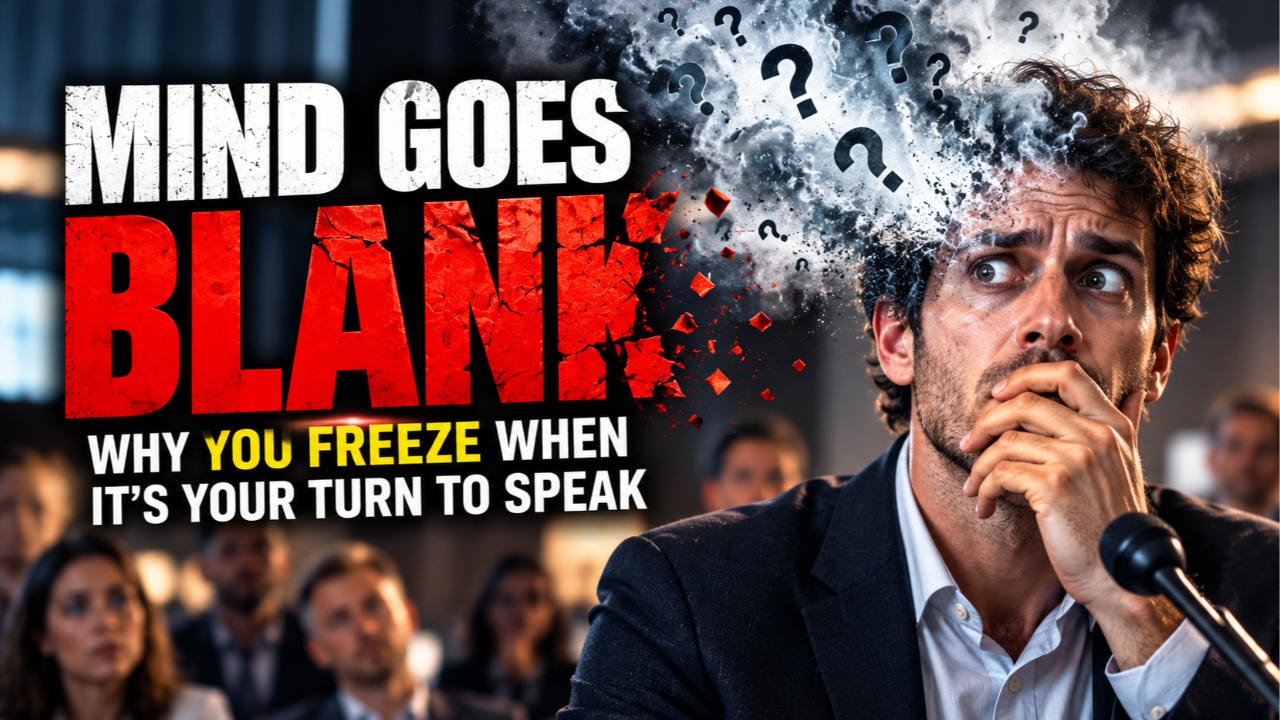
When your mind goes blank as it's your turn to speak, your brain hasn't broken down. It has switched on an ancient threat response. The moment attention swings towards you, stress chemistry floods the thinking part of your brain and turns down the very system you use to find words. The freeze is a protective reflex designed for predators, not meetings, and it fires because you care about how the group sees you.
 You know the moment. The meeting goes round the table, everyone saying their name and what they do, and you're fourth. Person one is fine. Person two makes a little joke. By person three, you can hear your own heartbeat, and the sentence you've been rehearsing for ten minutes has quietly packed its bags and left. Then every face turns to you, and there's nothing there at all.
And it isn't only work. It's the wedding toast you agreed to in a weak moment, the parents' evening introduction, the video call where someone says "what do you think?" and your brain offers static. Afterwards you know exactly what you wanted to say. It comes back in the car, perfectly formed and annoyingly fluent. So, why does a mind that can chat for hours with a friend go completely dark the second it's officially your turn?
Want the full method for staying switched on when the spotlight lands on you? Get Bulletproof Public Speaking: Speak with Confidence Quick & Easy on Amazon.
The Story You Tell Yourself When Your Mind Goes Blank
The story most people believe goes like this. Some people are natural speakers and you're not one of them. You're a bit shy, a bit awkward, and when your mind goes blank it's proof you weren't built for this. The confident ones were born with a gift, and you got the cheaper model with the faulty microphone.
It's a tidy story, and it falls apart the minute you look at your own life. You don't go blank telling your best mate about the ridiculous thing your neighbour did. You don't freeze ordering a coffee or arguing about football. Your vocabulary, memory and wit all show up for work every day. They only vanish in a very narrow set of circumstances, when a group is watching and it's officially your turn.
That tells you something important. A lack of ability would show up everywhere. A problem that only switches on under a spotlight is a reaction to the spotlight. So, the question was never whether you can speak. It's what your brain thinks is happening when the room goes quiet and waits for you.
What the Countdown Is Doing to Your Brain
For most of human history, being stared at by a group was a big deal. Eyes on you could mean you were about to be welcomed, challenged or thrown out of the tribe, and being thrown out was close to a death sentence. So, your brain still treats a circle of expectant faces as a high stakes event, and it prepares you the way it always has, with adrenaline, a racing pulse and muscles ready to run.
The trouble is what that chemistry does upstairs. The front of your brain, the part that plans sentences and pulls up the right word at the right time, is unusually sensitive to stress. Researchers have found that even mild stress you feel unable to control can rapidly weaken that thinking region, and a classic way to trigger that kind of stress in a lab is to ask people to give a speech to strangers. In plain English, the alarm hands control from the thoughtful manager to the security guard, and security guards are not famous for their small talk.
The countdown makes it worse. Waiting your turn gives the alarm several minutes to build, which is why going fourth feels harder than being asked something out of the blue. Every person who speaks before you is another tick of the clock. By the time it reaches you, your body is ready for a fight with a bear, and you're expected to say your job title in a friendly voice.
The Freeze Loop: How One Blank Moment Becomes a Habit
Every stubborn habit runs on a loop of cue, routine and reward, and the freeze has its own. The cue is the moment you realise your turn is coming, the agenda item with your name on it, or the best man glancing your way. The routine is the inner scramble, rehearsing your line, monitoring your voice and checking whether anyone has noticed your face going red. The reward arrives when it's over. The relief is so strong that your brain files the whole episode under narrowly escaped danger.
That relief is the sneaky part. Each time you dodge a turn, mumble the shortest possible answer or let someone else give the toast, you get a lovely wash of calm. Your brain notices the calm and draws the obvious conclusion, which is that avoiding the spotlight kept you safe. Next time, it fires the alarm a little earlier and a little louder to make sure you avoid it again.
Over months and years, the pattern spreads. You start sitting near the door in meetings. You keep your camera off on calls. You volunteer to go first to get it over with, or you hang back to go last and pray the meeting overruns. You turn down the chance to present your own work and watch someone less qualified take the credit. What started as one blank moment has become a quiet set of rules for keeping yourself small.

Why Rehearsing Your Line Makes the Blank Worse
The most common fix is to write the perfect sentence and repeat it in your head until it's word perfect. It feels sensible. But it turns speaking into a memory test, and memory is the first thing stress takes offline. Worse still, you spend everyone else's turn rehearsing, so you hear none of what they said and arrive at your moment with no connection to the conversation at all. If one word of the script slips, the whole thing collapses, because there was never anything underneath it.
Then there's the advice to be confident and stop worrying, which is like telling someone to stop sneezing. Fighting the feeling makes it bigger, because now you're anxious and anxious about looking anxious. Your attention flips inwards to your heartbeat and your shaking hands, which leaves even less room for words. Psychologists call it self-focused attention, and it means you're so busy watching yourself that you've stopped talking to anyone else.
And some people reach for a glass of something to take the edge off before a toast. It can soften the first few seconds, but it borrows calm from your future and teaches your brain that you can't handle the moment without help. It also has a habit of making the speech longer, louder and more memorable for all the wrong reasons. None of these fixes ever touched the real issue, which is that your threat system has misread the situation.
Ready to stop scripting and start speaking like yourself? Grab Bulletproof Public Speaking: Speak with Confidence Quick & Easy on Amazon and get the full method in one afternoon's reading.
Your Brain Isn't Failing, It's Protecting You
Here is the reframe at the heart of all this. The blank is not your brain letting you down. It's your brain doing its oldest job brilliantly in the wrong setting. Freezing is what animals do when running isn't an option, and there is no way to run out of a round-the-table introduction without making it worse. So, your nervous system picks the next best option and goes still. It's loyal, clumsy and badly out of date.
The other half of the reframe is about the audience. Your alarm assumes the faces around the table are judges. In reality they're mostly thinking about their own turn, their next meeting or what's for lunch. People hugely overestimate how much others notice their nerves, and a pause that feels like an hour to you registers as a thoughtful second to everyone else. Most rooms want you to do well, because watching someone struggle is uncomfortable for them too.
I learned this the embarrassing way. Early in my radio career, the red light came on and I forgot the name of the song I was about to play, a song I'd chosen myself ten minutes earlier. I said nothing for what felt like a week. Afterwards I asked the producer how bad it was, and she looked at me blankly and asked what I meant. From the other side of the glass, nobody had noticed anything at all.
Once you see the freeze as an overprotective bodyguard rather than proof of weakness, the shame starts to drain out of it. You don't need to defeat it. You need to show it, a few times, that this situation is safe. If you're a habitual people pleaser, you may notice the same bodyguard at work, terrified that one wrong word will cost you your place in the group.
Your First Small Move: Speak Early and Small
Start in the next meeting you attend. Your job is to say one sentence in the first five minutes, before the alarm has had time to build. It doesn't need to be clever. Agree with a point, ask a short question or say good morning to the room with your full voice. That early sentence breaks the countdown and tells your nervous system that speaking here is survivable, which takes the edge off when your proper turn arrives.
For introductions and toasts, swap the script for an anchor. Choose your name and one true thing you could say in your sleep, such as "I'm Sarah, I look after the accounts, and I've been here since the old coffee machine." When your turn comes, breathe out slowly before you open your mouth, because a long out-breath is one of the quickest ways to signal safety to your body. Then say the anchor and let the next sentence arrive on its own.

If a blank still comes, name it out loud. "Hold on, I've lost my thread" buys you two seconds and almost always gets a warm laugh, because everyone in the room has been there. Try this for three weeks and keep a note of each time you spoke early. Many people find the freeze arrives later, leaves sooner and slowly loses interest. If the fear of speaking is stopping you working, socialising or sleeping, please talk to your GP or a qualified professional alongside any self-help.
The Question Nobody Asks About Going Blank
When you freeze, who exactly are you afraid of disappointing? For a lot of people it isn't the colleagues in the room. It's the teacher who made them read aloud, the parent who corrected every sentence, or the classroom that laughed when they stumbled at nine years old. The blank is often a response to an audience that went home decades ago. If your inner critic sounds suspiciously like one of them, that's not a coincidence.
The worry before the event is a close cousin, and I've written about anticipatory anxiety separately. But the turn to speak is where it all comes to a head. If you stopped performing for that old audience, what would you say in the next meeting? Perhaps something small. Perhaps something funny. Perhaps the idea you've been sitting on for six months. Your voice has been waiting patiently behind the bodyguard all this time.
Want the full method for walking into any room and speaking with ease? Order Bulletproof Public Speaking: Speak with Confidence Quick & Easy on Amazon today and find out what you sound like when the freeze lets go.
"I dreaded the Monday team call for years because we go round and give updates. Learning that the freeze was a bodyguard and not a flaw changed how I felt about it. I say one thing early now, and last week I volunteered to lead the call." (Melissa R., Raleigh, North Carolina)
"My daughter asked me to speak at her wedding and I nearly said no. I used the anchor idea and breathed out before I started. I didn't read a single line from my notes, and people were still coming up to me about it at the end of the night." (Gary T., Boise, Idaho)
"I'm a nurse and I used to go silent in handover meetings with the consultants. Speaking early sounded too simple to work, but it has made a huge difference. I ask questions now, and my manager has started asking me to train new starters." (Andrea L., Omaha, Nebraska)
Frequently Asked Questions About Your Mind Going Blank
Why does my mind go blank when I speak in front of people?
Because your brain reads a group's full attention as a possible threat. It releases stress chemistry that prepares your body for action and turns down the front of the brain, the area that plans sentences and retrieves words. The longer you wait for your turn, the more that alarm builds, which is why round-the-table introductions feel so hard. It's a protective reflex working in the wrong setting, and it says nothing about your intelligence.
Is freezing in meetings a sign of social anxiety?
Not necessarily. Most people go blank under pressure at some point, and a single freeze is a normal stress reaction. It's more of a concern when the fear of speaking leads you to avoid meetings, calls or events, or when you worry for days before and after them. That pattern of worry before, during and after social situations is linked to social anxiety, so if it's affecting your life, it's worth getting support.
How do I stop my mind going blank during a toast or introduction?
Speak early, keep it small and drop the script. In meetings, say one sentence in the first few minutes so the countdown never builds. For toasts and introductions, use an anchor, your name and one true thing you know by heart, and breathe out slowly before you begin. If the blank arrives anyway, say you've lost your thread and give yourself a second. Most audiences warm to it, and the next words usually return.
About the Author
 Craig Beck spent years behind a live microphone as a UK broadcaster, so he knows exactly what a red light can do to a perfectly good vocabulary. He is a certified NLP Master Practitioner and the author of more than a hundred books on human behaviour, persuasion and confidence, from quitting alcohol to speaking without fear. His work skips the motivational noise and shows readers the machinery driving their habits. Learn more on his about page, explore one to one coaching, or try his guide to overcoming shyness.
Last updated 19 October 2026.