
Shyness Rewired: How Hypnosis Quiets the Inner Observer
May 11, 2026Shyness Rewired: How Hypnosis Quiets the Inner Observer
The cab pulls up outside the venue and you can already feel the room you have not yet entered. The party will be in full flow. The host will hug you a little too enthusiastically. Somebody will press a glass of something fizzy into your hand. And then you will quietly drift toward the safest corner of the kitchen, smile politely at four conversations you cannot quite work your way into, and spend the next ninety minutes performing a version of yourself who is genuinely having a good time. By the time you slip out at 10:43pm, you will be exhausted, slightly ashamed, and replaying every awkward sentence you uttered during the evening. Welcome to shyness, the most quietly exhausting condition that nobody else can see, because the room you walked through tonight had no idea that the person doing all the smiling was running a war inside their own head the entire time.
 Shyness is not introversion, weakness, or a missing social skill. It is a learned subconscious pattern in which the inner observer has been trained to scan every social situation for signs of judgement, rejection, or exposure. The exhaustion you feel afterwards is not the cost of being around people. It is the cost of running constant internal surveillance the whole time you were with them. Hypnosis works on shyness because it retrains the observer at the level the observer actually lives, beneath the reach of conscious effort.
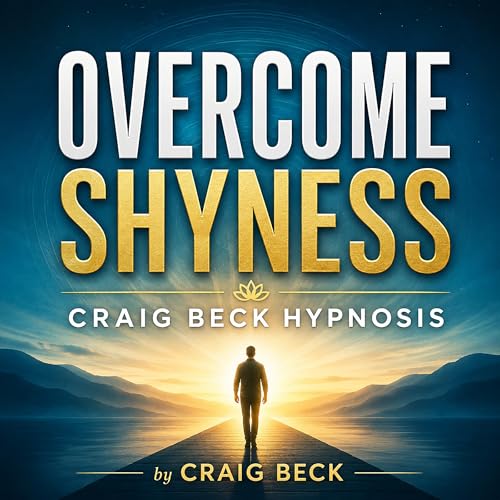
Ready to settle the inner watcher? Download Overcome Shyness: Craig Beck Hypnosis and start retraining the part of you that has been watching every interaction since you were six.
Why Overcoming Shyness Has Nothing to Do With Forcing Yourself Out There
The well-intentioned advice for shyness almost always boils down to the same prescription. Push yourself. Say yes to more invitations. Take a public speaking class. Go to a networking event every Tuesday until your tolerance increases. Drink one less coffee and one more glass of wine. The advice assumes that shyness is a muscle weakness that strengthens with repetition. It is not. Shyness is the symptom of a different problem entirely, and exposure without rewiring the underlying observer usually makes the exhaustion worse, not better. You can go to a thousand parties. If the watcher in your head keeps doing the same job, you will simply collect a thousand new memories of being uncomfortable.
I spent my twenties forcing myself into rooms where my whole nervous system was screaming for the exit. I told myself I was building tolerance. What I was actually building was a thicker performance and a deeper exhaustion. The breakthrough only arrived when I stopped trying to override the shyness and started understanding what it was protecting me from. Once the protection became unnecessary, the rooms became easier in a way no amount of brute force had ever managed.
The Hidden Wiring Behind the Inner Observer
Inside every shy person sits an inner observer, a part of the mind whose job is to monitor how you are appearing to other people. The observer was installed in childhood, often in response to a moment when being yourself produced a bad outcome. A laugh you misjudged. A piece of clothing somebody mocked. A question you asked in class that earned a roll of the eyes. A family rule that children should be seen and not heard. The observer took up its post at that moment and has not taken a break since. It is on duty when you walk into a coffee shop, when you join a Zoom call, when you sit down at a dinner party, when you reply to a message in a group chat. Its job is to make sure the original embarrassment never repeats.
The problem is that the observer cannot tell the difference between a small social moment and a survival event. Both produce the same vigilance. The same chest tightness. The same rehearsing of sentences. According to research summarised by the American Psychological Association, this kind of self-focused attention is one of the most consistent predictors of social discomfort in studies of shy adults. The cure is not less attention to social situations. It is less attention to yourself within them. Limiting beliefs about how you are perceived feed the observer constantly, giving it new material to scan for.
What Your Subconscious Believes Everyone Is Watching For
If you could ask the part of you that runs the observer what it is actually scanning for, the answers would be remarkably specific. Signs of disapproval. Tiny shifts in expression that suggest the person you are speaking to is finding you boring, awkward, or dim. The micro-pause before they reply. The flick of the eyes to somebody else. The way they shift their weight in the chair. The observer catalogues these signals in real time and produces a running commentary, almost always negative, about how the interaction is going. By the time the conversation ends, you have a complete internal record of every supposed failure, while the other person has barely registered the interaction at all.
This is the most painful misalignment in shyness. The observer is generating a forensic file on something nobody else has been watching with anything close to the same attention. Most people, most of the time, are too busy running their own internal observers to notice yours. The room you walked through tonight, where every face seemed to be quietly judging you, was almost entirely filled with people too preoccupied with their own performance to register yours at all. The observer in your head, sadly, has no idea. It is still working as if the entire room is taking notes.
The Spotlight Effect That Keeps You Frozen
Psychologist Thomas Gilovich and his colleagues at Cornell University ran a now classic series of experiments in 1999 to measure what they called the spotlight effect, the human tendency to drastically overestimate how much other people notice and remember about us. In one study, participants were asked to wear an embarrassing t-shirt and then walk through a room of strangers. Afterwards, they were asked to estimate what percentage of the strangers had noticed the t-shirt. They guessed about 50%. The actual figure was closer to 25%. Half of the perceived attention was a fiction generated entirely by their own inner observer.
Subsequent studies, including replications indexed by the National Center for Biotechnology Information, have shown the same pattern across many domains. People believe their stumbles, blushes, awkward sentences, and minor wardrobe malfunctions are far more visible to others than they actually are. The shy mind lives permanently inside this overestimation. It assumes the spotlight is harsh, focused, and tracking every move. The spotlight, in reality, is dim, intermittent, and pointed somewhere else most of the time. Internalising this is genuinely difficult, because logic does nothing to budge a belief that was installed before logic was available to you.
Done seeing the trap? Time to step out of it. Try Overcome Shyness: Craig Beck Hypnosis and let your subconscious finally update the size of the spotlight.
How Shyness Hijacks Your Identity Over Time
The most expensive thing about shyness is what it does to your sense of self over the years. Each time you avoid a moment because the observer flagged it as risky, the brain quietly logs another piece of evidence in the file labelled "I am the kind of person who stays at the edge of rooms." Each time you decline a party invitation, the file gets thicker. Each time you let somebody else speak first in a meeting and then mentally rehearse the contribution you never made, the identity hardens. Within a decade, you have a fully constructed self-concept around being shy, and that self-concept becomes its own engine. You then begin to behave shyly in order to be consistent with who you have decided you are. Identity is the most powerful predictor of behaviour we have, and shyness is a particularly stubborn identity to escape, because every avoidance reinforces it.
 This is why the cost of shyness compounds. The friendships you do not start. The relationships you do not pursue. The opportunities you do not raise your hand for. The salary you do not ask for. The opinions you do not voice in meetings where your insight would have changed the outcome. Every withheld contribution becomes another small confirmation, in your own subconscious filing system, that staying quiet is what people like you do. The world misses out on the contribution. You miss out on the version of your life where the contribution lived. The price, paid in small increments over thirty years, adds up to something genuinely large.
How Hypnosis Reprograms the Social Reflex
Hypnosis is uniquely suited to shyness because the observer that drives it lives precisely in the layer of mind that hypnosis is designed to reach. There is no swinging watch and no surrender of free will. Hypnosis is a focused state of relaxed attention, scientifically observable, in which the protective filter between your conscious mind and the deeper machinery softens, and new instructions can be loaded into the part of you that runs the surveillance. Your conscious mind does not need to win an argument with the observer. The work happens at a level below the argument.
If you have ever been on a quiet train looking out the window and arrived at your destination with very little memory of the journey, you have already touched the threshold of trance. The brain enters states like this many times a day. Hypnosis steers you into one on purpose and uses the open channel to do something targeted. For shyness, that means retraining the observer to scan for connection rather than judgement, updating the deep belief that you are being watched intensely by everyone, and dissolving the equation between being yourself and being at risk. The internal monitor does not get removed. It gets redirected to a more useful job.
Identity is the deepest leverage point. Most advice on shyness tries to change behaviour while leaving the underlying identity of "shy person" untouched. Behaviour change without identity change is fragile, because the identity will always pull you back to the original setting. Hypnosis goes underneath the behaviour and updates the file labelled "who I am in a room with other people." Once that file shifts, social ease becomes the default rather than something you must perform. Neuroplasticity, the brain's lifelong ability to rewire itself, rewards consistent input. The new pattern hardens with each session.
What Happens While You Listen
The Overcome Shyness recording opens with a slow, careful induction. The breath lengthens. The shoulders drop. The mental commentary that has been narrating your performance since you opened your eyes finally falls silent. Brainwave activity moves from the rapid beta of waking thought into the slower alpha and theta frequencies associated with deep meditation and the threshold of sleep. The doorway to your subconscious quietly opens, and the real work begins.
The script then walks your unconscious mind through the felt experience of a different relationship with other people. Carefully sequenced suggestions invite the inner observer to relax its post, recognise the social moments it has been guarding as low-stakes rather than threatening, and adopt a new lens through which other people appear as curious and friendly rather than evaluative and harsh. Visualisation guides you through the experience of walking into a room without bracing, joining a conversation without rehearsing your line, and leaving a social event with energy rather than depletion. The body learns, in trance, what the conscious mind has been trying to teach itself for decades without success.
Most listeners notice the internal monitoring softening within the first week of nightly use. By the four to six week mark, social interactions start to feel different in a way that is hard to describe but easy to recognise. The exhaustion drops. The replay loop quietens. The ease that confident people seem to take for granted begins to be available without performance. The change is rarely a sudden burst of extroversion. It is more often the slow realisation that you spent two hours at the dinner last night without rehearsing a single sentence in your head, and you came home actually enjoying having gone.
The Question Nobody Asks About Shyness
Everybody asks how to be less shy. Almost nobody asks who they will become once the observer finally settles. That second question is where the real prize lives.
When shyness loosens, the surface changes show up first. Conversations stop feeling like exams. You start replying in group chats without composing the message four times first. You speak up in meetings, sometimes before you have rehearsed the contribution, and discover the room is significantly more interested than the observer had warned you. You accept invitations because they sound interesting rather than calculating in advance how much social currency the evening will cost you. The calendar fills up with the kind of plans you used to envy other people for having.
The deeper change runs underneath. The chronic background tension of being watched falls away, and the energy you had been pouring into self-monitoring becomes available for actually being present with the people in front of you. Conversations land deeper, because you are listening rather than rehearsing. Friendships form faster, because you are showing up as yourself rather than as a curated facsimile. Romantic interest finds you more easily, because warmth and ease are the two most attractive qualities a human being can carry into a room. Work changes, because the contributions you had been swallowing for years finally make it out into the air.
And there is a quieter shift many listeners describe months in. The relationship with yourself changes. You stop replaying every social moment looking for evidence of your shortcomings. You stop apologising silently for taking up space. You stop being your own harshest reviewer. The kindness you have always been able to extend to others becomes available to extend to yourself, and the surplus you experience as a result is the closest thing to genuine inner peace most people will ever encounter. The shyness was never the enemy. The observer was, and the observer was only doing what it was hired to do decades ago. Once you change its job description, everything downstream changes too.
None of this requires you to become loud, performative, or socially dominant. The aim is not extroversion. The aim is ease. The aim is the quiet return of full availability to the people, situations, and opportunities that matter to you, without the weight of constant internal performance review. Hypnosis is the cleanest route there, because it works in exactly the layer of mind where the observer was installed.
Stop letting the watcher in your head edit the size of your life. Download Overcome Shyness: Craig Beck Hypnosis and let the system that has been monitoring you since childhood finally take a seat. The version of your social life waiting on the other side of one rewired reflex is closer than the corner of the kitchen has allowed you to imagine.
What Listeners Are Saying
Rebecca P., Lexington, Kentucky: "I have been the quiet one in every room I have ever entered. Forty-three years of dodging eye contact at parties, declining invitations, and going home exhausted from the few I did attend. Four weeks of nightly listening to this recording and I went to my husband's company Christmas event and actually had fun. I cannot remember the last time that sentence was true. The observer in my head has gone almost silent."
Andrew M., Des Moines, Iowa: "I am a software engineer. I love my job, hate the team socials. I tried therapy, tried beta blockers, tried just gritting my teeth. None of it touched the part of me doing the avoiding. Six weeks of using this nightly and I led a presentation last week without rehearsing my opening line seventeen times. My manager has asked me to do another. I cannot fully explain what changed. I only know something did."
Olivia G., Greenville, South Carolina: "I was a painfully shy child and grew into a painfully shy adult. The cost to my career and my friendships has been enormous. Eight weeks into using this recording and I went on a first date for the first time in three years without spending the entire evening reviewing my own performance in real time. We are seeing each other again on Friday. I do not know if it will go anywhere. I do know that the old me would not even have got to the maybe."
Frequently Asked Questions
Is shyness the same as social anxiety?
They overlap but are not identical. Social anxiety is a clinical condition involving intense fear of social situations to the point of avoidance and impairment. Shyness is a temperamental and learned discomfort that does not always reach clinical severity but still significantly shapes a person's life. Hypnosis is effective for both, because they share the same underlying mechanism in the inner observer and the self-focused attention pattern. Severe social anxiety may also benefit from professional support, with the recording used as a complementary daily practice alongside any clinical care.
Will I lose the parts of myself I value as a quieter person?
No. The aim of the recording is not to turn you into a loud extrovert. Many shy people are thoughtful, observant, and unusually attuned to nuance, and those qualities are not the problem. The problem is the constant internal surveillance that keeps you from accessing your own warmth in the moment. Listeners report becoming more themselves rather than less, because the energy that was being consumed by the observer becomes available for genuine connection. Quiet, thoughtful, and warm are not lost. They simply become more available.
How quickly will I see results?
Most listeners notice the internal monitoring softening within the first seven to ten days of nightly use. Behavioural changes, such as speaking up in meetings, accepting invitations, and feeling lighter after social events, tend to settle in over four to eight weeks. The deeper identity shift, in which shyness stops feeling like who you are, develops over two to three months of consistent listening. Repetition is the variable that matters most. Treat the recording as a nightly ritual and the new pattern hardens until ease becomes your default.
About the Author
 Craig Beck is internationally recognised as one of the leading voices in persuasion, behavioural psychology, and the mechanics of inner change. A certified NLP Master Practitioner, clinical hypnotherapist, former UK broadcaster, and bestselling author of more than one hundred books and audio programmes, he has spent two decades dismantling the patterns of fear, habit, and self-restriction that quietly run people's lives, and engineering the tools that release them. Over a million listeners around the world have used his hypnosis recordings to break addictions, retire phobias, and reclaim their place in the social rooms they once tiptoed around. He does not deliver theory from a lecture hall. He works in the layer underneath behaviour, where every meaningful change begins, and walks you through the process step by step. You can read more about his approach on his about page.
Last updated: 11 May 2026