Rostov Ripper Decoded: Understanding The Dark Psychology of Andrei Chikatilo
May 18, 2026Andrei Chikatilo Decoded: How a Quiet Soviet Clerk Hunted 53 Souls
Andrei Romanovich Chikatilo, known as the Rostov Ripper and the Butcher of Rostov, was a Soviet serial killer who murdered at least 53 children, women, and young men in southern Russia between 1978 and 1990. He stalked his victims at railway stations and bus stops, led them into forest belts, and mutilated their bodies in a pattern of escalating sexual sadism. Caught in November 1990, he confessed after a Rostov psychiatrist read aloud a profile that described his interior with uncanny accuracy. He was executed in February 1994.
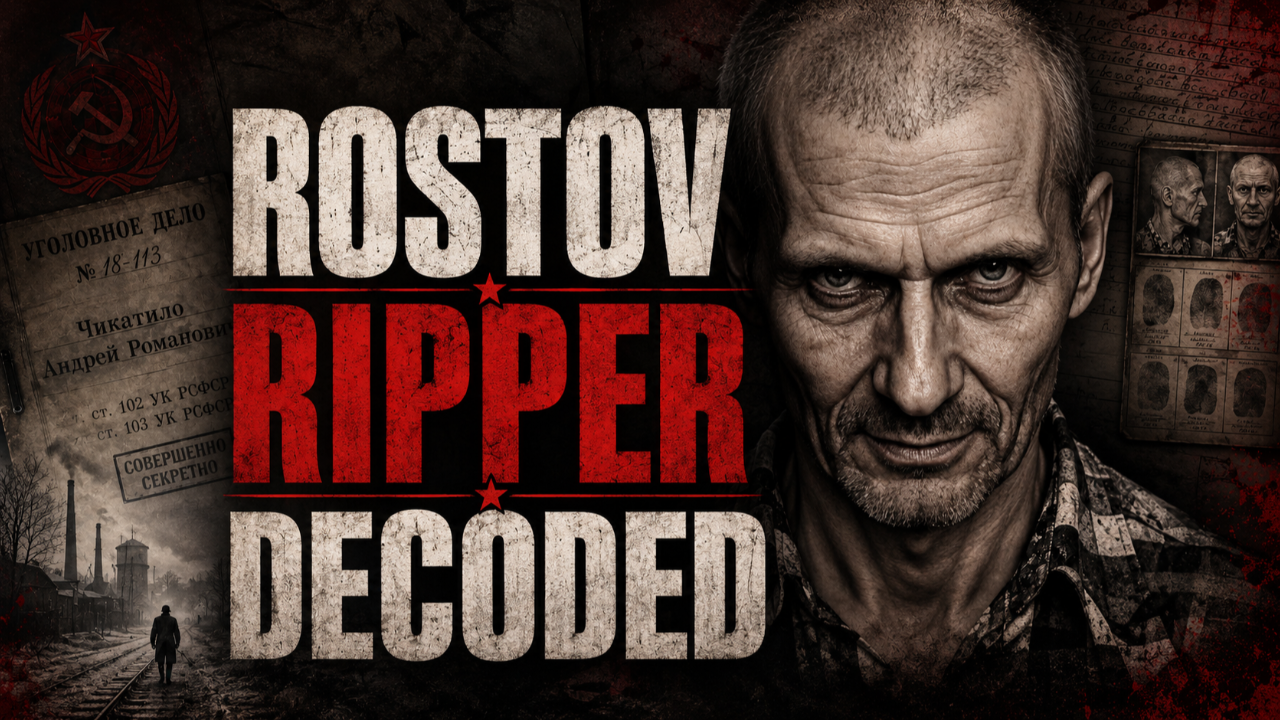
 The man behind those numbers was, in person, the kind of figure you would walk past at a tram stop and instantly fail to remember. A balding clerk with thick glasses and a polite stoop. A Communist Party card in his wallet. A factory job that sent him on long quiet train rides across the Soviet Union. A wife and two grown children at home. The dullest possible exterior for the most prolific serial killer the USSR ever produced. That contrast, that yawning distance between the visible man and the interior one, is the engine of this whole story.
This article goes inside the why. Not what he did, which has been catalogued in a thousand places already, but the slow assembly of the mind that did it. By the end of it, you will look at the quiet man in the queue behind you a little differently.
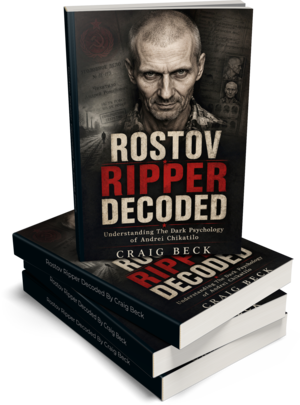
Want the full psychological deep dive? Pick up Rostov Ripper Decoded on Amazon and step inside the iron cage with me.
The Forgettable Face of Andrei Chikatilo
Chikatilo was born in 1936 in a Ukrainian village called Yablochnoye, into one of the bleakest decades any rural community in Europe had endured. He grew up myopic, frail, and bullied. He qualified as a teacher of Russian literature through a correspondence course and married a quiet woman named Fayina in 1963. They had two children, Lyudmila and Yuri. He was repeatedly transferred from school to school for inappropriate contact with pupils. He eventually took a job as a senior supply clerk at a Rostov firm that required him to travel constantly across the rail network. That travel pass became his hunting licence.
His Communist Party membership card, his unremarkable wage, his slightly stooped posture and his polite manner placed him, in the Soviet Union of his time, in the category of citizen the system was built to trust. Police checkpoints waved him through. Investigators looking for a beast in a black coat dismissed him. His blandness was, in every meaningful sense, his armour. He carried it for over a decade.
The Childhood That Built the Rostov Ripper
Every Decoded post starts with the same question. Where was this person before they were the figure on the front page? In Chikatilo's case, the answer reaches back into the Ukrainian famine of the 1930s, when Stalin's grain policies left millions of peasants chewing tree bark to stay alive. His mother told him, repeatedly, that he had once had an older brother named Stepan. She told him Stepan had been taken by hungry neighbours and eaten.
Whether that story was true is almost beside the point. No record of Stepan's birth has ever been found. What matters is that a small, half starved child believed it. The young Andrei learned, before he could read, that the human body was meat. That his own neighbours could cook a child. That being human offered him no protection at all. Add to this the chronic shame of bedwetting, the beatings he received from his mother for the ruined sheets, the bullying he absorbed for his myopia and his physical weakness, and you get the foundation of a brain that has been wired, from the ground up, to associate the body with vulnerability and contempt.
This is what trauma specialists describe as developmental layering. The early years lay bricks. Every voice, every touch, every absence sets a brick in place. By adulthood the building is largely finished. Chikatilo's building had no warmth and very few exits.
The Dark Triad Hiding Behind a Brown Briefcase
Modern forensic psychology identifies three connected traits that recur across the worst offenders. The cold strategic mind. The grandiose private self. The empty emotional channel where empathy should sit. Researchers call this combination the dark triad. The traits do not operate in isolation. They reinforce each other, removing both the rational brakes and the emotional ones at the same time.
Chikatilo was a textbook case. He felt nothing for the children he killed. He believed his interior universe was more real than theirs. He had taught himself, over decades of fantasy, exactly which approaches worked with which type of victim. The boys responded to invitations to look at his stamp collection. The girls responded to offers of food and a place to wait until their train. The runaways responded to the promise of safety. He had a different script for each. He had refined the scripts through trial. In any other field he would have been called an expert practitioner.
If you want to understand how this same wiring presents in other killers, my Ted Bundy Decoded piece walks the same anatomy through a different body.
How Chikatilo Hunted on the Soviet Rail Network
His preferred hunting ground was the lesopolosa, the long strips of trees the Soviets had planted alongside their rail lines and roads to prevent soil erosion. The strips ran for hundreds of miles. They sat within a short walk of every minor halt and bus stop in the Rostov region and across many of the southern republics. A man with a knife and a forty minute window could lead a child into them and walk back out alone before the next train rolled through.
His victim selection was deliberate and cruel. He preferred runaways from children's homes, teenage prostitutes who worked the train stations for kopecks, boys who had wandered out of institutions for the cognitively impaired, young women from rural backgrounds travelling alone to cities they did not know. He chose, in other words, the children whose absence the Soviet welfare state would notice last. He was studying the inattention of the system around him and feeding on its gaps. The pattern fits the documented behavioural template the FBI Behavioral Analysis Unit has compiled across the modern history of sexual homicide.
The wounds, when the bodies were found, followed a constellation the militsia could have used to identify a single offender from the start. Stab wounds in clusters. Sexual mutilation. Eyes carved out, often while the victim was still alive. The Soviet system, however, had been built to deny the existence of serial sexual murder. Serial murder, the official line ran, was a capitalist disease. The folders went into separate drawers in separate oblasts. The pattern stayed invisible.
The Blood Test That Set a Killer Free
In September 1984, a plainclothes officer named Aleksandr Zanasovski watched Chikatilo try to pick up a young woman in a Rostov bus station buffet. He noticed the trembling hands, the dark stain on the brown jacket cuff, the way the man's eyes never left his briefcase. He stopped him. He asked to see inside the bag. He found a kitchen knife wrapped in a cloth, a coil of wire cut to length, a roll of rope with knots tied at intervals, and a small jar of vaseline. He arrested him on the spot.
The militsia held him for three months. They matched him to the witness sketch from a recent killing. They placed him on the right trains on the right dates. Then they ran a blood test and let him go.
The reason is a rare biochemical quirk called paradoxical secretion. Around two percent of human beings produce blood antigens in their bodily fluids that do not match the type in their blood. Chikatilo was one of them. His blood typed as A. His semen, recovered from the victims, typed as AB. The Soviet lab declared the two could not be from the same man. He was charged with petty theft, served three months, and was returned to the trains. He killed at least thirty more people over the next six years.
The closing of the door, with the killer inside the room and the system on the other side waving him out, is one of the most painful forensic failures in twentieth century European policing. If you have read my Jeffrey Dahmer Decoded piece, you will recognise the same institutional pattern, the same reluctance to revisit a closed file once a suspect has been cleared.
Ready to step inside the interrogation cell where this all finally unravelled? Order Rostov Ripper Decoded on Amazon and walk through it with me.
The Confession That Cracked Russian Psychiatry
When Chikatilo was finally arrested in November 1990, after a thirteen day surveillance operation that followed a chance observation by a sergeant at a small rail halt called Donleskhoz, the militsia had ten days under Soviet law to charge him or release him. He sat through nine of those days saying nothing of value. Prosecutor Issa Kostoyev had run out of angles. On day nine, the lead detective Viktor Burakov made a suggestion nobody in the room wanted to hear. He proposed they bring in Aleksandr Bukhanovsky, the Rostov psychiatrist whose unauthorised sixty five page profile of the killer had been buried in a drawer for years.
Bukhanovsky walked into the cell with a carbon copy of his profile under his arm. He sat down. He asked Chikatilo if he could read aloud from a document he had brought. Chikatilo agreed. By the time the doctor reached the seventh page, the killer was weeping silently.
This is the most psychologically important moment in the whole case. The interrogators had been trying to crush him. Bukhanovsky had simply seen him. The seeing, after thirty years of careful invisibility, was something the man's psychological architecture could not withstand. People do not, in the end, fold under threat. They fold under accurate recognition. By the end of that single four hour conversation, Chikatilo had begun the confessions that would, in time, account for fifty three known murders and lead detectives to bodies they had not known existed.
The Iron Cage and the Public Reckoning
 The trial opened in April 1992 in a Rostov courtroom whose centre had been welded with a ten foot iron cage. The cage was not a security measure for the public. It was a security measure for him. Hundreds of relatives of the victims had been writing to the court for months threatening to tear him apart with their own hands. The cage kept him alive long enough to be tried.
He behaved, throughout the six month proceedings, like a man performing an insanity defence with no skill. He rocked. He shouted. He claimed to be a Soviet partisan. He claimed to be eight months pregnant. He exposed himself to the gallery on the day of his sentencing. None of it worked. The court of Judge Leonid Akubzhanov found him guilty of fifty two of the fifty three charges. He was sentenced to death.
President Boris Yeltsin denied clemency in January 1994. Chikatilo was executed by a single bullet to the back of the head at a holding facility in Novocherkassk on the 14th of February 1994. The Russian state buried him in an unmarked grave whose location has never been disclosed.
How To Spot The Quiet Predator In Your Own World
The popular image of a serial killer is a man overflowing with rage and appetite. The Chikatilo case suggests the opposite. He was, by every account from those who knew him, a quiet, slightly grey, almost forgettable man. His wife thought he was a poor lover and a disappointment in his career. His children thought of him as a presence in the flat rather than a person in it. His colleagues described him as boring. His superiors at the factory praised his diligence with the same warmth they used for the canteen menu.
The lesson is not that you must learn to recognise the obvious monster. The obvious monster is not the problem. The lesson is that the most dangerous figures, in any community, are the ones who have learned to feel almost nothing in their ordinary lives but have located a single channel of arousal running to something destructive. The warning signs in Chikatilo's adult life were there. The transferred teacher. The bloodstained shirts. The strange long absences. The hunger for trips that took him alone to towns he had no reason to visit. Each one, in isolation, was forgivable. Together they were a map.
For more on how this pattern shows up across the worst offenders of the modern era, my archive at craigbeck.com offers a deeper toolkit on dark psychology, persuasion and influence.
The Question No Other Chikatilo Book Bothers To Ask
The standard true crime question is what made him want to kill. I think this is the wrong question. The right question, the one I have built my own book around, is what had been taken from him before he killed.
The young Chikatilo's nervous system was so muted by famine, beatings, shame and humiliation that by adulthood he could no longer feel the small daily emotional weather the rest of us live by. The taste of bread. The warmth of an embrace. The pleasure of an unexpected piece of news. The sting of a small disappointment. The mute switch in his head was so firmly down that no ordinary signal could move it. The only event that registered as real was the killing. The blood and the wounds and the terror in his victims' eyes were not, in his interior, a sadistic indulgence. They were the only sensory experience available to him that came through at full sound.
This is, in clinical terms, the affective deficit hypothesis of sexual sadism, a framing increasingly reflected in modern Psychology Today coverage of the field. The killer is not overflowing. The killer is empty. The murders are not the leak of a too full vessel. They are the desperate gulp of an almost empty one. Once you have that frame in your head, the entire Chikatilo case looks different. The cage in the courtroom was not where he ended up. The cage was where he had been living since 1936.
Ready for the full unflinching read? Grab Rostov Ripper Decoded on Amazon and walk every dark room in this case with me.
About the Author
 Craig Beck is the world's foremost expert on persuasion and human behaviour. A certified NLP Master Practitioner, former UK broadcaster, and bestselling author of more than one hundred books, he has spent two decades reverse engineering the question of why people say yes. More than a million readers across the globe have used his work to understand the hidden mechanics of influence, decision making, and human motivation. He does not teach theory. He shows you how the wiring of humanity works, in plain English, with the dry humour of a man who has spent too long at the pub explaining it to friends.
Reader Reviews
"I have read every major Chikatilo book in English and Beck's is the only one that bothered to tell me why. Five stars and I want the next one."
Marcus Thornton, Austin, Texas
"Beck writes like a man who has thought about this case for twenty years and finally decided to speak. The chapter on the Bukhanovsky confession alone is worth the price of the book."
Jennifer Hale, Portland, Oregon
"Genuinely the most psychologically intelligent true crime book I have read this year. Decoded as advertised."
Robert Castellano, Pittsburgh, Pennsylvania
Frequently Asked Questions
How many people did Andrei Chikatilo kill?
Chikatilo was convicted of 52 murders in 1992 and confessed to 56 in total. He killed children, women, and young men between December 1978 and November 1990 across the Rostov, Krasnodar, Sverdlovsk, and other Soviet regions. Most of his victims were lured from train stations and bus stops into the lesopolosa forest belts of southern Russia. His official body count makes him the most prolific serial killer the Soviet Union ever produced and one of the most prolific in modern European history.
Why was Andrei Chikatilo not caught sooner?
He was arrested in September 1984 with a knife, rope, wire and vaseline in his briefcase, but released after a blood test produced a false negative due to a rare biochemical condition called paradoxical secretion. His blood type did not match the semen recovered from his victims because his body produced different antigens in his bodily fluids than in his blood. The Soviet system also refused, on ideological grounds, to acknowledge that serial sexual murder was occurring in the workers' paradise.
How was Andrei Chikatilo finally caught?
In November 1990, a militsia sergeant named Igor Rybakov watched Chikatilo emerge from a strip of woodland near a rail halt called Donleskhoz with grass on his trousers and a bandaged finger. Rybakov filed an index card noting his details. When the body of a young woman called Svetlana Korostik was found nearby a week later, detectives cross referenced the card. Thirteen days of discreet surveillance followed, leading to his arrest at a beer kiosk on the 20th of November 1990.
Last updated 18 May 2026