
H.H. Holmes Decoded: The Mind of America's First Serial Killer
May 11, 2026H.H. Holmes Decoded: The Mind of America's First Serial Killer
H.H. Holmes was the alias of Herman Webster Mudgett, an American physician born in 1861 in Gilmanton, New Hampshire, and hanged in Philadelphia in 1896. He is widely regarded as the first documented serial killer in United States history. Operating out of a purpose built three storey hotel in Chicago during the 1893 World's Columbian Exposition, Holmes confessed to 27 murders and was suspected of killing as many as 200 people. He used charm, intelligence, and a custom designed building riddled with gas chambers, soundproof rooms, and basement furnaces to murder guests and lovers for profit and pleasure.
 Take a moment and ask yourself a question most history books never bother with. Why does a clever young man, with a medical degree, a string of wives, and the world at his feet, choose to build a slaughterhouse and disguise it as a hotel. Why does he keep going long after the money is in the bank. The official story will give you dates, body counts, and the price of his train ticket to Philadelphia. We are going somewhere else entirely. We are going inside his head.
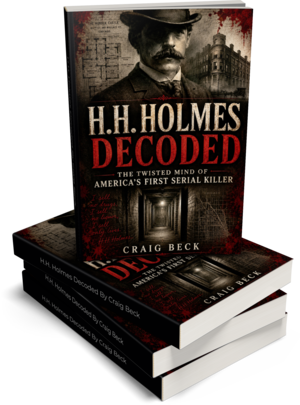
Want the whole story laid out the way only Craig Beck can tell it. Grab H.H. Holmes Decoded on Amazon and step inside the Murder Castle for yourself.
Who Was H.H. Holmes
He was born Herman Webster Mudgett on May 16, 1861, in the lake country village of Gilmanton, New Hampshire. By any outside measure, the Mudgett household looked respectable. His father Levi was a postmaster and a known disciplinarian, his mother Theodate a devout Methodist. The boy was bright, bookish, and small for his age, and that combination made him a target. Local lore says other children once dragged him into the office of the village doctor, a place he was terrified of, and forced him to confront a human skeleton hanging in the corner. He later wrote that the moment cured his fear by replacing it with something hungrier. Fascination.
By his twenties, Herman Mudgett had vanished. In his place stood Dr Henry Howard Holmes, charming, well dressed, articulate, and full of plans. He had already married a Vermont woman named Clara Lovering and quietly abandoned her and their infant son. He drifted through medical training at the University of Michigan, then through pharmacies and hotels in Chicago, leaving a trail of debts, lies, and missing acquaintances behind him like breadcrumbs nobody thought to follow.
The New Hampshire Boyhood That Built A Monster
Forensic psychology will tell you that almost every serial offender carries a fingerprint pressed into him in childhood. Holmes is no different. His father's discipline was harsh, sometimes physical, often theatrical. His mother's faith was severe. Punishment was constant, religious shame ran through the house like a cold draught, and affection had to be earned through obedience. That kind of home does two things to a clever child. It teaches him to mask his real self behind a polished surface, and it teaches him that other people are obstacles to manage, not equals to share a life with.
There is no honest record of Holmes ever loving anyone. Wives, lovers, business partners, even his own children, were used and discarded with the casual indifference most of us reserve for fruit that has gone off. That is the signature of a young brain that learned, somewhere around the age of seven or eight, that vulnerability gets you hurt. The smile becomes the weapon. The lie becomes the native language. Empathy goes quiet, and stays quiet for life.
He showed three classic markers researchers now group under the so called MacDonald Triad. He was cruel to animals from a young age, dissecting them on the kitchen table when nobody was watching. He was obsessed with skeletons and corpses by adolescence. He was a chronic, accomplished liar by the time he reached his teens. Modern criminologists argue about how predictive that triad really is, but in his case it reads less like a checklist and more like a precocious autobiography.
Medical School, Cadavers, and a Taste for Profit
At the University of Michigan, Holmes discovered the loophole that would underwrite the rest of his career. He would take out life insurance policies on imaginary or recently deceased people, then present a stolen or stripped cadaver, doctored to match the description, and collect the payout. His medical training gave him the technical skill to alter a body. His charm gave him the cover. His total absence of guilt gave him the appetite. He told one classmate, with a half smile, that a doctor who could not turn a corpse into money was wasting his education.
By the time he arrived in Chicago in 1886, he had refined the scam, abandoned at least one wife, married another, and adopted the surname Holmes for good. He took a job at a drugstore on the corner of South Wallace and West 63rd Street in the Englewood neighbourhood, ingratiated himself with the elderly owner, Mrs Holton, and quietly arranged for her and her husband to disappear. Friends were told they had moved to California. Nobody pressed for details, because Holmes always had a story, and the story was always told with a warm smile and steady eye contact.
This is where you start to see the dark triad working in full daylight. The clinical absence of conscience gave him the emotional blank slate. Narcissism gave him the conviction that he deserved every dollar and every body. The cold strategic mind that researchers call Machiavellian gave him the patience to spend a year setting up a single con. Most criminals are sloppy because the rush gets in the way. Holmes was different. The patience was the rush.
The Murder Castle: A Building Designed to Kill
In 1887, Holmes bought the lot opposite the drugstore and began construction on a three storey building that would become known to history as the Murder Castle. He hired wave after wave of workmen, fired them before they could understand the floor plan, and refused to pay several of them, knowing they had no recourse against a respected local doctor. Only Holmes himself ever held the complete set of blueprints.
The ground floor was conventional enough. Shops, the relocated drugstore, a jewellery counter. The upper floors were a maze. There were over one hundred rooms, many windowless, with doors that locked from the outside, peepholes wired to alarm bells in his quarters, and gas jets controlled from a panel in his bedroom. Some rooms were lined with asbestos and iron sheeting, designed as soundproof gas chambers. Body chutes ran from selected rooms straight down to a basement equipped with a dissection table, surgical instruments, vats of acid and quicklime, and a large oven the police would later describe as resembling a crematorium.
In 1893, Chicago hosted the World's Columbian Exposition. More than 27 million visitors poured into the city, many of them young women travelling alone for the first time. Holmes advertised cheap, respectable accommodation a short tram ride from the Fair. He preferred his victims to be female, unattached, and from out of state. They tended to vanish without anybody knowing exactly when they had stopped writing letters home.
He sold their skeletons to medical schools, where articulated human bones were always in demand and questions were rarely asked. He cashed life insurance policies on the ones he had thought to insure. He pawned their jewellery. He used some of the money to fund the next round of charming engagements and bigamous weddings. He kept a private tally, in his way. Most of the women had no tally to keep. Their families wrote letters that arrived at empty rooms and were answered by nobody.
If this is hooking you, the full breakdown lives inside H.H. Holmes Decoded, available on Amazon now. Every wife, every workman, every locked door, every chute.
The Dark Triad Wearing a Smile
If you want to understand why neighbours, fiancées, business partners and police all failed to see Holmes for what he was, you must abandon the Hollywood image of the serial killer as a dead eyed loner in a long coat. Holmes was the opposite. He was the warm handshake at the church social. He was the doctor who remembered your mother's name. He was the fiancé who proposed within a fortnight and meant every word, until the policy paid out.
This is psychopathy as social camouflage. The brain wiring that strips empathy out of him also strips out the social anxiety that makes the rest of us sweat through small lies. He could promise marriage in the morning, kill in the afternoon, and eat a hearty supper in the evening. Detectives who later interviewed him remarked on how unsettlingly normal he seemed across a table.
Narcissism powered his belief that every woman who entered his orbit owed him something. Machiavellian planning gave him the stomach to spend twelve months grooming a single target. Underneath all of it sat a sexual sadism he disguised as romance. The screaming, the begging, the slow death by gas or by suffocation in a sealed vault, those were the rewards he came back for. Money was the alibi he told himself, and possibly told God, on the rare occasions he pretended to consider Him.
If you have read my breakdown of Ted Bundy Decoded, you will recognise the wiring. Different decade, different state, same architecture under the skull. The mask is the crime. The killing is the punctuation.
The Pitezel Insurance Scheme and the Beginning of the End
By the mid 1890s, Holmes had drifted out of Chicago, partly because creditors and suspicious relatives were closing in, and partly because he was bored. His undoing came in the form of Benjamin Pitezel, a long time business partner, alcoholic, and willing accomplice. The plan was straightforward and grotesque. Pitezel would fake his own death, Holmes would identify a substitute body, and they would split a 10,000 dollar payout from the Fidelity Mutual Life Association of Philadelphia.
Holmes adjusted the script. He did not bother with a substitute. He simply murdered Pitezel in a Philadelphia rooming house in September 1894, doused him in chloroform, set the body up to look like an industrial accident, and collected the policy. Then, because Pitezel's wife and five children might one day ask awkward questions, Holmes took three of those children, Alice, Nellie, and Howard, on a long, baffling rail journey through the United States and Canada. By the time he had finished, Alice and Nellie had been suffocated in the cellar of a rented house in Toronto, and Howard had been dismembered and burned in a stove in Indianapolis.
A Pinkerton detective named Frank Geyer doggedly retraced Holmes's movements, knocking on doors in city after city until he found the cellar in Toronto and the chimney in Indianapolis. That investigation, more than any other, made the case. Holmes was already in custody on the insurance fraud. Geyer turned a fraud arrest into a murder hunt that has rarely been matched in nineteenth century American policing. You can read the FBI's broader study of organised, long term killers in their serial murder symposium report, and you will see that Geyer's instincts in 1895 predicted modern profiling by almost a hundred years.
The Hangman's Botched Job
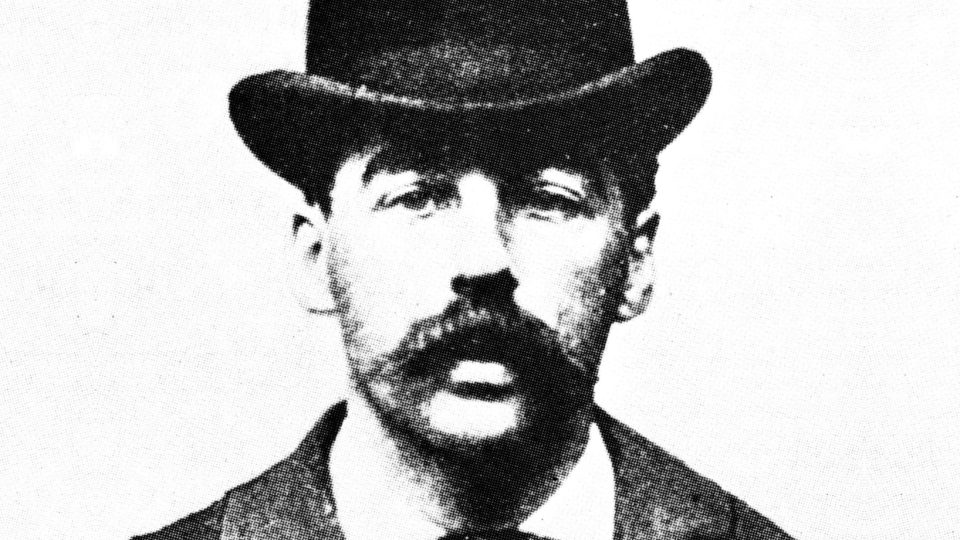
Holmes was tried in Philadelphia for the murder of Benjamin Pitezel and convicted in November 1895. While awaiting execution he produced two competing memoirs, in which the body count climbed and the contrition wavered. In one he confessed to 27 killings. In another he retracted half of them. He told a reporter he believed he was becoming, physically and morally, the devil. He may have been performing, but the cold expression in the surviving photographs makes it hard to be certain.
On May 7, 1896, he climbed the scaffold at Moyamensing Prison. He requested that his neck be cut and his body buried under several feet of concrete, so that no medical student or souvenir hunter could ever dig him up to study him. He got his wish. The trap door opened, the rope was poorly placed, and his neck failed to snap. He twitched and slowly strangled at the end of the rope for somewhere between 15 and 20 minutes while witnesses stood in silence. The so called Curse of Holmes, a series of unexplained deaths that struck people connected to his case, would become one of America's earliest tabloid obsessions. Smithsonian Magazine has documented the strange afterlife of the case in some detail, including the eventual exhumation of his body in 2017, which confirmed it really was him under the concrete.
What H.H. Holmes Teaches Us About Spotting the Predator Next Door
 Here is the lesson nobody likes to hear, because it threatens our basic faith in our own judgement. The kind of person who can do what Holmes did does not look or sound like a monster. He looks like a doctor, a landlord, a fiancé, a small businessman with good manners. The face the world saw at his hanging was the same face that smiled at his victims as he turned the gas valve. If your gut tells you a person is too smooth, too quick to charm, too eager to position themselves as the saviour of every problem in your life, listen to that gut. It is older than your manners.
If you are looking for warning signs in a real person, forget the cartoon glare. Watch for these instead. A history that does not quite add up across decades, with bursts of charm filling the gaps. Relationships that move at unnatural speed, especially when money or property comes with them. A constant low level pattern of small lies that nobody bothers to challenge because the smile is too disarming. An almost theatrical fluency around grief, sympathy, and apology, with none of the awkward stuttering most of us produce when we feel real shame.
The pattern is consistent across the lust killers I have written about. From Florida coeds to North London bedsits. You can see the same wiring in my Dennis Nilsen Decoded breakdown and again in Jack the Ripper Decoded, which sits in the same global decade as Holmes. Different centuries, identical engineering.
The Question Nobody Asks About H.H. Holmes
Most articles about Holmes get stuck on the body count, the Murder Castle, and the glittering backdrop of the World's Fair. The question I keep coming back to is older and more uncomfortable. What does it mean that a country which was barely a hundred years old produced him so cleanly. America in 1893 was a place where you could change your name on a train, marry a stranger by Sunday, and build a fortress without a single official signing off on the plans. That mobility, that anonymity, that worship of the self made man, was the perfect petri dish for a personality that needed cover and constant motion to function.
Holmes was not an aberration of his moment. He was the dark twin of the American dream. The same restless ambition that built railroads, skyscrapers, and the Columbian Exposition itself, dialled across into a brain with no empathy at the wheel, gives you a man like him. He was, in a horrible sense, exactly what the country was unwittingly designing for. Every nation eventually produces the predator it has made room for. America made room for Herman Webster Mudgett, and Herman Webster Mudgett accepted the invitation.
Ready to step deeper into the mind of the man who turned the American dream into a slaughterhouse. H.H. Holmes Decoded is on Amazon now, waiting for you to open the first door.
About The Author
 Craig Beck is the world's foremost expert on persuasion and human behaviour. A certified NLP Master Practitioner, former UK broadcaster, and bestselling author of more than one hundred titles, he has spent two decades reverse engineering the mechanics of why people say yes. More than a million readers across the globe have used his work to understand influence, decision making, and the hidden wiring of motivation. He does not deal in theory. He shows you how the engine of human behaviour really runs, and where its dangerous parts live.
What Readers Are Saying
Sarah Whitfield, Charleston, SC: "This is the only Holmes book that bothers to ask why. I have read three biographies and a true crime anthology on him over the years, and this one finally took me inside the man rather than just listing the bodies. Beck writes like he is sitting next to you. I finished it in two sittings and immediately bought his Bundy book."
Marcus Delaney, Boulder, CO: "As a retired nurse I have a strong stomach for dark material, and this still rattled me. Beck does not flinch, but he never wallows. The psychology is sharp, the storytelling is cinematic, and the chapter on the Pitezel children left me thinking for days. Worth every penny."
Janet Brockman, Tampa, FL: "I picked this up on holiday expecting standard true crime and got something closer to a forensic profile written by a friend. Craig has a way of explaining the dark triad without sounding like a textbook. If you have already read the famous Holmes books and felt unsatisfied, this is the one that finally fills the gap."
Frequently Asked Questions
How many people did H.H. Holmes really kill?
The honest answer is nobody knows. Holmes confessed to 27 murders in one prison memoir, retracted several in another, and police later confirmed only nine deaths beyond reasonable doubt. Contemporary tabloid coverage pushed his rumoured total as high as 200, a figure widely repeated but never substantiated. Modern historians tend to settle somewhere between 20 and 50 victims, given the sheer number of women associated with the Murder Castle who simply vanished from family correspondence during the 1893 World's Fair and were never traced again.
Did the Murder Castle really exist?
Yes, although its layout was less elaborate than the legend suggests. The building stood at 601 to 603 West 63rd Street in Englewood, Chicago, and police did find sealed rooms, gas piping into bedrooms, body chutes, basement furnaces, and a dissection table on the premises in 1895. Some of the wilder later embellishments, secret stairways and trap doors in every single room, were added by sensational reporters. The fundamental design, a private slaughterhouse hiding inside a working hotel, was completely real.
Why is H.H. Holmes considered America's first serial killer?
He earned the title by being the first American to fit the modern criteria for serial murder. Multiple victims over an extended period, a cooling off phase between killings, and a recognisable psychological signature. Other Americans had certainly killed repeatedly before him, but Holmes was the first whose pattern was identified, named, prosecuted, and publicly dissected in the press. His 1896 hanging marked the moment the United States accepted that organised, long term, multi victim murder lived inside its own borders, no longer a European import for tabloid readers to shiver over.
Last updated 11 May 2026