
Charles Manson Decoded: The Psychology of a Serial Killer Cult Leade
May 11, 2026Charles Manson Decoded: The Psychology of a Cult Killer
Charles Manson was a five-foot-two career criminal turned cult leader who orchestrated the 1969 Tate-LaBianca murders without personally landing a single blow at either crime scene. Born in 1934 to a 16-year-old mother in Cincinnati, he weaponised charisma, LSD, and apocalyptic prophecy to transform a commune of damaged young women into a kill squad. He was not a serial killer in the traditional sense. He was something rarer, and arguably more dangerous. He was a predator who programmed other people to do the bleeding for him.
 That distinction is the whole story. While Bundy stalked sorority houses and Jeffrey Dahmer butchered young men in his Milwaukee flat, Manson sat at Spahn Ranch and let the knives travel for him. The horror is not that he killed. The horror is that he convinced barefoot teenage girls, most of them barely out of school, to stab a heavily pregnant film star sixteen times and then write on the wall in her blood.
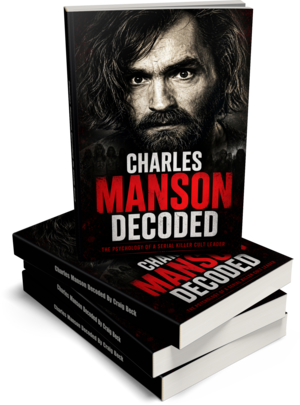
Want the full story behind the cult, the killings, and the man who built them? Pick up Charles Manson Decoded on Amazon today.
Who Was Charles Manson Really
On the surface, Charles Milles Manson was a pint-sized drifter with a guitar and a head full of borrowed slogans. He was short, scruffy, often filthy, and looked nothing like the cinematic monster his name now conjures. People who met him in 1967 in San Francisco's Haight-Ashbury district described him as charming, funny, weirdly magnetic. Hippies fed him. Girls slept with him. Music industry insiders, including Beach Boys drummer Dennis Wilson, paid for his drugs and let him crash on their floors.
Underneath the smile sat a 32-year-old who had spent 17 of those years locked up. Reform schools, federal prisons, county jails. By the time he walked out of Terminal Island in March 1967, he had already begged the warden to let him stay. He had no idea how to live in the outside world. That detail tells you everything. Prison was home. Society was a foreign country he intended to invade.
The Summer of Love handed him the perfect cover. Long hair was normal. Drug use was sacred. Sleeping with strangers was a political statement. A small, witty ex-convict spouting cosmic nonsense fitted right in. By 1968 he had drawn around him a cluster of mostly young, mostly female followers, most of them runaways or castoffs from middle-class American homes that had failed them. They called themselves the Family. He called himself, eventually, God and the Devil at once.
The Childhood That Built a Predator
Manson's mother, Kathleen Maddox, was 16 and a part-time prostitute when he was born on 12 November 1934. The often-repeated story that she sold him to a waitress for a pitcher of beer has never been fully verified, but the truth was nearly as bleak. He was bounced between his mother, his uncle, and his Pentecostal grandmother, whose religious cruelty matched his mother's negligence. By age nine he was already setting fires and stealing. By 13 he had been shipped to Indiana's Boys Town, from which he ran away within four days.
Look at the textbook predictors of antisocial development and Manson's childhood ticks every column. Maternal absence and rejection. Physical and emotional abuse. Early institutionalisation. Cruelty to animals reported by classmates. A pattern of arson, theft, and runaway behaviour before puberty arrived. He was, in the language of attachment theory, a child who never learned that adults could be safe. So, he learned the opposite lesson. People are tools. Affection is a weapon. Trust is for fools.
Inside reform school he was repeatedly raped, beaten, and held in solitary. By the time he hit federal prison in his twenties he was studying older inmates the way a graduate student studies professors. He learned the pimp's playbook from career criminals like Alvin Karpis. He absorbed Dale Carnegie's persuasion manual. He picked up the language of Scientology auditing. He reverse-engineered humanity from inside a cage. When he walked out in 1967 he was not rehabilitated. He was finished.
The Dark Triad Hiding Behind a Guitar
Forensic psychologists describe a cluster of three interlocking traits known as the Dark Triad. Psychopathy, the absence of empathy and remorse. Narcissism, the bottomless need for admiration and a grandiose sense of personal importance. Machiavellianism, the cold strategic willingness to manipulate. Most violent offenders score high on one. Cult leaders tend to score high on all three. Manson was a textbook case.
His psychopathy showed in the casual ease with which he discussed killing, and in his complete failure to grieve any of his victims even decades later. His narcissism was so blatant that one court psychiatrist described him as living inside a hall of mirrors where every reflection was Christ. His Machiavellianism was the secret of the Family. He was not a wild-eyed mystic. He was a strategist who had spent prison rotations watching cellmates and learning which lever broke each personality.
You can hear the calculation in the way he separated lovers, manufactured jealousies, named children, and assigned tasks. He worked out the psychological geometry of a group the way a pool player reads a table. He did not need everybody to love him equally. He needed each person to love him uniquely. That is how a cult holds together when the outside world starts knocking on the gate.
How Charles Manson Hunted His Followers
 Manson's victim selection began long before any blood was spilt. He targeted young women aged 16 to 22 with traumatic family histories, often runaways, often middle class, often educated enough to be articulate but vulnerable enough to be desperate for a father figure. Susan Atkins came from an alcoholic home. Patricia Krenwinkel was a quiet girl with low self-esteem and a hyperactive thyroid that gave her body hair she hated. Leslie Van Houten had aborted a baby in her teens and never recovered. Linda Kasabian had run from a violent husband. None of them were monsters when they met him. Within 18 months several would be murderers.
The grooming followed a pattern researchers now recognise across high-control groups. Love bombing in the first weeks. Sex with Charlie himself, often staged as the centrepiece of the bond. Heavy LSD use under his direction, with Manson always taking smaller doses than his followers so he could pilot the experience. Sleep deprivation and irregular meals. Constant shifting of approval. Isolation from outside family and friends. The slow rewriting of personal history through repeated communal storytelling, until each follower's biography matched the official Family version.
By the time the murders happened, his followers were not making free decisions. They were operating inside a frame Manson had built around them, brick by chemical brick. Every cult specialist who later interviewed Family members reached the same conclusion. They were not stupid girls. They were not naturally violent. They had been engineered.
If the cult mechanics fascinate you, the deep dive sits inside Charles Manson Decoded on Amazon. Every grooming step, every drug ritual, every recorded confession dissected.
Helter Skelter and the Manufactured Apocalypse
By 1968 Manson's grandiosity had outgrown the commune. He believed the Beatles' White Album, released that November, was a coded message addressed to him personally. The track Helter Skelter, in his reading, predicted an imminent race war between Black and white America. Black militants would rise, slaughter the white establishment, then prove unable to govern themselves, at which point Charlie and the Family would emerge from a hidden hole in Death Valley to take their rightful place as rulers of the planet.
Read it again. Try not to laugh. Then remember that several intelligent young women heard this and nodded along seriously enough to commit murder for it.
The delusion has all the hallmarks of pathological narcissism mutated by amphetamine and acid. Manson was not psychotic in any clinical sense. He never lost contact with practical reality. He could still drive, deal drugs, manipulate police, and cut a record. But the centre of his self-image had inflated into messianic territory. He was the second coming and the antichrist together. The race war was simply the stage on which his importance would finally be recognised.
There was a more domestic motive lurking underneath. Manson had spent the previous year trying and failing to land a record deal. Beach Boys producer Terry Melcher had passed on him. Melcher's old address was 10050 Cielo Drive. By August 1969 the house was rented by Roman Polanski and Sharon Tate. So, when Manson selected the location for the first night of murder, he was lighting two fuses at once. One was Helter Skelter. The other was a personal message to a music industry that had refused to crown him.
The Long Night of August 1969
On the night of 8 August 1969, Charles Manson sent four followers to 10050 Cielo Drive in the hills above Beverly Hills. Tex Watson drove. Susan Atkins, Patricia Krenwinkel, and Linda Kasabian followed. Manson's instruction was simple. Kill everyone inside and make it as gruesome as possible. The killers cut the phone lines, climbed the gate, and shot 18-year-old Steven Parent dead in his car as he tried to leave the property.
Inside the house they found four people. Sharon Tate, eight and a half months pregnant. Hairstylist Jay Sebring. Coffee heiress Abigail Folger. Polish writer Wojciech Frykowski. What followed lasted around 30 minutes. Sebring was shot and stabbed seven times. Frykowski was clubbed, shot, and stabbed 51 times. Folger was stabbed 28 times in the front lawn after running for her life. Tate begged Atkins for the life of her unborn child. She was stabbed 16 times. Atkins later boasted that she had tasted Tate's blood.
The next night Manson came along himself, partly to show his followers how to do it properly. He tied up grocery store owner Leno LaBianca and his wife Rosemary in their Los Feliz home, then handed them off to Watson, Krenwinkel, and Van Houten. Leno was stabbed 26 times, with the word WAR carved into his chest. Rosemary was stabbed 41 times. The killers wrote Healter Skelter, misspelt, on the fridge in her blood, along with Death to Pigs and Rise.
The savagery was not random. The over-stabbing, the wall messages, the targeting of a pregnant woman were theatre staged to ignite a race war Manson believed was already overdue. The murders were a press release written in blood.
The Capture and the Court Performance
The Family's downfall came not from forensic genius but from a Family member's mouth. Susan Atkins, arrested on an unrelated car-theft charge, started bragging to a cellmate at Sybil Brand Institute about Sharon Tate. The cellmate told the police. Within months, prosecutor Vincent Bugliosi had built the case that became one of the longest criminal trials in American history.
Manson treated court like a stage. He carved an X into his forehead, later converting it into a swastika. He attempted to attack the judge, prompting the now-iconic image of him being dragged from the courtroom in mid-scream. He instructed his female co-defendants to mirror his mutilations and his outbursts. He demanded to represent himself, was refused, and continued to perform regardless. His defence was the same defence narcissists always reach for. Society was the real defendant. He was simply its mirror.
On 25 January 1971, he was convicted of seven counts of first-degree murder. The original death sentence was commuted in 1972 when California temporarily abolished capital punishment. He spent the next 45 years in California prisons, denied parole 12 times, before dying of natural causes on 19 November 2017 at the age of 83.
What Manson's Story Teaches Us About Spotting Predators
If there is a usable lesson buried in this case, it is the most uncomfortable one. The most dangerous personalities rarely arrive looking dangerous. Manson did not stalk his victims through dark alleys. He sang to them. He made them laugh. He told them they were special. He listened to their childhood pain and reflected it back as cosmic destiny. The recipe is not unique to him. It is the same recipe used by abusive partners, predatory bosses, and modern online manipulators every day of the week.
The warning signs to watch for in your own life are quieter than the headlines suggest. Sudden intense flattery. The isolation of you from friends and family. The reframing of your past as a story only this person can interpret. The slow shift from suggestion to expectation to obligation. The casual punishment of any independent thought. None of these things require a desert ranch or a White Album. They require a willing mark and a trained operator. Manson trained himself in a federal prison. The next one might be training himself in a Discord server.
If you want to see how this same charm operates across other monsters, my deeper breakdown sits inside Why Serial Killers Keep Fooling Us. The mechanics are nearly identical across Manson, Bundy, and the cult leaders we still trust today. For the wider view of how forensic psychology truly decodes these minds, you can read Forensic Psychology vs Pop True Crime.
The Question Nobody Asks About Charles Manson
Every documentary asks the same three things. Was he insane. Was he evil. How did the Family let it happen. The question almost no one asks is the one that matters most. Why did Charles Manson never personally kill at Cielo Drive?
The standard answer is cowardice. He was small, physically unimpressive, easily overpowered. The deeper answer is the one that should keep you awake. Manson understood, with the chilling clarity of a chess player, that the act of killing creates a permanent psychological bond with the killer. He needed his followers locked in. Once Tex Watson had pulled a trigger, once Atkins had pushed a knife into Sharon Tate, they belonged to him forever. They had something to lose that he did not. They had become his hostages and his weapons in the same instant.
That is the part of his psychology that should disturb you the most. Manson did not lose control of his followers in a moment of mass hysteria. He calculated, in advance, that the surest way to keep them was to make them murderers. Their hands were dirty so his could stay clean. The Beatles delusion gave them a story. The drugs and the sex gave them a frame. The murders gave them a leash. He was not riding a wave. He was the engineer of every wave they surfed.
That is what separates a Charles Manson from an ordinary monster. Most killers are slaves to their compulsions. Manson made other people into the slaves and watched from a porch while they did the work. The man who never swung a knife at Cielo Drive was the most calculating presence inside that house, even though his body never crossed the threshold. His real weapon was never a knife. It was the architecture of belief he built around four broken young women in a barn outside Los Angeles.
The FBI's own profilers have since described his model of remote-control killing as a template that later inspired everything from Heaven's Gate to Jonestown. The man is dead. The blueprint is not. You can read more on how investigators classify these patterns in the FBI's report on serial murder, which built much of its cult-leader framework on the lessons of the Manson case.
What Readers Are Saying
"Beck is the only true crime author I trust to truly explain why these people do what they do. The Manson breakdown gave me chills." Maria Reynolds, Phoenix, Arizona.
"I have read everything on Manson and thought I knew the case. Craig Beck found angles nobody else has touched. Worth every penny." Brian Castellano, Burlington, Vermont.
"Read it in two sittings. Genuinely changed how I see persuasion in everyday life. Five stars." Tasha Williams, Tallahassee, Florida.
Ready to go beyond the blog? The complete psychological dismantling of the most calculating cult leader of the twentieth century is waiting in Charles Manson Decoded: The Psychology of a Serial Killer Cult Leader.
Frequently Asked Questions
Was Charles Manson really a serial killer?
Strictly, no. The classic FBI definition of a serial killer requires three or more victims killed by the same offender in separate events with a cooling-off period in between. Manson personally killed only one or two people directly, with most authorities citing the killing of musician Gary Hinman as the most likely. His real crime was orchestration. He directed at least nine murders without committing most of them himself, which technically makes him a mass murderer by proxy and a cult leader. Cult leader is closer to the truth than serial killer, even though Charles Manson Decoded uses the broader popular term.
What was Charles Manson's IQ?
Prison records from the 1950s and 1960s placed Manson's IQ at around 109, which is mildly above the population average but nowhere near genius territory. The myth of his hidden brilliance comes from how effectively he manipulated others, not from raw intellect. He was clever, but his real edge was emotional. He read people the way a card sharp reads a table, a skill that has nothing to do with standardised testing and everything to do with predatory practice across two decades of incarceration.
Why did the Manson Family follow him so devotedly?
The Family was built from people whose lives had already broken before they met Manson. He offered them three things they were starving for. A father figure who never abandoned them. A purpose larger than themselves through the Helter Skelter prophecy. And a sexual, chemical, and emotional environment so saturated that ordinary life felt grey by comparison. He combined cult grooming techniques he had absorbed in prison with the cultural permission slip the late 1960s handed him. The result was a closed system that punished doubt and rewarded obedience.
About The Author
 Craig Beck is the world's foremost expert on persuasion and human behaviour. A certified NLP Master Practitioner, former British broadcaster, and bestselling author of more than one hundred books, he has spent two decades reverse engineering the question of why people say yes. More than a million readers worldwide have used his work to understand the hidden mechanics of influence, decision making, and motivation. He does not teach theory. He shows you exactly how the wiring of humanity works.
Last updated: 9 May 2026