Weekends Only, No Spirits, Never Alone: Why Your Drinking Rules Keep Breaking
Nov 01, 2026Weekends Only, No Spirits, Never Alone: Why Your Drinking Rules Keep Breaking
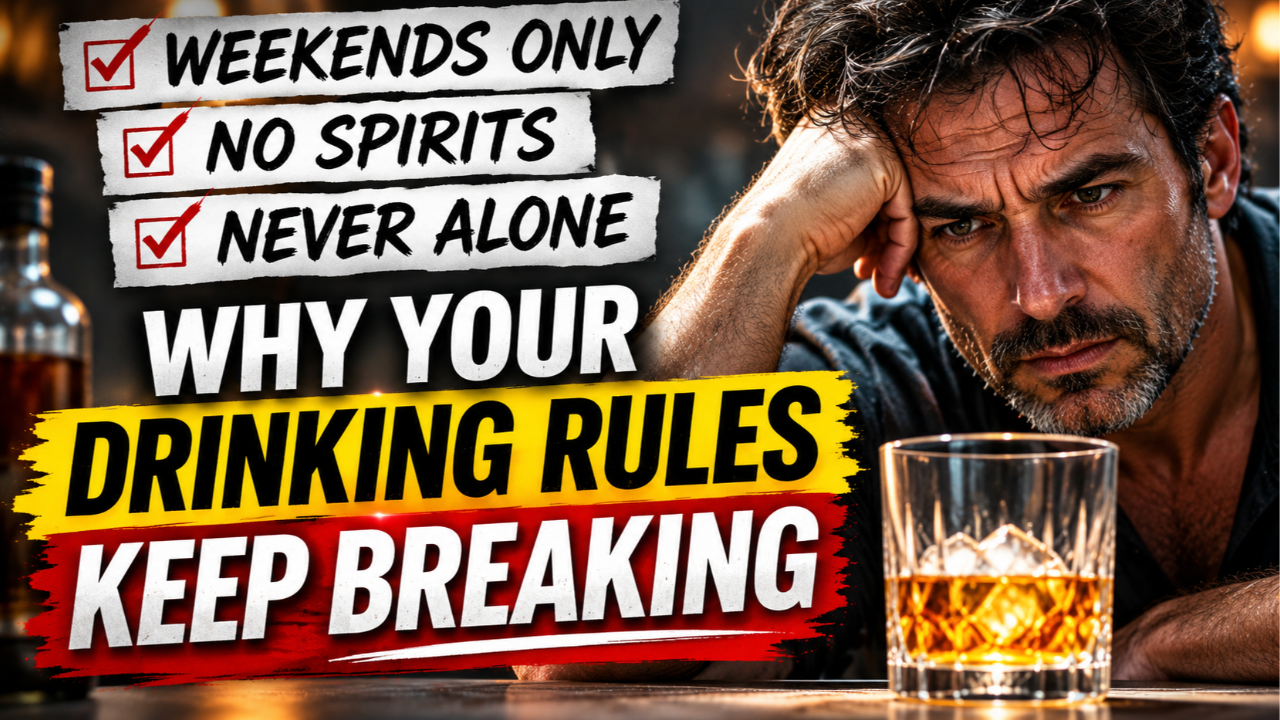
Your drinking rules keep breaking because they're built on top of a belief they never touch. Weekends only, no spirits, never alone, two glasses and done: each rule tells your subconscious it's being denied something good. As long as part of you still believes alcohol is a reward, every rule becomes a deprivation it will fight, bargain with and eventually overturn. More willpower won't fix that. Changing the belief will.
And you're not daft. You wrote those rules for good reasons, usually on a Sunday morning with a dry mouth and a vague memory of sending a text you now regret. The rules felt sensible and grown-up. Weekends only meant you'd be sharp at work. No spirits meant no more blurry endings. Never drinking alone meant you weren't one of those people. For a week or two the system worked, and you felt a little smug about it. Then a Wednesday came along with a rotten meeting in it, and someone said the magic words "it's a special occasion", and the rulebook quietly went in the recycling with the empties. So, if the rules were so reasonable, why does your own head keep tearing them up?
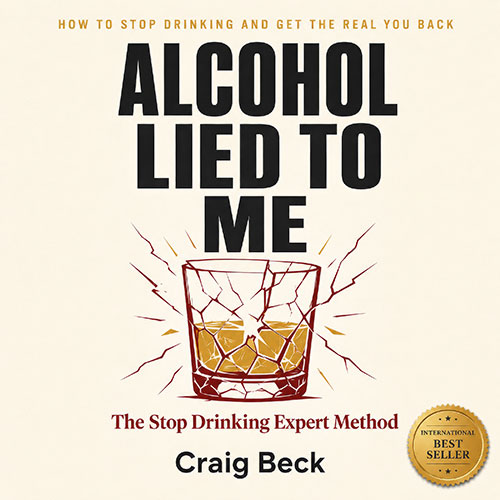
Want the full method for getting free without a rulebook? Get Alcohol Lied to Me: The Intelligent Way to Escape Alcohol Addiction on Amazon.
The Rulebook Every Sensible Drinker Writes
Almost every intelligent drinker writes the same rulebook, and it usually arrives one clause at a time. It starts with timing. You'll only drink on Friday and Saturday, because weekdays are for work and weekends are for living. Then it moves on to the type of drink. Spirits are the problem, you decide, so it's wine or beer from now on. Then comes the company you keep. Drinking with friends is social, drinking at the kitchen counter on your own is a warning sign, so you'll only drink when there's someone else in the room.
The last clause is about quantity. Two glasses, two pints, or one bottle shared between two adults who are very definitely in control. I wrote nearly all of these rules myself during my own drinking years, and I'd have defended every one of them to you in the pub. The story behind the rulebook is that drinking is basically fine, and you only need to put a fence around it. Your problem, as you see it, is a shortage of discipline. Find a bit more backbone, add a few better rules, and the fence will hold. It's a comforting story, because it means you never need to give anything up. You only need to manage it.
How Weekends Only Turns Into Thursday Is Nearly Friday
Here's the crack in that story. Watch what happens to your rules over a couple of months, and you'll notice they rarely break with a bang. They bend. Weekends only becomes weekends plus Thursday, because Thursday is nearly Friday and everyone knows it. No spirits becomes no spirits except gin, because gin is basically a long drink once you've put tonic in it. Never alone becomes never alone unless your partner is working late, in which case you're technically waiting for company.
Two glasses is the funniest one, because it stays perfectly intact while the glasses get bigger. You may have noticed the wine glass in your cupboard that holds a third of a bottle and still counts as one. I remember banning spirits and then discovering a sudden passion for strong continental lager, which I told myself was a completely different thing. And then there are the special occasions. It's astonishing how even the smallest event can suddenly become special: a colleague's birthday, a sunny evening, a bad day, a good day, the end of a long week that started on a Monday. None of this is you being weak. It's a very clever part of your mind doing exactly what it was built to do.
What a Drinking Rule Looks Like to Your Subconscious
To understand why moderation keeps failing, you must look at the rule from the other side of the wall. Your conscious mind writes the rule. Your subconscious mind must live with it. The conscious part of you is the sensible manager with the clipboard, making plans on a Sunday. The subconscious is the part that runs all the automatic programs you never think about, from tying your shoelaces to reaching for the corkscrew at six o'clock. It doesn't read your rulebook. It only reads what it believes.
The Belief Running Underneath the Rule
So, what does your subconscious believe about alcohol? If you've been drinking for years, the answer is usually something like this: alcohol relaxes me, rewards me, makes me more fun and gets me through the hard bits. Think of it as a line of code that reads "drink equals treat". Now look at what a rule does to that code. It doesn't delete it. It adds a second line underneath that reads "but you can't have your treat until Saturday". To your subconscious, that's not a health plan. That's a punishment. You've told a part of your mind that something lovely is being kept from it, and you've given it a calendar to count down the days.
Why Deprivation Makes the Drink Look Bigger
Psychologists call the next bit reactance, which is a fancy word for the urge to grab whatever you're told you can't have. Tell a child the biscuit tin is off limits and the biscuit tin becomes the most interesting object in the house. Your brain's wanting system works the same way. Dopamine is less about pleasure and more about anticipation, and nothing feeds anticipation like a forbidden thing on a timer. By the time Friday arrives, the drink has been inflated into a prize. The National Institute on Alcohol Abuse and Alcoholism describes how repeated drinking changes the brain's reward and stress circuits, which is part of why the craving can feel louder than your best intentions. So, the very rule meant to shrink the drink ends up making it look enormous.

The Loophole Department in Your Head
Once a rule feels like deprivation, your subconscious opens what I like to call the loophole department. It's staffed by excellent lawyers who work very long hours. Their only job is to find the gap in the wording. They noticed that "weekends only" never defined when the weekend starts. They spotted that "no spirits" said nothing about fortified wine. They realised "never alone" is satisfied by a video call with your sister. They're not criminals. They're simply working for a client who believes the drink is a good thing that's being unfairly withheld.
This is where the pattern escalates. Every time the loophole department wins, two things happen. First, you get the drink, which reinforces the belief that it was worth fighting for. Second, you feel a little worse about yourself, because you broke your own rule again. That second feeling matters more than people realise. Shame is a stress, and your old program has one favourite answer to stress. So the broken rule becomes a reason to drink, and the drink becomes the next broken rule. If you've ever wondered why you can't moderate your drinking when other areas of your life run so smoothly, this is the loop. It's the same one I unpacked in the piece on the 6pm craving, only with a rulebook bolted on top.
Want the full method for switching off the belief instead of fighting it? Get Alcohol Lied to Me: The Intelligent Way to Escape Alcohol Addiction on Amazon.
Why Stricter Rules and Better Apps Keep Losing
The natural response to a broken rule is a tougher rule. If weekends only failed, try Saturday only. If two glasses failed, buy a smaller bottle. Download the drink tracker, set the phone reminders, tell your mates you're on a health kick and hope the public shame keeps you honest. Some people sign up for a dry month, white-knuckle it to the finish line and then celebrate the success with a drink, which tells you everything about what they still believe.
Every one of these fixes was doomed for the same reason. They all treat alcohol as a precious thing that must be rationed, which only confirms the belief that it's precious. They also rely on willpower, and willpower behaves more like a phone battery than a muscle you can build forever. The American Psychological Association's overview of willpower explains how self-control can wear thin when you lean on it all day. You spend yours on the boss, the kids, the traffic and the inbox, and by seven o'clock there's very little left to guard the fence. Then there's the all-or-nothing trap. The moment you break the rule by one glass, a voice says the day is ruined anyway, so you may as well finish the bottle. A rule that collapses completely after one slip was never really holding anything up.
If you're a heavy daily drinker, please speak to your doctor before stopping suddenly, because withdrawal can be dangerous; the NHS guidance on getting help with alcohol is a sensible place to start. A book can be a powerful companion on this road, but it's not a substitute for medical care.
Change the Belief and the Rules Become Pointless
Here's the reframe, and it's the heart of everything I teach. You don't need a better rule. You need to stop believing the drink is a treat. In Alcohol Lied to Me, I put it with a slightly grim comparison. If a reckless friend told you he played Russian roulette a few times a week for kicks, you wouldn't advise him to cut down and only do it at the weekend. You'd tell him to stop, because the activity itself is the problem, not the schedule. Moderation makes perfect sense for things that are good for you in sensible amounts. It makes very little sense for an addictive drug that's quietly lying to you about what it gives.
When the belief changes, something odd happens to the rulebook. It becomes unnecessary, in the same way you don't need a rule about how often you're allowed to lick a battery. Nobody white-knuckles their way past a bowl of cold porridge. You don't feel deprived of something you don't want. That's why I'm always saying the goal isn't to resist the drink. It's to see it so clearly that the wanting fades by itself.
That's also why I'm not a fan of labels here. You don't need to decide whether you're an alcoholic before any of this works, which I've explained in why the "am I an alcoholic" question keeps you drinking. The question that matters is simpler. What do you believe alcohol is doing for you, and is it true?
Your First Move: Audit the Rule, Not Yourself
Here's something you can do tonight that needs no willpower whatsoever. Take a piece of paper and write down every drinking rule you've ever set yourself, including the ones you've quietly abandoned. Weekends only, no spirits, never alone, two glasses, not before six, not on a school night, whatever your personal version was. Don't judge the list. Just get the rules out of your head and onto the page where you can see them in daylight.

Then, next to each rule, write the belief it was protecting you from. Weekends only might sit beside "alcohol is how I relax". No spirits might sit beside "I can't trust myself once I start". Two glasses might sit beside "a drink is my reward for getting through the day". You'll probably find the same two or three beliefs behind almost every rule. Those are the real targets. Over the next week, each time you feel a pull towards a drink, ask which belief just spoke up, and whether it's ever delivered what it promised. You're not trying to win the argument. You're simply noticing that it is an argument, and that you've been taking one side on trust for years. If you'd like a gentler, practical frame for the weeks ahead, my guide to quitting drinking naturally picks up from here.
The Rule Nobody Needs for Things They Don't Want
Notice what you don't have rules about. You don't have a weekends-only policy for flossing, or a strict two-portion limit on Brussels sprouts. Rules only appear around the things a part of you still wants more of. So, every rule you've written is a signpost, pointing straight at a belief you haven't examined yet. Seen that way, all those broken rules weren't failures at all. They were your subconscious telling you, quite loudly, where the real work is. I explored the bigger version of this in why you can't stop drinking, and it's worth a read if this piece has stirred something.
And maybe the most useful question isn't how to make your rules stronger. Maybe it's what your life would look like if you never needed to write another one.
Ready for the full method that makes the rulebook redundant? Pick up Alcohol Lied to Me: The Intelligent Way to Escape Alcohol Addiction on Amazon and start with the belief, not the bottle.
"For about six years I had a rule for everything: no drinking Monday to Wednesday, white wine only, never more than two. I broke every one of them weekly and hated myself for it. Once I stopped seeing wine as my treat, the rules just stopped mattering. I sleep through the night now and I'm really present with my kids at bedtime."
Melissa T., Columbus, Ohio
"I switched from bourbon to beer to light beer and thought that was progress. It wasn't. What changed things was realizing the craving was a belief I could question, not an order I had to obey. Eight months on, my wife says I'm a calmer guy, and my Saturday mornings belong to me again."
Greg H., Spokane, Washington
"My rule was never drink alone. Then I started inviting people over just so I could drink. Looking at the belief instead of the rule was the first thing that ever worked for me. I've saved enough to take my sister on the trip we always talked about."
Denise M., Asheville, North Carolina
Frequently Asked Questions About Drinking Rules and Moderation
Why can't I stick to my drinking rules?
Drinking rules usually fail because they leave the underlying belief untouched. If part of your mind still sees alcohol as a reward or a way to relax, any rule that limits it feels like deprivation. That part of you will bargain, find loopholes and wait for a special occasion. It's not a lack of character. You're asking willpower to hold back something your subconscious believes is good for you, and willpower tires long before the belief does.
Does only drinking at weekends work?
For some people it seems to work for a while, but it often turns into a countdown. Saving alcohol for Friday and Saturday can make the drink feel even more like a prize, and weekend drinking tends to creep into Thursday and Sunday. It can also make the weekend sessions heavier. If you notice that the rule needs constant defending, that's a sign the belief underneath it is still running the show.
How do I stop drinking without relying on willpower?
Start by questioning what you believe alcohol gives you, rather than policing how much you drink. Write down your old rules and the belief each one protected, then notice which belief speaks up when a craving arrives. When you stop seeing the drink as a treat, there's far less to resist. If you drink heavily every day, talk to your doctor first, because stopping suddenly can be risky and may need medical support.
About the Author
Craig Beck spent twenty years behind the microphone as a UK broadcaster before turning his attention to why people do the things they swear they'll stop doing. He's a certified NLP Master Practitioner and trained hypnotherapist, and the bestselling author of more than a hundred books on human behaviour, happiness and freedom from alcohol. Having once lived the double life of a functioning professional with a two-bottle-a-night habit, he writes about drinking without lectures, labels or white-knuckle willpower. You can read more about Craig and his work here.
Last updated: 26 October 2026