Why Saving Harder Is Making You Poorer
Nov 07, 2026Why Saving Harder Is Making You Poorer
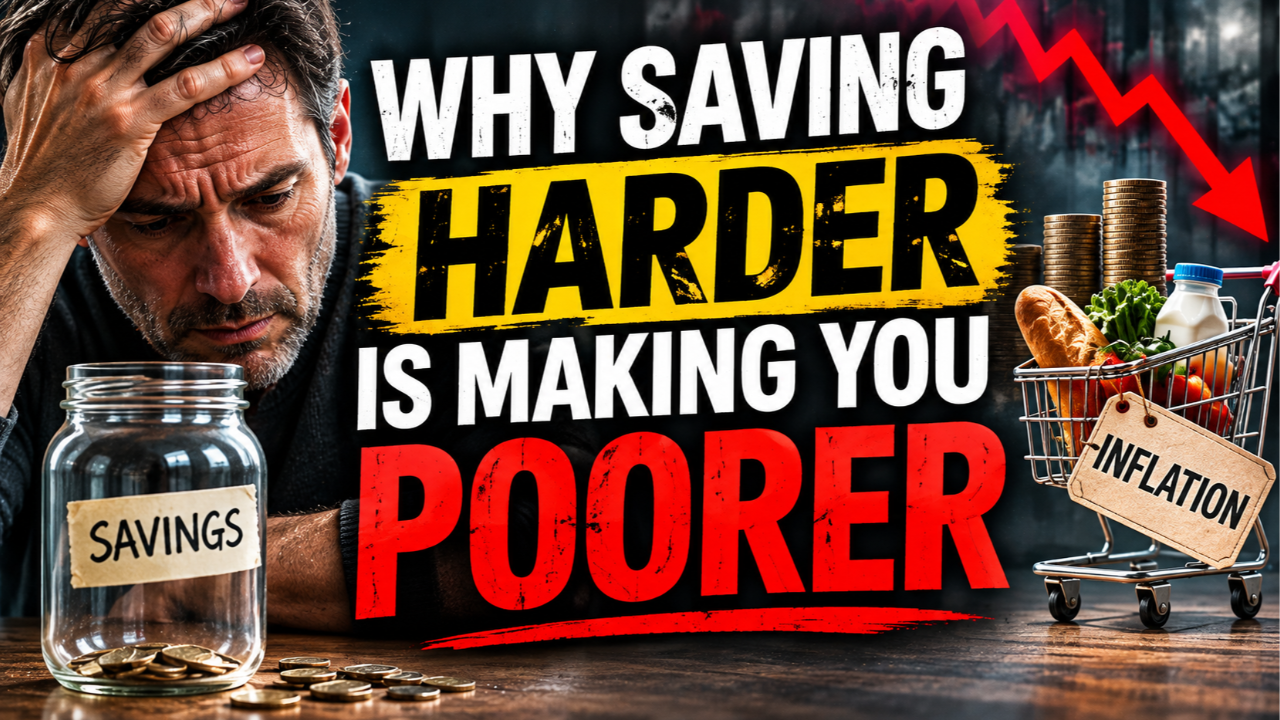
Saving harder can make you poorer when the money sits in cash earning less than the rate at which prices rise. The number on your statement grows, yet what that money can buy quietly shrinks. Most people keep doing it anyway, because the habit is run by a fear program in the mind that labels doing nothing as safe and any change as danger. The balance feels like protection. The maths says otherwise.
And you probably know the feeling this habit pays you in. It's the small glow of checking your banking app and seeing the savings pot a little fatter than last month. You skipped the takeaway, you said no to the weekend away, you moved another chunk across on payday like a responsible adult. Then you go to the supermarket and the same trolley of shopping costs noticeably more than it did a few years ago. The car insurance renewal arrives with a figure that makes you laugh out loud, and not in a good way. Somewhere in the back of your mind a quiet question starts nagging. If you're doing everything right, saving harder than your friends and never touching the pot, why does it feel like you're running up a down escalator?
Want the full method for stepping out of the broken money game? Get The 21-Million Revolution: Escaping Broken Money To Secure Your Financial Future With Bitcoin on Amazon.
The Comfortable Lie of the Safe Saver
The story most of us were raised on is simple and sounds wise. Spend less than you earn, put the difference in the bank, and never gamble with money you can't afford to lose. Your parents probably said it, and their parents said it with even more conviction. My own grandmother kept a biscuit tin of notes at the back of the wardrobe and regarded banks with the suspicion most people save for timeshare salesmen. In her world, money you could see was money you still had. That belief got passed down the family like a recipe, and for a long time nobody thought to check whether the ingredients still worked.
Here's the surface story the safe saver believes. Cash is neutral. It sits there, it doesn't do anything clever, and so it can't hurt you. Investing is risk, spending is weakness, and the savings account is the sensible middle ground where grown-ups keep their future. It's a lovely story. It lets you feel virtuous every payday and it gives you something solid to point at when the world feels wobbly. The trouble is that it rests on one hidden assumption, and that assumption is the crack the whole thing falls through.
What Inflation Is Doing to Your Savings While You Sleep
The hidden assumption is that a pound or a dollar is a fixed measuring stick. It isn't. The Bank of England's own explainer on inflation spells it out plainly: inflation is prices rising, and the UK government sets a target of 2% a year. That target is the plan, not an accident. The system is designed so that a basket of shopping costing £100 this year should cost around £102 next year. Keep money in savings at a rate below that, and you lose ground every single year while the statement tells you you're winning.
The plan doesn't always hold, either. According to the Office for National Statistics, UK consumer prices rose by 11.1% in the 12 months to October 2022, a level not seen for decades. Even at the gentle official target, the arithmetic is sobering. If prices rise by a steady 2% a year, £10,000 left in an account paying nothing buys roughly what £8,200 buys today after ten years. Nobody sends you a letter about that. There's no red warning light on the app. Inflation eating your savings is the quietest loss most people will ever suffer, and that silence is exactly why the habit survives.
Why Your Brain Prefers a Slow Loss to a Scary Choice
So, if the numbers are this clear, why do intelligent people keep piling cash into an account that loses value? Because the decision is never really made by the part of you that does sums. It's made by much older software whose only job is to keep you alive, and that software was written long before anyone invented a bank.
The Fear Program That Runs on Autopilot
Your brain treats losses and gains very differently. Researchers call it loss aversion, which in pub language means losing a tenner stings far more than finding a tenner pleases you. Brain imaging work published in Science found that people's sensitivity to potential losses showed up in the brain's own valuation systems, which helps explain why the dread of a bad decision can outweigh the hope of a good one. Now add the second piece of code, the status quo bias. Doing nothing never feels like a decision, so it never feels like a mistake. If you move money and it falls, that's your fault and you'll replay it for months. If you leave it in cash and it shrinks, that's just the economy. The fear program picks the option that protects you from regret, even when it costs you more.
How Money Illusion Fools a Clever Mind
The third bug is one economists have chewed over for nearly a century, the money illusion. Your mind reads the number on the screen and ignores what the number can buy. A balance that has grown from £10,000 to £10,500 looks like progress, so the reward chemistry fires and you feel safe. The brain is responding to the size of the figure, not its purchasing power, and that's like judging how full your petrol tank is by counting the number of times you've visited the garage. It's a perfectly understandable shortcut. It's also the shortcut that lets the safe saver habit feel like a win while it quietly drains your future.

How the Safe Saver Habit Tightens Its Grip Every Year
Like any loop, this one gets stronger the more you run it. Every month you save and nothing terrible happens, the brain files another piece of evidence that cash equals safety. The cue is payday, the routine is moving money into the pot, and the reward is that little flush of relief. Behaviour that gets rewarded gets repeated, and after a decade or two it stops feeling like a choice at all. It becomes part of who you are. You're the sensible one. You're the person who doesn't take risks. Once a habit becomes identity, questioning it feels like an attack on your character rather than a review of your spreadsheet.
Then the escalation kicks in. As prices rise and the pot buys less, the fear program doesn't conclude that the strategy is broken. It concludes you haven't saved hard enough. So, you cut back further, you feel guiltier about every coffee, and you save even more into the same leaking bucket. Money anxiety grows alongside the balance, which is a strange thing to experience. If you recognise the opposite pattern too, where you can't bear to open the bills at all, I've written about that in why some of us hide from our bank statements. Both habits come from the same place, a nervous system that has decided money is a threat to be managed rather than a tool to be understood.
Why Budgeting Harder and Panic Buying Both Fail
When people finally notice the leak, they usually reach for one of two fixes, and both are doomed for the same reason. The first is the white-knuckle budget. You download three apps, colour-code your spending and squeeze every last penny into savings. It feels productive, but it doubles down on the original program. You're still treating cash as the safe harbour, you're just rowing towards it faster. Willpower is a finite resource, and a budget built on deprivation tends to collapse around the third week of a cold, miserable February.
The second fix is the panic leap. Somebody at a barbecue tells you they made a fortune on something, and the fear of missing out briefly overpowers the fear of losing. You throw money at whatever is trending, without understanding what you've bought or why. When the price wobbles, the original fear program roars back to life, you sell at the worst moment, and you walk away with a fresh scar and a new rule: see, I told you investing is dangerous. That isn't a lesson about money. It's the fear software proving itself right by sabotaging the experiment. If that pattern sounds familiar beyond finance, my piece on rewiring the fear of failure explores the same machinery in other parts of life.
Safety Was Never the Same Thing as Standing Still
Here's the reframe, and it's the heart of the whole thing. The safe saver isn't stupid, greedy or weak. They're running a program that was perfectly sensible in a world where money held its value, and nobody told them the world had changed. You don't need to fight that program or shame yourself for it. You need to update the definition of safety it's working from. Real safety means protecting what your money can buy, and the number printed beside it is only half the picture. Once you see that, staying entirely in cash stops looking like the cautious option and starts looking like a slow, guaranteed loss wearing a sensible cardigan.
This is where The 21-Million Revolution comes in. The book traces how money has been changed over the centuries, from barter on Mediterranean shores to shells, silver, paper and plastic, and argues that each upgrade was corrupted at a moment of political convenience. It looks at the 2008 crash and the 2013 Cyprus deposit seizure as symptoms of a flawed system rather than freak accidents, and it makes the case for Bitcoin, a network hard-capped at 21 million coins. It also covers what it calls a low-time-preference mindset, the habit of valuing the future over instant comfort, and how that can reshape your spending, saving and even your relationships.
If you want the whole story of how money got broken and how a low-time-preference mindset changes the way you save, get The 21-Million Revolution: Escaping Broken Money To Secure Your Financial Future With Bitcoin on Amazon.

A quick and honest word before we go further. Nothing here is financial advice, and I'm not telling you where to put your money. Every option carries risk, including the option of doing nothing, and prices of assets like Bitcoin can fall as well as rise. The point of this article is to expose the program that makes one of those risks invisible to you, so that whatever you decide, you decide it with your eyes open. For decisions about your own savings, pensions or investments, speak to a regulated financial adviser who knows your circumstances.
Your First Move: Run the Real Number
The first step is small and it costs nothing. Find the interest rate on your main savings account, then look up the latest inflation rate for your country from the official statistics office or central bank. Write both numbers on a piece of paper and subtract the second from the first. That figure is your real return, the rate at which your spending power is growing or shrinking. For a lot of people it's the first time they've ever seen the number that matters, and it lands with a thud. Don't act on it yet. Just let it sit there and notice what your body does when you read it.
Then do the second half of the exercise, which is where the software gets exposed. Underneath your real number, write the honest sentence that explains why your money is where it is. It might be "I'm scared of losing it," or "I don't understand anything else," or "Dad always said banks were safe." That sentence is the line of code that has been running your financial life. You can't rewrite code you can't see. Once it's on paper, it stops being the truth and becomes a belief you're allowed to examine. If the thought of even doing this makes your chest tighten, my article on why your brain rehearses disaster explains what's going on, and if money worry is affecting your sleep or mood, it's worth talking to your GP.
After that, learn before you leap. Read widely, ask boring questions, and give yourself permission to understand how money works before you change anything. The aim isn't to swap one fear for another. It's to replace a reflex with a choice. If you'd like a broader look at the beliefs that shape how people build wealth, my piece on the millionaire mindset is a good companion read.
The Question Your Savings Account Can't Answer
There's a strange comfort in a savings balance. It sits there like a guard dog, and for years it has let you sleep at night. But a guard dog that has quietly gone deaf still looks reassuring on the doorstep. The real question isn't whether you've saved enough. It's whether the thing you've been calling safety is protecting you at all, or simply protecting you from the discomfort of thinking about it. That's a question only you can answer, and it might take a while. What matters is that you're asking it with the lights on.
Ready to stop letting fear manage your money and start understanding it? Grab your copy of The 21-Million Revolution: Escaping Broken Money To Secure Your Financial Future With Bitcoin on Amazon.
"I'd been squirreling money into savings for twenty years and feeling smug about it. This book made me look at what that money could buy, and the anxiety I'd carried about money finally started to make sense. I sleep better now because I understand what I'm doing, not because I'm hiding from it." Linda K., Columbus, Ohio
"I always thought I was bad with money. It turns out I was running my father's fears on repeat. Reading it gave me the courage to sit down with my wife and talk about our future without either of us getting defensive." Marcus T., Spokane, Washington
"The low-time-preference idea changed more than my finances. I stopped impulse buying, I started planning, and for the first time in years I feel like I'm steering my own life." Rachel D., Asheville, North Carolina
Frequently Asked Questions About Saving and Inflation
Is keeping cash in a savings account safe?
Cash in a regulated savings account is protected from many risks, and an emergency fund in cash is a sensible thing for most people to have. The hidden risk is inflation. If your savings rate is lower than the rate at which prices rise, the money buys less each year even though the balance grows. So, cash is safe from sudden drops but exposed to a slow loss of purchasing power. Knowing both sides lets you make a calmer, more informed choice.
Why do I feel safer with money in the bank even when I know inflation is high?
Your brain is wired to fear losses more than it values gains, and it treats doing nothing as the default that can't go wrong. It also responds to the number on the screen rather than what that number can buy. Together these create a fear program that rewards you with relief every time you save, while hiding the slow loss. Recognising the program is the first step to making decisions from understanding rather than reflex.
Does The 21-Million Revolution tell me to put all my savings into Bitcoin?
The book makes the case for Bitcoin as an alternative to money that loses value, explains the history behind that argument, and describes strategies for accumulating and securing a position without obsessing over price charts. It's not personal financial advice, and every reader's situation is different. Bitcoin's price can fall as well as rise. Before you change anything about your savings, investments or pension, talk to a regulated financial adviser who understands your circumstances.
About the Author
Craig Beck spent years as a UK broadcaster learning how a single sentence can change how people feel, then turned that curiosity into a career decoding human behaviour. A certified NLP Master Practitioner and the author of more than 100 books, he writes about the hidden programs that drive our habits, from drinking and anxiety to money and motivation. His work strips away the motivational noise and shows readers the machinery underneath, so they can stop fighting themselves and start making real choices. You can read more about Craig Beck here.
Last updated: 28 October 2026