The Day Steve Jobs Was Fired From His Own Company
Nov 02, 2026The Day Steve Jobs Was Fired From His Own Company
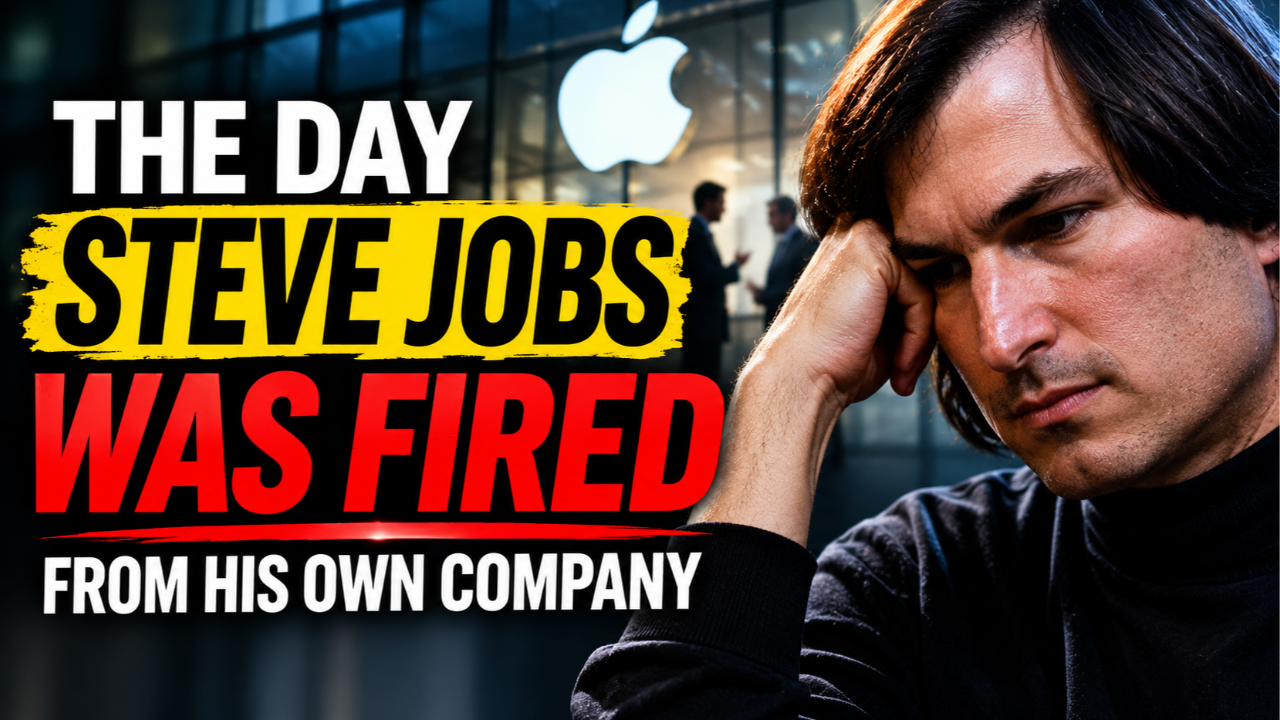
In 1985, Steve Jobs was effectively fired from his own company when Apple's board sided with chief executive John Sculley in a power struggle. He was 30 and, by his own account, devastated. Within months he had started NeXT, and within a year he had bought what became Pixar. By 1997 he was back running Apple. Being fired felt like a final verdict. It turned out to be a reset.
And that's the bit worth sitting with, because you've probably had your own version. Maybe it was a redundancy meeting that lasted eleven minutes, a business that folded in public or a relationship that ended with everyone you know taking sides. Whatever the event, the aftermath tends to look the same. You replay it at 3am. You start to suspect that the people who rejected you saw something true about you that you'd managed to hide from yourself. So, if one of the most celebrated entrepreneurs of the last century could be shown the door by his own board, what exactly is going on in your head when you treat your rejection as proof that you're finished?
Want the full story of the mind that turned the worst day of his career into a comeback? Get Steve Jobs Decoded: The Brilliant, Broken Psychology of a True Genius on Amazon.
The Boardroom Decision That Took Apple Away From Its Founder
The history is well documented, so let's keep it straight. Jobs and Steve Wozniak started Apple in 1976, and the Jobs family garage has since become one of the most famous rooms in business folklore. In 1983, Jobs persuaded John Sculley, then president of PepsiCo, to become Apple's chief executive, reportedly by asking him whether he wanted to sell sugar water for the rest of his life. For a while the two men got on well.
Then the Macintosh, launched with enormous fanfare in January 1984, sold disappointingly. According to Britannica's account of his career, the early Macs were underpowered, expensive and short of software, and tensions grew inside the company. In 1985 Sculley convinced Apple's board to remove its famous cofounder from his role. Jobs later described it plainly in his 2005 commencement address at Stanford: "our board of directors sided with him. And so at 30 I was out, and very publicly out." The man whose name was on the story of the company no longer had a job in it.
The Story You Tell Yourself After Being Fired
Here's what most people believe after a public rejection. The decision was a measurement. Somebody with the authority to judge you looked carefully at your worth and found it lacking, and the verdict is now on record. Being fired, dumped or passed over becomes a kind of official report on who you are, and the only sensible response is to accept it, hide, or prove it wrong with exhausting desperation.
Jobs felt that too, and he didn't dress it up. In the prepared text of that Stanford speech, he said that what had been the focus of his entire adult life was gone, and that it was devastating. He talked about feeling that he'd let the previous generation of entrepreneurs down. He even said, "I was a very public failure, and I even thought about running away from the Valley." The most confident man in Silicon Valley didn't experience his firing as a strategic setback. He experienced it as an identity collapse, the same way you probably did.
Why Rejection Feels Like a Verdict on Who You Are
The reason it hurts so much has very little to do with the job, the business or the person who walked away. It has to do with how your mind stores the idea of you. Think of your sense of self as a piece of software that's been quietly updating for decades. Somewhere in that code, usually without your permission, a line got written that says your worth equals your position. I am the manager. I am the founder. I am the wife. I am the one who's good at this.
The Line of Code That Says You Are Your Role
Psychologists talk about the self-concept, which is just the story your brain runs about who you are. When a role sits at the centre of that story, the program stops treating it as something you do and starts treating it as something you are. Most of the time this is harmless, even useful, because it keeps you turning up and caring. The trouble starts when the role is deleted from outside. The software doesn't calmly update to say "former manager, still a capable human being". It throws an error. If I am my job and the job is gone, the logic runs, then I am nothing. That conclusion feels like insight. It's a bug.
Why Your Brain Treats Exclusion Like an Injury
There's an older layer underneath, too. For most of human history, being pushed out of the group was dangerous, because a lone human didn't last long. So your nervous system learned to treat exclusion as a threat to be taken seriously. Brain-imaging research, including a well-known study of social exclusion published in Science, suggests that being left out activates some of the same brain regions involved in the distress of physical pain. That's why a rejection email can make your stomach drop as though you've missed a step on the stairs. You aren't being dramatic. Your alarm system is doing exactly what it was built to do, for a world that no longer exists.

How One Bad Day Becomes a Life Sentence
Left alone, the pattern escalates in a predictable way. First comes overgeneralisation, where one event gets stretched into a rule. I was let go from this company becomes I'm the kind of person who gets let go. Then comes rumination, the mind's habit of replaying the scene in the hope of finding a different ending. If you've ever lain awake reliving a conversation, you'll recognise the loop I unpicked in why your brain won't let a conversation go. Every replay feels like problem-solving, and every replay strengthens the original wound.
The final stage is the quiet one, and it's the most expensive. You start protecting yourself from the next rejection by not trying. You don't apply for the bigger role. You don't pitch the idea. Psychologists call the extreme version of this learned helplessness, which is a fancy way of saying the brain concludes that effort doesn't change outcomes, so why bother. From the outside it looks like caution. From the inside it feels like wisdom. In reality, it's the software protecting a bug instead of fixing it, and it can run for years. The inner commentary that keeps all this going is the same voice I wrote about in the piece on negative self-talk.
What Jobs Did in the Wilderness Years
Now look at what Jobs did instead. Shortly after leaving Apple, he founded NeXT, a company building powerful workstation computers, largely for education. It wasn't a fairy tale. Britannica notes that the NeXT machine was admired for its engineering and still lost out to cheaper competitors, and the business eventually shifted its focus to its software. In 1986 he bought a controlling interest in a computer graphics group that had started life as a division of George Lucas's Lucasfilm. That company became Pixar, and in 1995 it released Toy Story, the first full-length feature film made entirely with computer animation.
Then came the twist nobody would have scripted. In December 1996, Apple, which was in serious trouble, announced that it would buy NeXT, largely for its operating system software, and Jobs came back as an adviser. In 1997 he became interim chief executive of the company that had pushed him out. Jobs summed it up in that Stanford speech: "I'm pretty sure none of this would have happened if I hadn't been fired from Apple. It was awful-tasting medicine, but I guess the patient needed it."
Let's be honest about the limits of the comparison, because you deserve better than a poster on an office wall. Jobs left Apple a wealthy man, with a reputation that opened doors most of us will never knock on. Your redundancy cheque probably won't fund a computer company. But the money isn't the part that transfers. The part that transfers is what happened inside his head, and that's free. I dig much deeper into the wiring behind his stubbornness, and why his greatest gift and his deepest damage came from the same place, in my psychological profile of Steve Jobs.
Ready to see how that same wiring built a genius and broke a few people along the way? Grab Steve Jobs Decoded: The Brilliant, Broken Psychology of a True Genius on Amazon.
The Lightness of Being a Beginner Again
The most useful sentence in the whole speech is this one: "I didn't see it then, but it turned out that getting fired from Apple was the best thing that could have ever happened to me. The heaviness of being successful was replaced by the lightness of being a beginner again, less sure about everything." Read that twice, because it describes a software update, not a pep talk. Jobs didn't decide that being fired was secretly wonderful. He noticed that the identity he'd been carrying, the founder, the boy wonder, the man with everything to protect, had been heavy. When it was taken away, something lighter was left underneath.
He also put his finger on the exact line of code that saved him. "I'd been rejected, but I was still in love," he said, meaning in love with the work itself. In other words, his sense of self had a second anchor that the board couldn't vote away. That's the reframe at the heart of this whole piece. A rejection removes a role. It can't remove what you value, what you're good at or what you're curious about, unless you hand those over voluntarily by deciding the verdict was final.
I saw a small version of this during my years in radio, where you can be the voice of a breakfast show one month and a name on a leaving card the next. The presenters who struggled most weren't always the least talented. They were the ones who'd merged completely with the show. The ones who bounced back had something underneath the job title that belonged to them, and they went looking for the next place to use it.

Why Pretending You're Fine Keeps the Wound Open
Most of the usual fixes fail for the same reason: they leave the original bug in place. The first is bravado, where you tell everyone it was the best thing that ever happened before you've had a chance to feel anything at all. That's borrowing Jobs's conclusion without doing his work, and the unprocessed hurt usually leaks out later as bitterness or exhaustion. The second is the revenge plan, where your whole next chapter is organised around proving the people who rejected you wrong. It feels like strength, but it keeps them in charge of your direction.
The third is the rush to replace. You grab the first similar job, relationship or project, not because you want it but because the empty space feels unbearable. It often repeats the same pattern with new faces, because the program that says your worth is your position never got questioned. And the fourth is the quiet retreat into safety I described earlier. If you recognise yourself in the habit of pulling back whenever you might be turned down, it may help to read about why you sabotage the things you want most. None of these fixes are signs that you're weak. They're all attempts to stop the alarm ringing without asking why it went off.
Your First Move: Separate the Event From the Identity
So, here's a small, practical place to start. Take a piece of paper and draw a line down the middle. On the left, write exactly what happened, as a journalist would report it, with no adjectives. The company restructured and my role was removed. The board chose a different direction. The relationship ended in March. On the right, write the verdict your mind has attached to it. I'm not good enough. I'm too old. People eventually see through me. Seeing them side by side matters, because your brain has been storing them as a single fact, and they aren't. The left column is history. The right column is interpretation, and interpretations can be edited.
Then add a third line underneath, the one Jobs found almost by accident. Write down what you still care about, the thing that the event couldn't touch. It might be the craft you're good at, the people you love, a problem you've always wanted to solve or simply your curiosity. Read it every morning for a week, and notice what happens to the right-hand column. It won't vanish overnight, but it starts to lose its authority. If the hurt from a rejection or job loss becomes something heavier, such as hopelessness, a low mood that won't lift or any thoughts of harming yourself, please speak to your GP or a mental health professional, because that deserves proper support rather than a worksheet.
The Verdict Nobody Gets to Write for You
It's tempting to read Jobs's story as a neat redemption arc, but the man himself didn't know how it would end when he was sitting in the wreckage in 1985. He had a bruised ego, a pile of money, a love of the work and a decision about what to do next. You don't get the hindsight either. What you do get is the same choice about which part of the story you treat as the verdict. If fear of rejection has been running your decisions for a while, the fear of rejection hypnosis session is another way to work on the program directly. And if you're curious about a very different moment in Jobs's life, I looked at the viral claims around his final words in the truth about his so-called deathbed statement.
Maybe the most useful question isn't whether you deserved to be rejected. Maybe it's what you'd start building if you stopped waiting for the people who rejected you to change their minds.
Curious how a man so brilliant could also be so broken, and what that tells you about your own wiring? Pick up Steve Jobs Decoded: The Brilliant, Broken Psychology of a True Genius on Amazon and read the full profile.
"I was laid off after nineteen years with the same company and honestly felt like my life was over. Reading how Jobs handled being pushed out of Apple, and why it hit him so hard, made me realize I'd let my job title become my whole personality. I took a year to rebuild, and I now run a small woodworking business I love."
Kevin R., Dayton, Ohio
"My startup failed in front of everyone I knew, and I hid for months. This book helped me see that the shame was a story my brain was telling, not a fact about me. I started pitching again, and I'm calmer about hearing no than I have ever been."
Alicia M., Tempe, Arizona
"I bought it because I'm interested in Steve Jobs, and I didn't expect it to change how I think about my own setbacks. After a divorce I'd stopped trying anything new. Now I'm back at college at 47 and loving being a beginner again."
Darren P., Knoxville, Tennessee
Frequently Asked Questions About Steve Jobs Being Fired and Bouncing Back
Was Steve Jobs really fired from Apple?
In effect, yes. In 1985, after a power struggle with chief executive John Sculley over the direction of the company and the struggling Macintosh, Apple's board sided with Sculley and Jobs was removed from his role. Jobs himself described it as being fired in his 2005 Stanford commencement speech, saying the board sided with Sculley and that at 30 he was "very publicly out". He returned in 1997 after Apple bought NeXT.
Why does being fired hurt so much?
Being fired hurts because it hits your identity as well as your income. When a role sits at the centre of your self-concept, losing it can feel like losing yourself, and the brain tends to stretch one event into a global verdict about your worth. Social rejection also triggers your threat system, which evolved when being excluded from the group was dangerous. The pain is real, but the conclusion your mind draws from it is an interpretation that can be questioned and changed.
How do I get over being fired or publicly rejected?
Start by separating the event from the meaning you've attached to it. Write down what happened in plain facts, then write the verdict your mind added, and notice they're different things. Next, name what you still care about that the rejection couldn't touch, and take one small step towards it. Avoid rushing to prove anyone wrong. If low mood or hopelessness hangs around, speak to your GP or a qualified professional for support.
About the Author
Craig Beck spent twenty years as a UK broadcaster, learning first-hand how quickly a career can change direction, before turning his attention to why people think, feel and behave the way they do. He's a certified NLP Master Practitioner and the bestselling author of more than a hundred books on human behaviour, persuasion and personal freedom, including a series of psychological profiles of the people who shaped the modern world. You can read more about Craig and his work here.
Last updated: 27 October 2026