Overcoming Claustrophobia Rewired: How Hypnosis Opens the Door
May 11, 2026Overcoming Claustrophobia Rewired: How Hypnosis Opens the Door
The lift doors closed and you were the last one in. There were six other people, all of them politely staring at their phones. The lift began to move. Then it stopped between the third and fourth floors with a small mechanical hiccup that lasted perhaps eleven seconds. By the time the doors opened on the fourth floor, your shirt was wet through, your heart was doing something theatrical inside your chest, and you had quietly decided to take the stairs for the rest of your career. The other six people stepped out and went about their day, oblivious to the small private apocalypse you had just survived in their company. Welcome to claustrophobia, the most lonely phobia, because nobody else in the room ever seems to feel it.
 Claustrophobia is not fear of small spaces. It is fear of losing the ability to leave at will. The lift, the MRI scanner, the packed train, the locked airplane cabin, each one represents a situation in which control over your own exit has been surrendered. The actual size of the space is rarely the variable that produces the panic. The agency is. Hypnosis works on claustrophobia because it restores the inner sense of freedom that the situation appears to be removing.
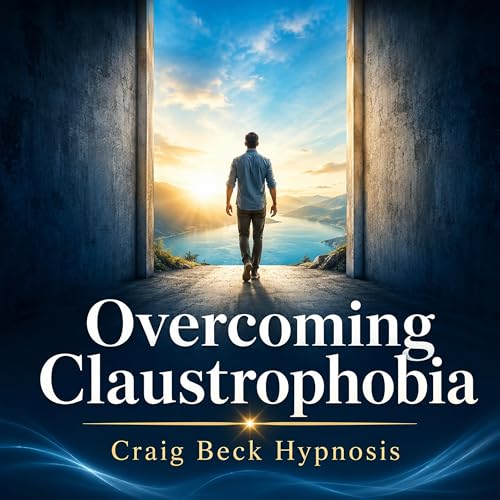
Ready to walk back into the lift? Download Overcoming Claustrophobia: Craig Beck Hypnosis and start retraining the part of you that has been mistaking confinement for capture.
Why Overcoming Claustrophobia Has Nothing to Do With Forcing Yourself Inside
The standard advice for claustrophobia tends to involve some variation of repeated exposure. Get into the lift on purpose. Ride it up and down until the fear subsides. Have somebody talk you through the MRI. Book a tunnel drive. Practise. Each prescription assumes the fear is a muscle that strengthens with use. It does not. Exposure without first updating the alarm produces hours of internal misery and very little learning, because the nervous system is too activated during the experience to absorb new information. You can ride the lift a hundred times and still feel the same panic on attempt 101, because the alarm has not been retrained, it has only been repeatedly endured.
The reason willpower keeps losing this fight is that the system producing the fear has already overridden the system that would attempt to manage it. By the time the doors close, your sympathetic nervous system has flooded your bloodstream with adrenaline, your prefrontal cortex has gone temporarily offline, and the conscious mind is now a passenger watching the body do something it cannot reason its way out of. The way out is not to force more exposure. The way out is to recalibrate the alarm at the layer where the alarm actually lives.
The Hidden Wiring Behind the Trapped Feeling
Inside the brain, a small almond-shaped structure on each side of the head, the amygdala, runs continuous threat assessments. For somebody with claustrophobia, the amygdala has been trained to read certain physical situations as life-threatening, not because of the space itself, but because the space contains a particular feature. You cannot get out whenever you want. The lift will not open until the floor selected. The MRI will not release you until the scan completes. The packed train will not stop at an unscheduled station because you are uncomfortable. The plane will not land mid-flight to let you walk it off.
This is the critical detail most articles on claustrophobia miss entirely. It is not the dimensions of the space. People who panic in lifts feel perfectly fine in cosy log cabins of identical interior volume. The difference is the door. According to research summarised by the American Psychological Association, specific phobias rooted in perceived inescapability produce a particularly stubborn activation of the threat response, because the survival drive that would normally express itself as flight has been blocked, and the unspent energy turns inward into the cascade you experience as panic. Your limiting beliefs about your ability to tolerate discomfort then sit on top, ensuring the system keeps firing every time the door clicks shut.
What Your Subconscious Is Really Afraid Of Losing
If you could pause yourself mid-panic in a stuck lift and ask the part of you producing the alarm what it is afraid will happen, the answers are remarkably consistent. The air will run out. You will pass out. You will lose control of your bladder in front of strangers. You will scream. You will bang on the doors and humiliate yourself. You will be discovered in some unflattering state when the doors eventually open. None of these is the actual underlying fear. Each is a surface translation of a deeper anxiety, which is the loss of agency. The subconscious is responding to the disappearance of your power to leave, and it is using the cluster of physical fears as evidence that the situation is dangerous enough to justify the alarm.
This is also why reassurance from companions almost never lands. Telling somebody in a stuck lift that the lift is safe, the air is plentiful, and the engineer is on the way addresses none of the underlying concern. The underlying concern is not about safety. It is about choice. The body wants to leave, the door will not allow it, and the system reads the disagreement as a failure mode of life itself. Until the deeper relationship between confinement and choice is rewritten, no amount of factual reassurance will close the alarm.
The Agency Problem That Drives the Panic
The original fight or flight response, refined over millions of years of evolution, presupposed one critical condition. You could always run. The savannah, the forest, the cave entrance, all of these allowed for retreat. The modern environment routinely puts you in situations where retreat has been temporarily revoked. Buckled into a plane seat at thirty-five thousand feet. Strapped into an MRI scanner with a face cage. Wedged onto a London tube during the morning rush. Sealed into a windowless conference room when the meeting overruns by an hour. Your nervous system, evolved for a world of available exits, encounters these and produces a response that would have made perfect sense in the ancestral environment but reads as catastrophic in the modern one.
According to a clinical review indexed by the National Center for Biotechnology Information, perceived inescapability is one of the most reliable triggers of acute panic in laboratory studies, even when the actual physical situation poses no genuine risk. The mechanism is not subtle. Block the flight response, and the body, primed for action but unable to act, redirects the energy inward into cascading symptoms that feel like the start of a serious medical event. The cure for this is not better breathing techniques. The cure is restoring the subconscious sense of freedom that the situation appears to have removed.
Done seeing the agency problem? Time to dissolve it. Try Overcoming Claustrophobia: Craig Beck Hypnosis and let your subconscious learn that the closing door is not the disappearance of your choice.
How Claustrophobia Quietly Edits Your Daily Life
The most expensive feature of claustrophobia is the slow contraction of your options. Each avoidance is small. You take the stairs instead of the lift. You decline the city break that involves the underground. You refuse the holiday that requires a long-haul flight. You wriggle out of the medical scan you actually need. You arrange your social life so that crowded venues, packed trains, and underground bars never appear on the calendar. Each refusal looks reasonable in isolation. The cumulative cost across a decade is a life slowly fenced into the spaces that still feel safe, with most of the more interesting ones quietly removed from the map.
Worse, the avoidance compounds. The lift you have not used in five years is now twice as terrifying as it was the first time you ducked it. The avoidance reinforced the alarm. The Tube journey you have not made in three years has grown into something the brain rehearses as an impossible feat. By the time you notice the shape of your life, it has been redrawn around the fear, often without you ever having consciously agreed to the redrawing. The hardest losses are the ones nobody else can see, because they are the journeys you never tried to take.
How Hypnosis Reprograms the Inner Space
Hypnosis is uniquely effective for claustrophobia because the agency response that produces it lives precisely in the layer of mind hypnosis is designed to reach. It is not stage theatre. It is not surrender of free will. Hypnosis is a focused state of relaxed attention, scientifically observable, in which the protective filter between conscious thought and the deeper machinery softens, and new instructions can be loaded directly into the part of you that has been firing the alarm. Your conscious mind does not need to win an argument with the trapped sensation. The work happens beneath the argument.
If you have ever been at the dentist and felt yourself drift slightly while they worked, you have already touched the threshold of trance. The brain naturally enters states like this many times a day. Hypnosis steers you into one deliberately and uses the open channel to do something targeted. For claustrophobia, that means restoring the subconscious sense of internal freedom that does not depend on the position of the door, dissolving the equation between physical confinement and existential capture, and updating the deep response that has been firing every time a lift, scanner, train, or cabin removes the option to leave on command.
Identity is the deepest leverage point. Most claustrophobia advice tries to change behaviour while leaving the underlying identity of "person who panics in confined spaces" untouched. Behaviour change without identity change rarely sticks, because the next mechanical hiccup will collapse it. Hypnosis goes underneath the behaviour and updates the file labelled "who I am inside a closed door." Once that file shifts, the closed door simply stops carrying the meaning it has been carrying. Neuroplasticity, the brain's lifelong ability to rewire itself, rewards consistent input. The new pattern hardens with each session.
What Happens While You Listen
The Overcoming Claustrophobia recording opens with a slow, gentle induction. The breath lengthens. The body settles. The mental commentary that has been quietly cataloguing the day's potential confinement risks since you opened your eyes finally falls silent. Brainwave activity moves from the rapid beta of waking thought into the slower alpha and theta frequencies associated with deep meditation and the threshold of sleep. The doorway to the subconscious quietly opens, and the real work begins.
The script then guides your unconscious mind through a series of structured suggestions designed to restore the inner sense of freedom that the alarm has been signalling as lost. Carefully sequenced language invites the part of you that fires the panic to recognise the closed door as temporary rather than permanent, to dissolve the equation between confinement and capture, and to discover that internal space remains available even when external space appears to be restricted. Visualisation walks you through the experience of stepping into a lift and feeling settled, sliding into an MRI scanner and remaining calm, sitting through a flight without the cabin shrinking around you.
Most listeners report a softening of the dread within the first week of nightly use. By the four to six week mark, previously avoided situations begin to feel approachable again. The change is rarely a single dramatic moment. It is more often the slow realisation that you have just taken the lift to the eleventh floor without your pulse climbing, and you cannot remember when that was last true.
The Question Nobody Asks About Claustrophobia
Everybody asks how to stop being claustrophobic. Almost nobody asks what life becomes available again once the fear loosens. That second question is where the real reward sits.
 When the alarm finally settles, the world quietly reopens. Lifts return as ordinary transportation. Trains stop being negotiations. Long-haul flights become possible again. The medical scan you have been postponing becomes something you can attend. The underground stations you have been routing around stop being landmarks of avoidance and start being routes through your own city. The holiday that involved tunnels, ferries, or cable cars becomes a calendar entry rather than a private impossibility. The freedom of being able to go anywhere, by any sensible means, returns to your life in degrees that often surprise you with how much had been quietly missing.
The deeper change runs underneath. The chronic background tax of constantly scanning every space for available exits dissolves. The mental load of pre-planning every meeting room, every restaurant, every venue around the proximity to a clear escape route, becomes available for everything else. You become more present in rooms because part of your attention is no longer permanently devoted to monitoring the door. The strange exhaustion that came from running a parallel survival assessment under every social occasion drops away, and the energy that was being consumed by it comes back into the rest of your life.
None of this requires you to enjoy being confined. The aim is not to become eager to ride in coffins. The aim is the simple return of normal availability to the ordinary confined spaces of modern life, which a recalibrated alarm will allow without producing terror. Hypnosis is the cleanest route there, because it speaks to the part of you that has been firing the alarm, in the language that part actually understands. If your claustrophobia is severe or interfering significantly with daily life, please do also speak with a qualified clinician. Hypnosis is a powerful complement to professional care, not a replacement for it.
Stop letting the closed door decide where the rest of your life can go. Download Overcoming Claustrophobia: Craig Beck Hypnosis and let the system that has been mistaking confinement for capture finally update its records. The version of your week, your travel, and your medical care waiting on the other side of one recalibrated response is closer than the stairwell has allowed you to imagine.
What Listeners Are Saying
Janelle T., Springfield, Missouri: "I have not been in a lift since 2019. I work on the eighteenth floor and I have been climbing the stairs in heels and pretending I love the exercise. Five weeks of nightly listening to this recording and I took the lift on Monday for the first time in five years. I did not panic. I did not even bookmark the door. I just rode it up to my floor like everybody else. I cried at my desk for ten minutes afterwards."
Robert M., Worcester, Massachusetts: "I had an MRI scheduled three times and bailed three times. The doctor told me at this point we would have to sedate me for the next attempt. Six weeks of using this recording and I went in last week, lay still for forty-three minutes, and walked out. The technician asked if I had ever done one before. I told her this was my fourth booking but my first completion. She looked confused. I did not bother explaining."
Priya S., Las Vegas, Nevada: "I have refused every long-haul flight for the past decade. My family is in Mumbai and I have not seen them since 2014. Eight weeks of nightly listening to this recording and I have booked tickets for December. I am not pretending I am completely calm about it. I am, however, finally able to imagine being on the plane without my brain shutting down at the thought. That alone is a kind of miracle."
Frequently Asked Questions
Is claustrophobia really about small spaces?
The clinical name suggests it is, but the underlying mechanism is closer to fear of inescapability than fear of small dimensions. People with claustrophobia often feel perfectly relaxed in small cosy rooms they have chosen to be in, and only panic in identically-sized spaces where the exit has been removed. The variable is agency, not square footage. The recording targets the agency mechanism, which is why it produces results across the full range of triggering situations, from lifts to MRIs to crowded venues.
How quickly will I notice a difference?
Most listeners report a softening of the anticipatory dread within the first seven to ten days of nightly use. Previously avoided situations such as lifts, public transport, and medical scans tend to become approachable inside four to six weeks. Deeper or longer-standing claustrophobia, particularly when linked to a frightening incident, may take eight to twelve weeks of consistent listening to fully resolve. Repetition is the variable that matters most. Treat the recording as a nightly ritual, and the new calibration continues to consolidate.
Will I still feel some discomfort in genuinely tight spaces?
Mild discomfort in genuinely cramped spaces is normal and is shared by most people. The recording does not aim to eliminate every flicker of awareness in confined situations. The aim is to remove the panic that has been firing in ordinary confined spaces where no real threat exists. Listeners report a clear distinction emerging between rational caution in genuinely uncomfortable situations and the false alarm that used to fire in ordinary ones. The first remains. The second dissolves.
About the Author
 Craig Beck is internationally recognised as one of the leading voices in persuasion, behavioural psychology, and the mechanics of inner change. A certified NLP Master Practitioner, clinical hypnotherapist, former UK broadcaster, and bestselling author of more than one hundred books and audio programmes, he has spent two decades dismantling the fears, phobias, and miscalibrated responses that quietly fence people's lives, and engineering the tools that release them. Over a million listeners around the world have used his hypnosis recordings to retire phobias, break addictions, and reclaim the spaces they had quietly written off as unavailable. He does not deliver theory from a textbook. He works in the layer underneath conscious thought, where every meaningful change begins. You can read more about his approach on his about page.
Last updated: 11 May 2026