
Fear of Needles Rewired: How Hypnosis Calms the Faint
May 11, 2026Fear of Needles Rewired: How Hypnosis Calms the Faint
You held it together in the waiting room. You held it together when the nurse called your name. You even held it together when she explained, with a professional smile, that this would only take a moment. Then she reached for the tourniquet, tied it around your upper arm, and the room began to do that small wobble it always does. By the time the alcohol wipe touched your skin you were already trying to remember whether the chair you were sitting in had armrests. The needle, when it appeared, was not the actual problem. The problem was the version of you who was about to slide quietly toward the floor and embarrass yourself in a small, well-lit clinic for the seventh time in your adult life. Welcome to fear of needles, the most physical of all phobias, and one of the few where the body genuinely does keep its promise to make you collapse.
 Fear of needles is unusual among phobias. Most phobias produce sustained fight-or-flight activation, the racing heart and tight chest you can recognise from other anxiety states. Needle phobia produces something quite different. A vasovagal response, in which the heart slows, the blood pressure drops, and many sufferers actually faint. This is a separate physiological pattern from ordinary phobic anxiety, and treating it like ordinary anxiety is one reason most attempts to address it fail. Hypnosis works because it can retrain the response at the level it actually fires.
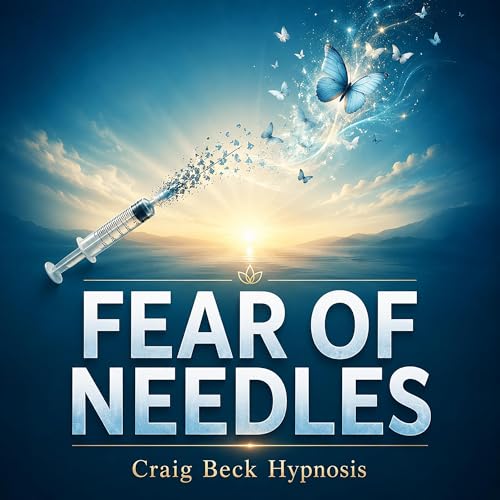
Ready to stop arriving at appointments braced for the floor? Download Fear Of Needles: Craig Beck Hypnosis and start retraining the part of you that has been preparing to drop since the tourniquet appears.
Why Conquering Fear of Needles Has Nothing to Do With Looking Away
The conventional advice for needle fear is a small museum of well-meaning suggestions that miss the point entirely. Look away. Take deep breaths. Squeeze a stress ball. Have somebody hold your other hand. Listen to music. Each of these strategies treats the problem as ordinary anxiety, manageable with conscious distraction. The trouble is that needle phobia is not ordinary anxiety. The fainting response is not produced by panic. It is produced by a sudden drop in blood pressure that happens whether or not you are consciously frightened, and no amount of looking away or breathing slowly will prevent it once the cascade has been triggered.
This is also why patients with needle phobia are often misunderstood by medical staff. The professional, expecting standard anxiety, offers distractions and reassurances that simply do not address the mechanism. The patient, expecting standard anxiety, blames themselves for not being able to talk their way through it. The faint arrives anyway, and the pattern reinforces itself. The genuine fix is not distraction. The genuine fix is retraining the underlying vasovagal response at the level it actually lives, which means reaching the layer of mind that produces it before the conscious mind has registered what is happening.
The Hidden Wiring Behind the Vasovagal Drop
The vasovagal response is a reflex governed by the vagus nerve, the longest of the cranial nerves, which runs from the brainstem down through the chest and abdomen. When the vagus fires strongly, it slows the heart and dilates blood vessels, dropping blood pressure quickly. In ordinary life this happens in mild form during meditation or relaxation. In needle phobia, the response fires with disproportionate force at the sight, thought, or anticipation of a needle, producing the classic cascade. The skin goes pale. The forehead beads with sweat. The ears begin to ring. The vision narrows from the edges inward. And then the body drops.
According to research summarised by the American Psychological Association, blood-injection-injury phobia is the only major subtype of specific phobia that consistently produces fainting, and it has been classified separately in clinical literature for this exact reason. The mechanism is distinct from other phobias and requires a different approach. Some researchers believe the response may be an evolutionary holdover from a time when collapsing in the presence of injury reduced blood loss and may have made the injured person look less threatening to predators. Whatever its origin, the wiring is real, and your limiting beliefs about your ability to remain upright in a medical setting then sit on top, reinforcing the reflex every time it fires.
What Your Body Is Trying to Do When the Needle Comes Out
If you could pause the cascade midway through and ask the part of you that produces it what it is attempting to achieve, the answer is genuinely strange. It is preparing the body for serious injury. The blood pressure drop, in evolutionary terms, may help reduce bleeding from a deep wound. The fainting may have reduced the chance of further attack from a predator. The pallor and clamminess may have signalled to others in the group that help was needed. Every feature of the response, viewed through that ancient lens, makes a kind of grim sense. The trouble is that the lens is wrong. You are not about to be mauled. The needle is a small precision instrument operated by a trained clinician, designed to either remove a few millilitres of blood or deliver a precisely calibrated dose of something useful.
The subconscious does not register the difference. It reads "puncture wound about to occur" and runs the ancestral protocol. The fact that the puncture in question is half a millimetre wide and lasts three seconds does not modify the response. The protocol has been activated, and the protocol does not consult modern context before firing. Until the underlying programme is updated, the cascade will continue to arrive every time a needle is involved, regardless of how much you intellectually understand that the situation is safe.
The Inherited Pattern Many Sufferers Never Realised They Carried
 Twin studies and family research have consistently found that blood-injection-injury phobia has a stronger genetic component than most other specific phobias. People with severe needle fear frequently discover that a parent or sibling shares the response, often without anybody in the family having previously connected the dots. This is not a learned fear in the ordinary sense. It is, in significant measure, a wiring pattern that runs in families and shows up reliably regardless of upbringing. Children who never witnessed a parent faint at a needle still inherit a more sensitive vasovagal threshold and frequently develop the response on their own.
According to research published by the National Center for Biotechnology Information, heritability estimates for blood-injection-injury phobia run substantially higher than for most other phobic disorders. This is good news in one important sense. It means the response is not your fault, not a sign of weakness, and not a character flaw. It is a wiring pattern your body inherited, and like any wiring pattern, it can be modified once approached correctly. The recording does not need to argue with your character. It needs to retrain the threshold at which the vagus nerve fires, and that work happens in the layer beneath your conscious sense of who you are.
How Fear of Needles Quietly Blocks Critical Medical Care
The most expensive feature of needle phobia is the medical care it removes from your life. The blood tests not taken. The vaccinations not received. The flu jab skipped every year. The travel vaccinations declined, with holidays narrowed to safer destinations. The fertility treatment investigated but never started because the injection schedule felt impossible. The diabetes diagnosis postponed because the screening involves a finger prick. The chemotherapy delayed because the picc line appointment kept being rescheduled. Each refusal feels small in the moment. The cumulative consequences, particularly for serious conditions where early detection matters most, can be genuinely severe.
Doctors are increasingly aware of needle phobia as a barrier to care, and many practices now offer accommodations, including topical anaesthetic creams, reclined positioning, and quiet rooms. The advice is to mention the fear at booking. The trouble is that the same wiring that produces the faint also produces the avoidance of the conversation in which you might mention it. People who faint at needles also tend to put off the phone call to the receptionist that would arrange a more accommodating appointment. The avoidance closes the door before the help can reach you. This is one of the kindest consequences of addressing the underlying wiring. Once the response softens, the willingness to ask for help arrives naturally.
Done seeing the pattern? Time to update it. Try Fear Of Needles: Craig Beck Hypnosis and let your subconscious learn a new response to the moment the tourniquet appears.
How Hypnosis Reprograms the Needle Response
Hypnosis is uniquely effective for needle phobia because the reflex that produces it lives precisely in the layer of mind hypnosis is designed to reach. It is not stage theatre. It is not surrender of free will. Hypnosis is a focused state of relaxed attention, scientifically observable, in which the protective filter between conscious thought and the deeper autonomic systems softens, and new instructions can be loaded directly into the part of you that has been firing the vagal cascade. Your conscious mind does not need to negotiate with the faint. The work happens in the layer beneath the conscious negotiation.
If you have ever been on a slow train looking out at fields rolling past and felt the rhythm pull you toward the edge of sleep without crossing it, you have already touched the threshold of trance. The brain enters states like this many times a day. Hypnosis steers you into one deliberately and uses the open channel to do something targeted. For needle phobia, that means recalibrating the vasovagal threshold so the response no longer fires for a routine medical procedure, dissolving the equation between needle and catastrophic injury, and installing a new default in which the body remains in a steady, parasympathetic-but-stable state during clinical visits rather than dropping into the full collapse cascade.
Identity is the deepest leverage point. Most advice on needle phobia tries to manage behaviour while leaving the underlying identity of "person who faints at needles" untouched. Behaviour change without identity change is fragile, because the next blood test will collapse it. Hypnosis goes underneath the behaviour and updates the file labelled "who I am in a clinical setting." Once that file shifts, the body stops anticipating the cascade, and the cascade stops arriving. Neuroplasticity, the brain's lifelong ability to rewire itself, rewards consistent input. The new pattern hardens with each session.
What Happens While You Listen
The Fear Of Needles recording opens with a slow, careful induction. The breath lengthens. The body settles. The mental commentary that has been quietly catastrophising the next medical appointment finally falls silent. Brainwave activity moves from the rapid beta of waking thought into the slower alpha and theta frequencies associated with deep meditation and the threshold of sleep. The doorway to the subconscious quietly opens, and the real work begins.
The script then guides your unconscious mind through a series of structured suggestions designed to recalibrate the vasovagal response. Carefully sequenced language invites the part of you that has been firing the cascade to recognise the modern medical setting as different from an ancestral injury, to release the equation between needle and danger, and to maintain a steady, stable physiological state during clinical encounters. Visualisation walks you through the felt experience of arriving for an appointment without dread, sitting down for a blood draw without bracing, and walking out afterwards with your colour intact and your dignity preserved.
Most listeners report a softening of the anticipatory dread within the first week of nightly use. By the four to six week mark, previously impossible procedures become genuinely manageable, and the vasovagal cascade either fails to fire entirely or fires at significantly reduced intensity. The change is rarely a single dramatic moment. It is more often the slow realisation that you have just had a blood test without holding the chair, and you cannot remember when that was last true.
The Question Nobody Asks About Fear of Needles
Everybody asks how to stop fainting at needles. Almost nobody asks what becomes possible again once the response settles. That second question is where the actual reward lives.
When the phobia softens, the most immediate change is the return of routine medical care to your life. Blood tests become manageable. Vaccinations become possible. The travel destinations you had been quietly avoiding because of the injection schedule become available again. The annual flu jab stops being a small private ordeal. The fertility treatment becomes possible. The diabetes management becomes practical. The cancer screening becomes something you can attend. The reopening of standard preventative care is, for many listeners, life-altering in ways that quietly compound across years.
The deeper change runs underneath. The chronic background dread of any upcoming appointment requiring blood work simply dissolves. The mental load of carrying that dread becomes available for actually living your life. The strange shame of being a competent adult who reliably collapses in clinical settings lifts, and the self-image that had been quietly stained by that pattern begins to repair. Past listeners describe a sense of being more grown-up in their own bodies, which is a curious phrase but a remarkably consistent one. The relationship with healthcare in general often shifts toward partnership rather than avoidance, and the broader pattern of medical procrastination that often accompanies needle phobia begins to dissolve.
And there is a quieter shift listeners report many months in. The body that had been an unreliable narrator becomes trustworthy again. The strange sense of being slightly betrayed by your own physiology in clinical settings ends. You stop carrying the secret that you cannot quite handle a small medical procedure. The freedom of that single secret being dissolved is larger than most people anticipate, and it tends to ripple outward into broader confidence in your own resilience.
None of this requires you to enjoy needles. The aim is not enthusiasm. The aim is the return of ordinary tolerance for ordinary medical care, which a recalibrated vagal response will reliably allow. Hypnosis is the cleanest route there, because it works in exactly the layer where the original reflex was inherited or installed. If you faint regularly during medical procedures, please do also mention this to your clinician. Many practices have established protocols for vasovagal patients, including reclined positions and slower pacing, and combining their accommodations with the recording produces consistently excellent outcomes.
Stop letting an ancient reflex decide what medical care you can receive. Download Fear Of Needles: Craig Beck Hypnosis and let the system that has been firing the cascade finally update its threshold. The version of your next appointment waiting on the other side of one recalibrated reflex is closer than the waiting room has allowed you to imagine.
What Listeners Are Saying
Sarah K., Bismarck, North Dakota: "I have fainted at every blood test of my adult life. I am thirty-seven and I have been turned away from blood donation, postponed routine screening, and once cracked my head on a clinic floor. Six weeks of nightly listening to this recording and I had a full panel done last Tuesday without so much as a wobble. The nurse asked if I had done this before. I told her honestly that I had been preparing for thirty years. She laughed. I almost did too."
Mark T., Lubbock, Texas: "Needle phobia runs in my family. My father fainted at his own wedding when the photographer asked about a flu shot mentioned in conversation. I bought this recording when my doctor told me I needed regular injections for an autoimmune condition. Five weeks in and I have done four injections at home without my wife having to talk me through any of them. I cannot believe I am writing those words."
Lauren M., Spokane, Washington: "I have been delaying IVF treatment for over a year because of the daily injections involved. The fear felt insurmountable. Eight weeks of nightly listening to this recording and I started the protocol last month. I have not fainted. I have not panicked. I have given myself sixteen injections so far. My husband and I are quietly cautiously hopeful. The recording cost less than one round of medication and arguably mattered more."
Frequently Asked Questions
Why does fear of needles cause fainting when other phobias do not?
Needle phobia belongs to a clinical subtype called blood-injection-injury phobia, which is unique among specific phobias in producing a vasovagal response. The vagus nerve fires strongly at the sight or anticipation of a needle, slowing the heart and dropping blood pressure quickly, which produces the classic faint cascade. This is a distinct physiological mechanism from the sustained sympathetic activation of most other phobias, and it requires a different therapeutic approach. Hypnosis is well-suited to recalibrating this specific reflex because it works in the autonomic layer where the response is generated.
How quickly will I see results?
Most listeners report a softening of the anticipatory dread within the first seven to ten days of nightly use. The vasovagal cascade itself tends to begin firing with reduced intensity inside four to six weeks of consistent listening. Deeper or longer-standing needle phobia, particularly when inherited, may take eight to twelve weeks to fully recalibrate. Treat the recording as a nightly ritual, and consider listening intensively in the days leading up to any planned medical procedure for maximum effect. Repetition is the variable that converts a temporary shift into a lasting rewiring.
Should I tell the clinician about my fear?
Absolutely. Modern medical practices increasingly understand vasovagal phobia and offer accommodations such as reclined positioning, topical anaesthetic creams, and slower procedures. Mentioning the fear at booking allows the team to prepare accordingly. Combining their accommodations with the recording produces consistently strong outcomes. The recording is not designed to replace any of the practical strategies that can support you in the moment. It works underneath them by recalibrating the reflex itself, leaving the practical measures more effective when they are applied.
About the Author
 Craig Beck is internationally recognised as one of the leading voices in persuasion, behavioural psychology, and the mechanics of inner change. A certified NLP Master Practitioner, clinical hypnotherapist, former UK broadcaster, and bestselling author of more than one hundred books and audio programmes, he has spent two decades dismantling the fears, phobias, and miscalibrated reflexes that quietly block people from the care, situations, and experiences they deserve. Over a million listeners around the world have used his hypnosis recordings to retire phobias, break addictions, and reclaim access to ordinary moments that had become impossible. He does not deliver theory from a textbook. He works in the layer underneath conscious thought, where every meaningful change begins. You can read more about his approach on his about page.
Last updated: 11 May 2026