Low Energy Rewired: How Hypnosis Restores Vitality
May 11, 2026Low Energy Rewired: How Hypnosis Restores Vitality
The alarm goes off and your first conscious thought is a small, private negotiation. Ten more minutes. Just ten. Or twenty. You promised yourself last night you were going to get up early today, hit the gym, prep the meals, smash through the project you have been putting off since February. Instead you are bartering with a clock at 6:47am like a hostage trying to delay the inevitable. By 9am you are caffeinated and going through the motions. By 2pm you are wondering whether anybody would notice if you put your head down on the desk for ten minutes. By 8pm you are too wiped out to do any of the things this morning's version of you swore would happen. Welcome to the modern energy crisis.
 Low energy in modern life is rarely a problem of sleep, diet, or fitness. It is a problem of where your body's available fuel is being spent. Suppressed emotions, mental rumination, decision fatigue, and a nervous system stuck on quiet alert all burn enormous amounts of vitality before you ever reach your to-do list. Hypnosis works because it shuts down the invisible background processes that have been draining your battery, and returns that energy to the version of you who actually wanted to live the day.
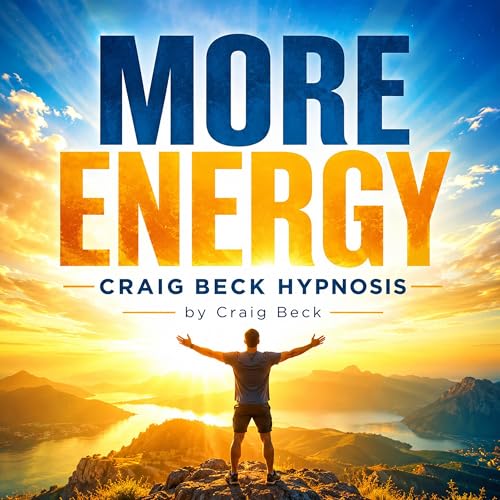
Ready to plug the leak? Download More Energy: Craig Beck Hypnosis and start retraining the system that has been quietly siphoning your vitality.
Why Feeling Tired Has Nothing to Do With Sleep
If sleep was the variable, you would already be fine. You have tried the eight hours. You have tried the nine. You have tried the gummies, the blackout curtains, the silk pillowcase, the magnesium powder that tastes like brackish lake water, the app that monitors your respiration while you doze. You still wake up feeling like somebody siphoned your life force overnight. The reason is simple. Sleep restores the body. It does not restore the mind that has been running open browser tabs all night long.
Modern fatigue is a software problem dressed up as a hardware problem. The conscious mind says "I am tired." The unconscious mind, behind the curtain, has spent the last sixteen hours processing twenty-three unresolved conversations, four micro-anxieties about money, a low-level worry about your mother's health, three replayed embarrassments from 2014, and a constant background scan for threats that have not arrived yet. By the time you reach your second coffee, the work has already been done. There is no fuel left in the tank because the engine has been running on the driveway since before you stepped outside.
The Hidden Wiring Behind Modern Exhaustion
Think of your nervous system as a smartphone. The model is excellent. The battery is generous. The problem is that you have forty-seven apps running in the background, each one quietly using a sliver of power, and you never opened any of them on purpose. Worry about that email is one app. Suppressed irritation toward your colleague is another. The unfinished argument with your partner that you both agreed to drop is still humming away in the third. None of these processes are visible on the home screen. All of them are visible on the battery report at the end of the day.
Research published by the American Psychological Association shows that chronic low-grade stress drains cognitive and physical resources at a rate most people drastically underestimate. The body does not differentiate between an active threat and a long-running mental simulation of one. The same cortisol fires. The same vigilance circuits stay on. By the end of a normal Tuesday, a person under chronic background stress has spent more biological fuel than a relaxed person would burn through a hard physical day. The result is a deep, bone-level tiredness that no nap can touch.
What Your Subconscious Is Burning Fuel On
If you could see the inside of an average mind on a quiet weekday afternoon, you would witness a remarkable scene. The unconscious is not resting. It is running simulations. Replaying old conversations and improving your lines. Rehearsing imagined arguments with people who are getting on with their own lives somewhere else. Stress-testing future scenarios that may never happen. Forecasting failure on tomorrow's meeting in seventeen different configurations. Each simulation costs energy in exactly the same way each rep at the gym costs glycogen. The body does not know the difference between exercising muscles and exercising worry.
And then there are the open emotional loops. The thing your father said in 1998 that you never quite responded to. The compliment you brushed off because it did not match how you see yourself. The grief you carried on your shoulder for a year after the bereavement and then quietly tried to pack into a box. None of these are gone. They have been deferred, and your unconscious is paying interest on every one of them. Your limiting beliefs about rest, productivity, and what you must achieve to deserve a moment of peace also pull a steady draw on the battery, twenty-four hours a day.
How Low Energy Hijacks Your Reward System
Here is where the cruel feedback loop kicks in. When your nervous system is depleted, the brain raises the bar for what counts as a meaningful reward. The walk that used to clear your head no longer touches the sides. The book you used to lose yourself in fails to hold your attention. The conversation with a friend that should energise you feels like work. The activities that would naturally restore your vitality stop working, because your reward system is too flattened to register their effect. So, you reach for shortcuts. Caffeine that turns the volume up without adding any signal. Sugar that lifts you for forty minutes and drops you for two hours. Doomscrolling that keeps you anaesthetised on the sofa while quietly draining the last reserves you had.
The shortcuts feel like solutions in the moment. They are precisely the things deepening the deficit. According to neuroscience research summarised by the National Center for Biotechnology Information, chronic over-stimulation of the brain's reward circuitry produces measurable downregulation of dopamine receptors, meaning the more shortcuts you take, the less satisfying every real-world activity becomes. Tiredness recruits more tiredness. And the harder you push through it, the less responsive your system becomes to the things that would have replenished you.
This is why "just take a holiday" never quite works. You bring the depleted system with you to the beach. The system finds new things to worry about. You return more tired than you left.
The Three Drains You Don't Know Are Running
Most chronic energy depletion comes from three specific background processes that operate beneath conscious awareness. The first is suppressed emotion. Anger you never spoke aloud. Grief you never let yourself sit inside. Resentment toward people you decided it was simpler to forgive on paper than feel angry with in person. Every unfelt emotion remains stored in the body, and the body spends fuel every single day keeping the lid on it. The longer the lid has been on, the bigger the draw.
The second drain is identity friction. Living slightly out of alignment with who you actually are takes more energy than most people realise. Performing a version of yourself at work that does not match your private wiring. Saying yes when your nervous system is screaming no. Smiling through interactions you would rather decline. Each micro-performance costs something. By the end of a week of performing, you can be physically rested and still feel cooked from the inside out.
The third, and most stubborn, is unfinished mental loops. The Zeigarnik effect, named for a Russian psychologist who studied it in the 1920s, describes the brain's compulsion to keep open tasks active in memory until they are either completed or formally closed. Every unfinished email, every promise you made and forgot, every project you started in 2021 and have not touched since, every conversation that did not reach a clean ending, sits in your subconscious as an active process consuming a small share of your daily energy. Forty unfinished loops will quietly empty the deepest reservoir.
Done diagnosing the drain? Time to plug it. Pick up More Energy: Craig Beck Hypnosis and let your subconscious close the loops your conscious mind cannot reach.
How Hypnosis Reprograms Your Energy Default
 Hypnosis is the most direct route ever developed to the part of you that runs the background processes. It is not a stage trick. It is not surrender. It is a focused, naturally occurring state of relaxed attention in which the protective filter between conscious and unconscious thought softens, and new instructions can be loaded into the part of you that has been quietly burning the fuel. The conscious mind does not need to negotiate the change. It only needs to step aside long enough for the work to take.
If you have ever stepped into a hot bath and felt your shoulders drop two inches in the first thirty seconds, you have already experienced the threshold of trance. The brain naturally enters states like this many times a day. Hypnosis steers you into one on purpose and uses the open channel to do something useful. For energy depletion, that means giving your subconscious permission to release the suppressed emotional weight, close the open loops it has been keeping warm, and step out of the chronic vigilance pattern that has been running since you were a child trying to keep things peaceful in the family kitchen.
Once those background processes are switched off, the energy they had been quietly consuming returns to the foreground. The change is rarely a dramatic surge. It is more like the moment you close eleven unused tabs on your laptop and the fan finally goes quiet. The machine was always capable. The drain was the problem.
What Happens While You Listen
The More Energy recording opens with a deep induction designed to settle the body into the kind of release most people only experience during the deepest stretch of a Sunday afternoon nap. The breath lengthens. The face softens. The mental commentary that has been narrating your day since you opened your eyes finally goes quiet. Brain imaging during sessions of this depth reveals a measurable shift from the rapid beta activity of waking thought into the slower alpha and theta ranges associated with deep meditation and pre-sleep states. This is the gate to the back office swinging open.
From there, the work begins. Carefully sequenced suggestions guide your subconscious to identify the most active background drains, release the emotional weight they have been carrying, and close the open loops that have been quietly running. Visualisation walks you through the felt experience of a body humming with available energy, a mind clear of clutter, and a nervous system at ease in the day rather than braced against it. Neuroplasticity, the brain's lifelong capacity to rewire, responds to consistent input by hardening the new pattern into the default.
Most listeners report a noticeable lift within the first week. By week four, the morning negotiation with the alarm clock tends to disappear. The 2pm slump fades. The 8pm collapse onto the sofa is replaced by a quieter sense of having something left in the tank for the people and activities you actually love. The energy was never gone. It had been spoken for.
The Question Nobody Asks About Feeling Drained
Everybody asks how to get more energy. Almost nobody asks what they would do with it. That second question is far more revealing than the first.
When the chronic drain stops, the changes are quieter than the marketing of supplements would have you believe. You do not suddenly run a marathon at lunchtime. You stop yawning in the middle of conversations. You stop forgetting things because your working memory has room again. You start to want to do the things you used to make excuses around. The gym becomes interesting. Cooking becomes interesting. Sex becomes interesting. Reading a real book in a real chair for an hour, with no second screen, becomes possible. The life you have been telling yourself you would live one day quietly becomes available on a Wednesday evening.
And then comes the deeper shift. With energy comes presence. With presence comes connection. The person you sleep next to gets the version of you who is actually awake. The children get the parent who can listen. The work gets the creativity it has been starved of for years because your prefrontal cortex was too busy holding back leaks to do anything imaginative. Friends start commenting that you seem lighter. Strangers start treating you differently because you are no longer carrying around the weight of a system in chronic deficit. Energy, properly restored, looks like charisma to anybody watching from the outside.
None of this requires you to overhaul your diet, take up an extreme exercise regime, or move to the countryside. It requires the system that has been running you ragged from the inside to be given permission to stand down. Hypnosis is the cleanest way of issuing that permission, in language the subconscious actually responds to. The fuel was always there. The leak is the only thing in the way.
Stop dragging the same exhausted version of yourself through another month. Download More Energy: Craig Beck Hypnosis and let the system that has been bleeding your battery finally let go. The version of your day waiting on the other side is closer than your current depletion will let you see.
What Listeners Are Saying
Hannah W., Minneapolis, Minnesota: "I have been to four doctors, two functional medicine practitioners, and one slightly alarming naturopath who put me on a powder that tasted like sand. None of it touched my fatigue. Two weeks of nightly listening to this and I am waking before my alarm for the first time in eight years. The volume on the underlying tiredness has dropped to a level I did not believe was achievable without medication. Genuinely lost for words."
Jason K., Cleveland, Ohio: "I run my own contracting company. I had assumed the bone-deep exhaustion was the price of owning the business. Listened to this on a recommendation from my wife and within three weeks I had energy left at the end of the day for the first time in a decade. I have not changed my diet, my sleep schedule, or my workload. The only thing that changed is whatever was running in the background of my head that was using all the juice before I got home."
Olivia P., Charleston, South Carolina: "Forty-eight years old, two teenagers, demanding career, exhausted in a way no amount of vitamin D ever fixed. I was sceptical. I listened anyway. By week five I was the version of me I remember being at thirty-two. My husband keeps asking what I am taking. The honest answer is that I am no longer leaking energy on things I did not know were running. That was the whole problem."
Frequently Asked Questions
Can hypnosis really increase my energy levels?
Hypnosis does not generate physical energy out of thin air, and it is not a substitute for proper medical investigation if you suspect an underlying condition. What it does is dismantle the psychological and emotional drains that have been quietly consuming the energy your body already produces. For most people, the resulting lift is dramatic, because modern fatigue is overwhelmingly driven by chronic mental and emotional overhead. Plug those leaks and the energy that was always there returns to the foreground where you can use it.
How quickly will I notice a difference?
Most listeners report a softening of the underlying tiredness within the first week of nightly use. By weeks three to four, mornings tend to feel different and the afternoon slump softens significantly. Deeper changes, including the release of long-held emotional weight and the closing of unfinished loops, settle in over four to eight weeks. Use the recording as a consistent nightly ritual. Repetition is what converts a temporary lift into a permanent shift in your baseline state.
Should I see a doctor if my fatigue is severe?
Absolutely. Persistent or severe tiredness can be linked to medical conditions including thyroid issues, anaemia, sleep disorders, and several others that require proper diagnosis and treatment. Hypnosis is a powerful complement to medical care, not a replacement for it. Get the physical investigation done. Address whatever needs addressing. Then use the recording to remove the psychological layer that medical treatment alone rarely reaches. The two together produce the cleanest, fullest restoration of vitality.
About the Author
 Craig Beck stands among the most recognised authorities on persuasion, behavioural psychology, and the architecture of mental and emotional change. A certified NLP Master Practitioner, clinical hypnotherapist, former UK broadcaster, and bestselling author of more than one hundred books and audio programmes, he has spent two decades dissecting why people stay stuck in patterns of depletion and engineering the tools that bring them back to life. Over a million listeners across the world have used his hypnosis recordings to break addictions, dismantle inherited beliefs, and restore the inner machinery of their own minds. He does not deliver theory from a textbook. He shows you how the operating system underneath your mood, your habits, and your daily fuel actually works, and then walks you through the upgrade. You can read more on his about page.
Last updated: 11 May 2026