Approach Anxiety Rewired: How Hypnosis Breaks the Freeze
May 11, 2026Approach Anxiety Rewired: How Hypnosis Breaks the Freeze
You spotted her three minutes ago. Or him. The exact someone your nervous system instantly decided was worth approaching. Your stomach drops, your throat closes, and your feet quietly take out a restraining order on the rest of your body. You start composing the perfect opener in your head. You discard it. You write a better one. You discard that one too. By the time you have crafted something almost charming, they have paid for their coffee, swung a bag over a shoulder, and walked out into the street. You stare into your cup and pretend that did not just happen for the four hundredth time this year.
 Approach anxiety is the freeze response your subconscious triggers the moment you consider initiating contact with a stranger you find attractive, important, or socially valuable. It is not shyness. It is not a lack of confidence. It is a hardwired survival circuit misreading a low-stakes social moment as physical danger, dumping stress hormones into your bloodstream and switching off the part of your brain that knows how to form a sentence. Hypnosis works because it rewires that circuit at the level conscious thought cannot reach.
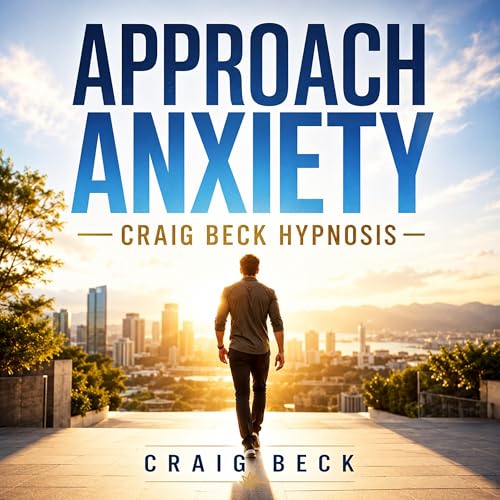
Ready to dismantle the freeze? Download Approach Anxiety: Craig Beck Hypnosis and start retraining the pattern tonight.
Why Approach Anxiety Has Nothing to Do With Confidence
Most of the advice on this topic is written by people who have never felt it. You know the script. Smile more. Just be yourself. Picture the audience naked. Read three books on body language and walk in like you own the room. It is all surface, and it is all useless once your amygdala has hit the panic button. Telling a person mid-freeze to relax is like shouting "swim harder" at someone whose legs have already locked up underwater.
Here is the truth most coaches will not tell you. Confident people experience the same chemical surge you do. The exact same cortisol spike, the same racing pulse, the same flicker of fight-or-flight when they spot somebody they want to talk to. The difference is not the absence of the signal. It is what their subconscious does with it. Yours interprets the spike as a warning. Theirs reads it as fuel. Both readings are learned. Both are stored in the unconscious mind. And both can be edited.
I spent the first thirty years of my life convinced I was a nervous, slightly broken introvert who had drawn the short straw on courage. Turns out I was running a very old, very well-rehearsed mental program. Once I learned to recognise it, the freeze stopped being a personality trait and started looking like what it always was. A reflex. Reflexes can be retrained.
The Hidden Wiring Behind the Freeze
Picture the brain as a vast house with two occupants. Upstairs in the well-lit study sits your conscious mind, sipping tea and writing the to-do list. Downstairs, in a cellar lit only by emergency strip lighting, lives the subconscious. It runs the boiler, watches the security cameras, and makes ninety-five percent of your decisions before the upstairs tenant has finished his sentence. When you spot somebody you want to approach, the cellar gets the alert first. The study only finds out once the body has already responded.
Your subconscious does not deal in probabilities. It deals in associations. Somewhere in your past, the act of putting yourself forward got linked to pain. Maybe a teacher humiliated you in front of the class. Maybe your first crush laughed at the wrong moment. Maybe a parent's love came with conditions that taught you wanting something was risky. The cellar filed those memories under "danger" and welded the cabinet shut. Every time you approach a similar moment as an adult, the same alarm goes off, and your body obeys it before you can even argue.
This is why willpower keeps failing you. You are bringing five percent of your mind to a fight the other ninety-five percent is already losing. Limiting beliefs sit in that cellar like dust on the shelves. They feel like facts because they have been there forever. They are not facts. They are settings.
What Your Subconscious Thinks You Are Walking Into
Your unconscious mind is not protecting you from rejection. It is protecting you from social annihilation. To the primitive layer of the brain, being publicly knocked back by a desired stranger is functionally identical to being cast out of the tribe. For most of human history, exile meant death. The cave version of you was the one who hesitated, played small, and waited for an opening that felt safe. That version survived long enough to pass his nervous system to you, and you inherited his caution along with his eye colour.
The cruel joke of modern life is that nothing real is at stake anymore. The barista will not banish you to the woods. The woman in the bookshop will not have your name removed from the parish register. Yet your body cannot tell the difference between a poor outcome at the coffee counter and a leopard in the long grass. The same chemicals fire. The same ancient script runs. And the same self-talk floods in afterwards to explain why you froze, which only deepens the groove for next time.
There is one more layer worth naming. Some readers carry an old, unspoken belief that they are unworthy of the people they are drawn to. That belief was usually installed before the age of seven by an adult who had no idea they were doing it. Until that belief is rewritten, no amount of pickup line memorisation will move the needle.
How Approach Anxiety Hijacks the Reward System
 Here is where it gets clever, and a little dark. Every time you almost approach somebody and then stand down, your brain logs a small reward. The freeze fades. The cortisol drops. Relief floods in. Your nervous system files that micro-relief next to "good decision" and reinforces the loop. So, the longer you avoid approaching, the more your reward circuitry trains you to keep avoiding. Avoidance becomes its own dopamine hit, smaller than the one you would get from connection, but available on demand and risk-free.
The behavioural psychologist B. F. Skinner called this negative reinforcement. Avoid the bad thing, get a tiny chemical pat on the head, repeat the avoidance. You can spend decades training yourself to be excellent at not approaching. By the time you notice the pattern, it is automatic and self-rewarding. According to the American Psychological Association, this is precisely how avoidance based anxiety entrenches itself over time. The relief becomes the addiction.
And while all that is happening internally, the cost is mounting externally. The connections you do not make. The conversations you do not have. The version of your life that quietly walks past you while you stand at the bar inventing reasons to stay where you are. Most readers know that cost by heart, because they live with it every single weekend.
The Three Lies Your Brain Tells at the Critical Moment
Right at the moment of decision, your subconscious will hand you three pre-packaged sentences to keep you exactly where you are. They sound like wisdom. They are not. They are the cellar shouting up the stairs.
The first is timing. It is not the right moment. They look busy. The lighting is wrong. The room is too quiet, or too loud, or the wrong shape. Tomorrow will be better. Tomorrow is never better. The right moment is a unicorn the subconscious invented to keep you safe, and it will gallop further away every time you reach for it.
The second is the script. I do not know what to say. You have spoken English for forty years, written emails to strangers, charmed your colleagues, made babies laugh, and talked yourself out of speeding tickets. The vocabulary has not left the building. The freeze convinced you it had. The opener is almost never the problem. The willingness to be seen attempting one is.
The third is identity. I am just not that kind of person. This is the most poisonous lie of the three because it parades as honesty. It tells you the freeze is who you are rather than what you do. Identity-level statements harden the pattern into bedrock. Once you say "I am shy" enough times, your subconscious treats it as instruction rather than description.
Done analysing it? Time to rewire it. Pick up Approach Anxiety: Craig Beck Hypnosis and let your subconscious do the work your conscious mind keeps refusing.
How Hypnosis Reprograms the Loop
Hypnosis is not a magic show. It is not somebody dangling a watch in front of your face while you cluck like a chicken. It is a focused state of relaxed attention, scientifically measurable on an EEG, in which the critical filter between conscious and subconscious thought loosens. In that loosened state, new instructions can be planted directly into the cellar without the upstairs tenant arguing with them first.
If you have ever lost an hour to a great novel and looked up to find the room had gone dark around you, you have already been in trance. The brain slips in and out of these states many times a day. Hypnosis simply guides you into one on purpose, holds you there long enough to do something useful, and brings you back with the new pattern installed. Research from the National Institutes of Health has consistently demonstrated measurable shifts in brain activity during clinical hypnosis, including reduced activity in the anterior cingulate cortex, the same region involved in conflict detection and anxiety responses.
What this means for approach anxiety is simple. The old association between social initiation and threat can be unhooked, and a new association between social initiation and calm, curious aliveness can be wired in its place. Your conscious mind does not need to believe it for the change to happen. It needs to get out of the way. That is exactly what hypnosis is engineered to do.
What Happens While You Listen
The Approach Anxiety recording opens with a gentle induction. Your breathing slows. Your shoulders drop. Your inner monologue, the one that has been criticising you since you put your shoes on this morning, finally goes quiet. Within a few minutes, your brain shifts from beta wave activity into alpha and theta, the same frequencies your body produces in deep relaxation and the moments before sleep. This is the cellar door swinging open.
From there, the work begins. Carefully sequenced suggestions guide your subconscious to recognise the old freeze pattern, see it as outdated rather than protective, and accept a new response in its place. Visualisation, embedded language, and post-hypnotic anchoring fold a fresh instruction set into the same drive that used to run the avoidance loop. The unconscious has no investment in the old behaviour, only in keeping you safe. Once it learns the old method no longer fits the actual world you live in, it lets go without a fight.
Most listeners report a noticeable shift after three to five sessions. Some feel it after the first. The work compounds the more you use it, because neuroplasticity rewards repetition. Every play deepens the new groove until walking up to a stranger feels less like jumping off a cliff and more like turning a page.
The Question Nobody Asks About Approach Anxiety
Everybody asks how to fix it. Almost nobody asks what gets unlocked when it is gone. That second question is worth more than the first.
When the freeze goes, you stop seeing strangers as judges and start seeing them as people. The bar, the gym, the coffee shop, the conference, the gallery, the train carriage, every one of those rooms suddenly contains potential connections rather than potential rejections. Your career changes because you start speaking up. Your social circle changes because you start striking up. Your love life changes because you stop waiting to be discovered like a forgotten painting in an attic. The compounding effect of one well-placed sentence, said in a moment that used to freeze you solid, is genuinely life altering.
And there is a quieter shift underneath all of that. Self-respect. The kind that grows every time you do the thing your old self could not. You stop apologising for taking up space. You stop pre-emptively shrinking before anyone has asked you to. You start carrying yourself like somebody who can be counted on, because for the first time in your adult life, you can be counted on by you.
None of this requires you to become an extrovert, a charmer, or a pickup artist. It only requires the cellar to update one outdated file. The rest takes care of itself, because the version of you under the freeze has been waiting to walk forward for years. Hypnosis is simply the key to the cabinet.
You can keep analysing the pattern, or you can rewire it. Grab Approach Anxiety: Craig Beck Hypnosis here and start tonight. The version of your life waiting on the other side of one conversation is closer than you think.
What Listeners Are Saying
Marcus T., Austin, Texas: "I have tried books, courses, and one very expensive coaching weekend. None of it touched the freeze. Three weeks of listening to this before bed and I introduced myself to a woman at a wedding without rehearsing a single line. We are seeing each other now. I do not understand exactly how this works, but it works."
Jennifer R., Sacramento, California: "I used to walk past people I wanted to know my whole life. Felt like a coward every time. This recording quietly changed something underneath that I could not change with logic. The first time I started a conversation in a queue without my heart trying to escape my ribs, I almost laughed out loud. Worth every penny."
David P., Charlotte, North Carolina: "I bought this expecting more self-help nonsense. What I got was a steady, weirdly comforting voice that seems to know exactly which wires to pull. Six weeks in, my work life has changed because I am finally pitching ideas in meetings. Did not even realise that was the same problem until I started listening."
Frequently Asked Questions
Is approach anxiety the same as social anxiety?
They overlap but are not identical. Social anxiety is a broader fear of being observed, judged, or evaluated across many situations. Approach anxiety is the targeted freeze that fires when you consider initiating contact with somebody you find attractive, valuable, or intimidating. A person can be socially confident in groups and still freeze cold the moment a one-on-one initiation is required. Hypnosis can address both, because they share the same underlying threat detection wiring in the subconscious mind.
How long before I see real change?
Most listeners notice the first shifts within a week of daily use. Deeper, more permanent changes typically settle in over four to six weeks of consistent listening. Hypnosis relies on neuroplasticity, and neuroplasticity rewards repetition. Treat the recording the way you would treat any new fitness routine. The brain rewires on a schedule similar to the body. Listen nightly, give your subconscious the same input on a loop, and the new pattern becomes the default rather than the exception.
Can I listen if I have never been hypnotised before?
Absolutely. Every human being enters trance several times a day without noticing. Driving on autopilot, getting lost in a film, the drift just before sleep, all of these are natural light trance states. The recording simply guides you into one on purpose. You remain in control throughout, you cannot get stuck, and you cannot be made to do anything against your values. First time listeners often have the most dramatic results because their subconscious has not yet learned to filter the suggestions through old scepticism.
About the Author
 Craig Beck is widely regarded as one of the world's leading authorities on persuasion and human behaviour. A certified NLP Master Practitioner, clinical hypnotherapist, former UK broadcaster, and bestselling author of more than one hundred books and audio programmes, he has spent two decades reverse engineering why people stay stuck and how to set them free. Over a million listeners across the globe have used his hypnosis recordings to break addictions, dismantle limiting beliefs, and rebuild the wiring inside their own heads. He does not teach theory from a textbook. He shows you how the operating system of humanity works, then helps you edit the parts that no longer serve you. You can read more about his background and approach on his about page.
Last updated: 11 May 2026